Customer experience automation (CXA): The definitive guide
Customer experience automation (CXA) helps businesses move past manual interactions, inconsistent service, and rising support costs by creating deeply personalized, consistent engagement throughout the entire customer lifecycle. Rather than relying on agents for every interaction, cx automation delivers faster resolutions and lower cost-to-serve by automating key touchpoints across every stage of the customer journey.
13:41 min read
Automation empowers contact center agents to do their jobs better, helping them craft faster, more accurate resolutions by surfacing relevant context and reducing repetitive tasks. It’s a win for customers and a win for the teams that support them.
Key takeaways.
-
Customer experience automation creates personalized, consistent engagement across the entire customer lifecycle, from prospecting to long-term retention.
-
Automation handles routine requests at scale, freeing agents to focus on complex, high-value conversations.
-
Four foundational processes, orchestration, segmentation, personalization, and automation, work together to deliver smarter customer journeys.
-
Quadient doubled self-service containment to 60%, Evara Health cut patient wait times by 98%, and Merchants Bank now answers 90% of calls within 20 seconds.
-
CX automation requires continuous monitoring, accurate data, and the right balance between automation and the human touch.
What is Customer Experience Automation (CXA)?
Customer experience automation (CXA) uses AI, machine learning, and data-driven workflows to automate customer interactions at every stage of the customer journey. CX automation automates key touchpoints while keeping the experience human-centered.
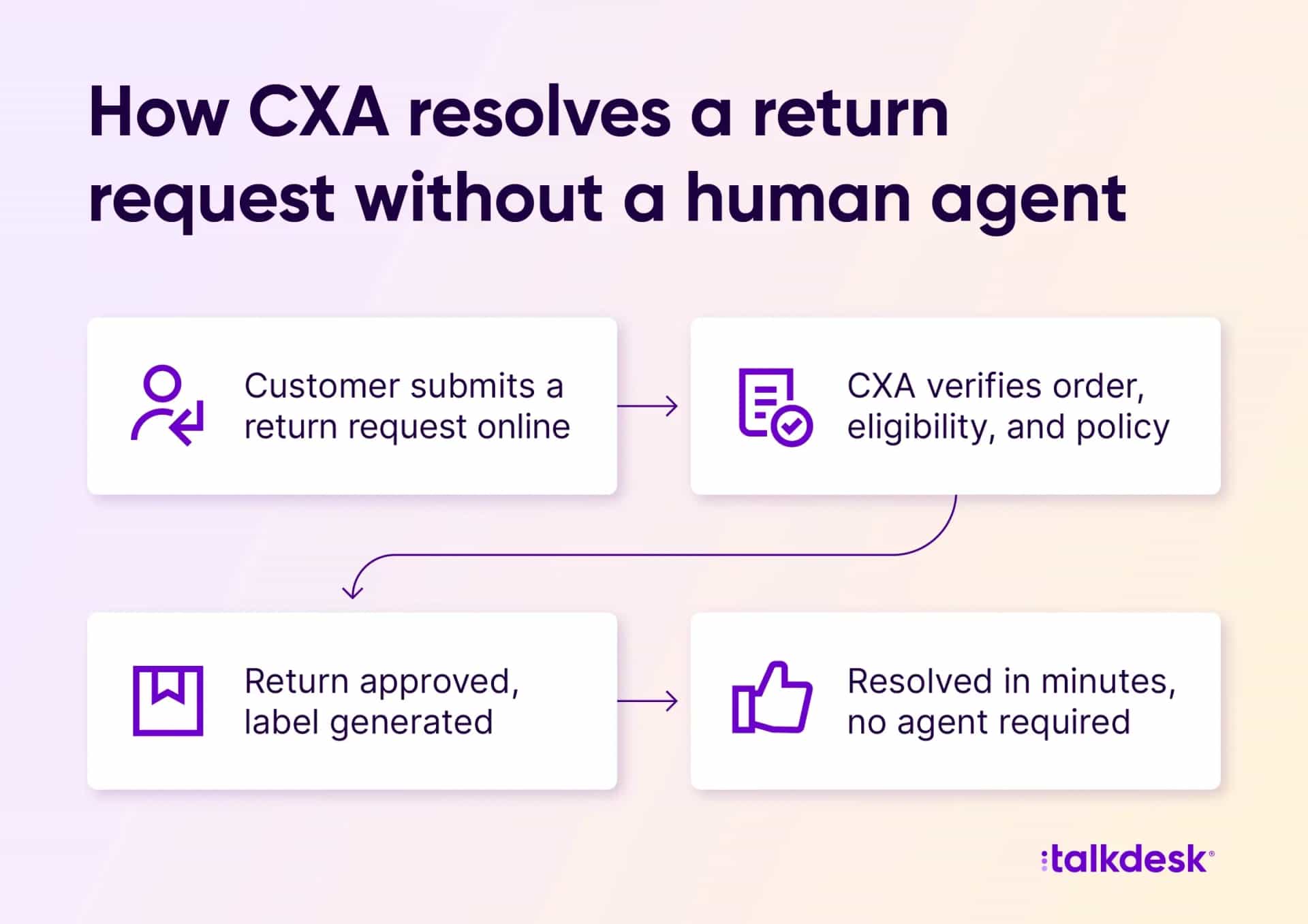
Think of a customer submitting a return request online and receiving a confirmation of resolution in minutes, no human agent required.
CX automation enables businesses to deliver timely, relevant interactions at scale, reducing friction, improving responsiveness, and fostering stronger relationships.
The four core processes behind customer experience automation.
Four foundational processes work together to create scalable, personalized, and impactful customer journeys:
- Automation. Powering the execution of customer journeys by triggering actions based on specific conditions or events. Automation ensures the right actions happen at the right time, without delay or human error.
Automation in action. When a customer submits a support ticket, automation instantly routes it to the right queue and sends a confirmation, no manual input needed.
- Segmentation. Organizing customers into groups based on shared characteristics such as behavior, demographics, or engagement level. This enables businesses to deliver more relevant content and experiences tailored to specific audience needs.
Segmentation at work. A retail brand might segment high-value customers to receive priority callback routing during peak periods.
Personalization. Using insights and data to tailor interactions to the individual, not the segment. This could mean addressing someone by name, recommending resources based on recent activity, or proactively offering support when usage drops off.
Personalization example: A customer who abandons onboarding midway receives a proactive outreach triggered by inactivity, not a generic follow-up.
- Orchestration. Strategic coordination of customer interactions across channels, teams, and systems. This ensures every touchpoint flows in sync with the broader customer journey, creating a cohesive, omnichannel experience.
Orchestration in practice: A customer who starts a conversation in chat, escalates to voice, and picks back up in email. Orchestration ensures the context travels with them every step of the way.
Seven technologies that power CX automation.
Customer experience automation is reshaping how businesses engage with customers, moving beyond basic self-service to intelligent systems that resolve real issues, streamline operations, and improve satisfaction. Seven technology capabilities are driving this transformation.
1. Multi-agent orchestration.
Single, rigid chatbots can only take a conversation so far. Customer experience automation instead relies on multi-agent orchestration, a team-based architecture in which an orchestrator agent dynamically directs specialized AI agents, such as a billing agent or a rebooking agent, to work together on complex, multi-step requests across systems.
The result is a resolution process with no manual handoffs and no fragmented steps.
Talkdesk customers have significantly reduced average handle time using AI agents.
2. AI-powered agents.
Your customers expect fast, effortless resolutions, and AI agents help deliver that. Using real-time reasoning and contextual awareness, they handle complex conversations and execute tasks autonomously or alongside your team, so customers get speed without losing the human touch when it matters.
3. Unified data intelligence.
Automated customer experience is only effective when fueled by timely, accurate, and contextual data. A unified data layer aggregates structured information (such as CRM records) and unstructured data (such as transcripts or emails), giving your automated workflows the context they need to make smarter decisions.
4. Hyper-automation tools.
Hyper-automation uses advanced technologies to rapidly identify, design, and automate a wide range of business processes. In the CX context, this includes modular applications that support routing, content optimization, compliance checks, identity validation, and more.
These tools work in concert, forming a feedback loop that discovers friction points, builds solutions, orchestrates automation, and measures outcomes, delivering continuous improvement at scale.
5. Industry-specific intelligence.
Generic automation tools often fall short when it comes to complex or regulated industries. Customer experience automation platforms that embed industry-specific knowledge into their AI agents can deliver faster time-to-value and higher accuracy.
Whether it’s automating patient scheduling in healthcare, managing claims in insurance, or personalizing experiences in retail, tailored AI workflows reduce risk, accelerate ROI, and improve customer outcomes.
6. Omnichannel continuity.
Today’s customers interact across a variety of channels, including chat, voice, email, and social and expect continuity at every step. Customer experience automation solutions unify these channels so automation can follow the customer wherever they go, preserving context and ensuring seamless transitions.
Automated systems can initiate, handle, or escalate interactions across any channel, creating a frictionless experience that feels consistent and connected.
7. Secure, flexible architecture.
Scalability and trust are essential for successful automation. CX leaders need assurance that automated systems are accurate, compliant, and aligned with brand standards. Responsible CX automation platforms deliver this through built-in safeguards such as content filters, prompt controls, data redaction, and human oversight.
Equally important is flexibility. Open architectures allow organizations to use their own AI models, integrate third-party tools, and deploy automation within any environment: cloud, hybrid, or on-prem, without being locked into a single vendor.
The benefits and challenges of customer experience automation.
Customer experience automation delivers both immediate and long-term advantages by optimizing how businesses engage, support, and retain their customers. However, as CX trends evolve, they also present challenges that require strategic oversight and thoughtful implementation.
Here’s a quick summary, with a full breakdown of each below.
| Benefits | Challenges |
|---|---|
Faster resolution and proactive service | Balancing scale with personalization |
Increased agent efficiency and scale | Ensuring data accuracy and integrity |
Consistency and cost savings | Continuous oversight and optimization |
Benefits of CX automation.
-
Enhanced customer satisfaction. Automation enables faster, more accurate responses through intelligent routing, virtual assistants, and AI agents. This reduces wait times and ensures customers receive relevant, helpful information, boosting satisfaction and brand perception.
-
24/7 support across every channel. With AI-powered systems available across voice and digital channels, customers can engage anytime, anywhere, and receive consistent service no matter the platform. This improves convenience and customer trust.
-
Increased agent efficiency and scale. By automating repetitive and administrative tasks, CX automation frees human agents to focus on more complex or emotionally nuanced cases. This drives higher productivity and allows service teams to scale without proportional increases in headcount.
-
Faster resolution and proactive service. Customer experience automation leverages real-time data and historical context to anticipate needs and resolve issues more quickly. Intelligent systems detect friction and automatically trigger the right action, reducing time-to-resolution and improving first-contact outcomes.
-
Consistency and cost savings. Automation ensures that processes, tone, and quality remain consistent across every touchpoint. At the same time, it reduces manual effort and lowers the cost to serve, improving margins while maintaining high service standards.
Challenges of CX automation.
-
Handling complex or sensitive situations. Automation may fall short when empathy, critical thinking, or contextual judgment are required. Human agents remain essential for resolving emotionally charged or multifaceted customer issues.
-
Balancing scale with personalization. Generic automated responses can erode trust. Automated messages that ignore customer history, like a renewal reminder sent to someone who just canceled, damage the experience fast. It’s crucial to use customer data to tailor interactions and know when to hand off to human agents.
-
Ensuring data accuracy and integrity. AI agents depend on the quality and consistency of the data they access. Inaccurate or outdated data can lead to poor decision-making, damaged experiences, and compliance risks.
-
Privacy and compliance risk. Any customer experience automation strategy must protect customer data and comply with regulatory requirements such as GDPR and CCPA. That means building security, transparency, and governance into your automation from the start, not as an afterthought.
-
Continuous oversight and optimization. CX automation requires ongoing monitoring, performance measurement, and human oversight to stay effective. Tracking the right customer experience KPIs helps teams know when to adjust and where automation is falling short.
Real customer experience automation (CXA) examples.
The following case studies show how real Talkdesk customers have put Talkdesk CXA to work, and the results they’ve achieved.
Customer stories
Real results from Talkdesk customers.
Evara Health: 45% increase in self-service rate.
Evara Health, a federally qualified health center serving roughly 60,000 patients and up to a quarter of a million visits per year, was navigating growing patient demand alongside remote work and operational efficiency pressures.
After implementing Talkdesk CXA, including a deep integration between Talkdesk Autopilot and Epic EHR. As a result, the health center cut patient wait times by 98% and now resolves 45% of call volume through automated self-service.
Merchants Bank: 90% calls within 20 seconds.
Merchants Bank, a community bank founded in 1875 in Winona, Minnesota, needed to modernize customer engagement while staying true to its reputation for stable, reliable service across its 150-year history.
After partnering with Talkdesk Financial Services Experience Cloud, Merchants Bank unified phone, chat, email, and text into one omnichannel contact center with real-time co-browsing and AI-powered support beyond traditional hours. Now, 90% of calls are answered within 20 seconds, and 50% of all bank calls run through the Talkdesk platform.
Quadient: Self-service doubled to 60%.
Quadient needed to scale global customer service without scaling headcount, particularly for its Parcel Pending offering where routine inquiries were consuming agent capacity.
After deploying Talkdesk CXA, self-service containment rates jumped from 33% to 60%, freeing agents to focus on complex inquiries across their international teams.
Automate your customer experience with Talkdesk.
Customer experience automation (CXA) scales customer service without sacrificing quality, from orchestrating complex journeys to deploying AI agents across every channel.
With a powerful suite of tools, including AI-powered agents, intelligent routing, workforce management, and more, Talkdesk helps you design smarter customer experiences from the ground up.
Ready to see AI-powered agents and intelligent routing in action? Learn how Talkdesk Customer Experience Automation (CXA) can help you automate, elevate, and future-proof your customer experience.
See how Talkdesk CXA transforms your customer experience.
Customer experience automation FAQs.
Find answers to the most common questions about customer experience automation.
Customer experience automation (CXA) is the use of advanced technology, such as AI, to deliver personalized, efficient, and consistent interactions across every stage of the customer journey. It helps businesses automate key touchpoints while maintaining a human-centered experience at scale.
CX automation lowers the cost to serve by automating routine interactions, deflecting repetitive requests through self-service, and reducing manual handoffs. The result is leaner operations without sacrificing service quality.
Customer experience automation improves customer satisfaction, boosts loyalty, accelerates issue resolution, and enables 24/7 support—all while scaling service operations and reducing costs. It empowers businesses to deliver faster, more personalized experiences without overburdening their teams.
Customer experience AI powers the intelligence behind customer experience automation by analyzing data, predicting behavior, and enabling automated yet personalized interactions. Technologies like machine learning and natural language processing (NLP) help tailor responses, understand intent, and improve outcomes over time.
CX automation operates through four key processes: orchestration (coordinating customer journeys across channels), segmentation (grouping customers based on behavior and needs), personalization (delivering tailored content and responses), and automation (executing timely, rule-based actions without manual input). Together, these create seamless, relevant experiences at scale.
Customer experience automation relies on a range of customer experience technologies, including AI agents, chatbots, CRM systems, customer analytics platforms, and omnichannel communication tools. Automation and customer experience work together to streamline workflows and enhance engagement across every customer touchpoint.
Common examples include automated email sequences, AI-powered chat support, intelligent call routing, and proactive alerts or reminders. CX automation can also enable self-service capabilities, agent coaching, and delivery of personalized content across both digital and voice channels.
Talkdesk CXA connects to existing CRM systems through native integrations and open APIs, syncing customer data in real time. This gives AI agents the context they need to personalize interactions, route requests accurately, and take action without requiring teams to overhaul their existing technology stack.
Traditional chatbots follow rigid, rule-based scripts and are limited to handling simple, predefined requests. AI agents understand context, reason across systems, and complete complex tasks autonomously. The result is measurable outcomes rather than scripted responses.

About Celia Cerdeira
Célia Cerdeira has more than 20 years experience in the contact center industry. She imagines, designs, and brings to life the right content for awesome customer journeys. When she's not writing, you can find her chilling on the beach enjoying a freshly squeezed juice and reading a novel by some of her favorite authors.