What is digital customer experience? A complete guide

By Celia Cerdeira
00:00 min read

Customer journeys now happen across websites, apps, messaging platforms, self-service portals, and social media—often within the same interaction. As digital channels become the primary way customers engage with businesses, expectations for speed, convenience, and continuity continue to rise.
Digital customer experience refers to how customers experience those interactions across digital channels. It includes every stage of the journey, from researching a product and making a purchase to contacting support and resolving issues.
73% of consumers say experience is an important factor in whether they complete a purchase, and 32% would stop doing business with a brand they love after a single bad experience. When the margin for error is that thin, the quality of every digital touchpoint is crucial. As more customer journeys begin and end online, the digital experience isn’t supplementing the customer relationship anymore. In many cases, it is the customer relationship.
This guide covers what the digital customer experience is, why it matters, how to improve it, and how to measure whether it’s working.
What is digital customer experience?
Digital customer experience (digital CX) is the quality, consistency, and usability of customer interactions across digital environments. It reflects how easily customers can complete actions, access support, find information, and move through the customer journey online.
A strong digital customer experience reduces friction and creates continuity across interactions. Customers can move between channels, complete tasks efficiently, and receive relevant support without unnecessary effort or repeated context.
Common digital channels that shape the digital customer experience include:
-
Websites and landing pages are often the first place customers evaluate a brand.
-
Mobile apps are increasingly the default interface for on-the-go interactions.
-
Email for onboarding, nurture campaigns, promotions, and transactional updates.
-
Live chat and messaging for real-time support across web and mobile.
-
Social media for discovery, engagement, and community building.
-
Self-service portals and knowledge bases are where customers go to resolve issues independently.
-
SMS and push notifications for timely, context-specific communication.
-
AI-powered virtual agents are increasingly common first points of contact.
Keep in mind that the digital customer experience isn’t confined to any one channel. It’s the connected, holistic experience as they move between channels.

AI AGENTS
Meet the AI agents built for your industry.
Pick one, run a pilot in your environment, and prove ROI in 30 to 45 days.
Digital customer experience vs. customer experience.
Customer experience (CX) is a broader term that covers every interaction a customer has with a brand across all channels, including in-store visits, phone calls, and face-to-face service. Digital customer experience focuses on interactions that happen through digital channels.
A customer speaking with an agent in a store is a CX touchpoint. That same customer using a self-service portal to receive an automated order update or chatting with a virtual agent is a digital CX touchpoint. Both contribute to how customers feel about the business, but digital CX includes distinct dynamics that aren’t part of in-person interactions (such as scale, speed, and personalization).
Why is digital customer experience important?
Digital customer experience is a direct driver of revenue, retention, and loyalty, with CX leaders being 26 times more likely to experience year-over-year revenue growth of 20% or more. Digital channels account for a huge share of every customer journey, making digital CX one of the highest-impact places to invest.
Improving digital experiences doesn’t just benefit customers. The impact extends to the organization in several meaningful ways:
-
Customer retention. Seamless digital experiences reduce churn by making it easy for customers to get help, find value, and stay engaged.
-
Brand trust. Consistent, well-designed digital experiences reinforce credibility and improve customer trust.
-
Operational efficiency. Digital customer experience solutions like self-service and customer experience automation reduce inbound support volume, cutting costs without sacrificing quality. Digitizing customer service can enhance satisfaction by 33% while cutting costs by 25–35%.
-
Competitive differentiation. When products and pricing are similar, customer experience is the differentiator.
-
Data-driven insights. Digital channels generate rich behavioral data, giving teams visibility into where customers drop off, what they’re searching for, and where the customer experience can be improved.
When customers have easy and helpful digital interactions, they convert more, stay longer, and recommend brands to others. When they don’t, they leave.
The seven stages of the digital customer experience journey.
No two digital customers are the same, but most move through a similar set of stages. Understanding each stage helps organizations design better experiences, allocate resources more effectively, and track the right movements at the right moment.
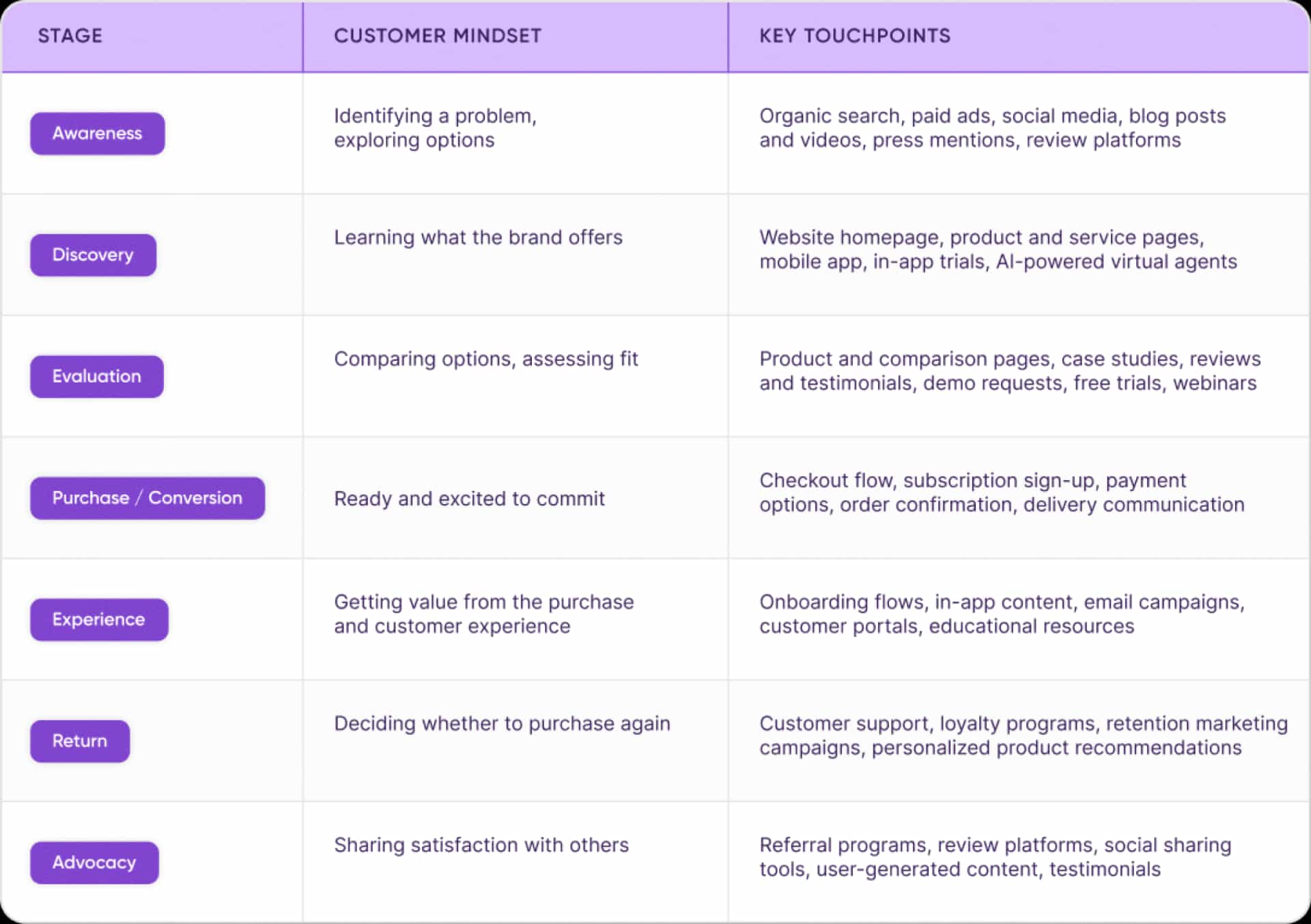
1. Awareness.
During the awareness stage, potential customers are experiencing a problem and beginning to explore solutions. They’re searching, scrolling, and getting recommendations from someone they trust.
The goal in this stage is discoverability and credibility. Brands that appear through organic search, well-targeted paid ads, social media posts, and word-of-mouth mentions are easier for the right customers to find. Online reviews and social proof are especially powerful at this stage, as they’re often the first signal to customers that an organization is worth a closer look.
2. Discovery.
Customers navigate the website or app, trying to understand the offerings and whether they align with their needs.
This is where UX quality has a big impact. Slow load times, confusing navigation, or unclear messaging push customers away before they’ve had a real chance to engage. Understanding customer intent at this stage is critical to designing the right experience.
3. Evaluation.
In the evaluation stage, customers are comparing their options. They’re reading reviews, checking out competitors, and deciding which solution best meets their needs. Clear positioning and strong differentiators can heavily influence the decision.
Using real-time behavioral data to personalize what customers see at this stage significantly reduces drop-off. This means surfacing the right case study, testimonial, or comparison page at the right time. Demos, AI-powered chats, and free trials are particularly effective tools for moving hesitant customers closer to purchase.
4. Purchase/conversion.
The conversion moment is where friction can have the biggest consequences. A customer who may be excited about a service/product and ready to buy. But if they run into a confusing signup process, unexpected fees, or a slow page, they will often abandon the process entirely and seek out a competitor. This applies to all industries, from e-commerce retail to subscription-based businesses. Capturing data on behavior and drop-off points helps identify and fix problem areas.
5. Experience.
After the purchase, the real relationship begins. This stage covers onboarding, ongoing product use, and all the ways an organization helps customers get more value over time. When done well, it turns a first-time buyer into a loyal customer.
Digital channels play a central role here. Order confirmation, delivery updates, in-app tips, how-to guides, and customer portals all help customers realize the value of what they’ve bought. This is also where personalization can really move the needle. 65% of customers say targeted promotions are a top reason to buy, and the post-purchase period is one of the highest-value moments to deliver them.
6. Return.
Retaining customers is cheaper than acquiring new ones, and the return stage is about giving those customers compelling reasons to come back.
AI-powered virtual agents, self-service tools, loyalty programs, and personalized recommendations all help keep customers engaged. Targeted campaigns re-engage at-risk customers or reward loyal ones. This gives brands a structured framework for managing this stage proactively, rather than reactively.
7. Advocacy.
Happy customers are one of the most valuable business assets. At the advocacy stage, they’re leaving reviews, referring friends, and sharing experiences. Word-of-mouth referrals carry more influence than paid advertising.
Closing the loop matters. Following up with customers after a positive experience through a simple review request or referral invitation can encourage them to share feedback or recommend the business to others. When customers post user-generated content or testimonials, that content doubles as discovery and evaluation material for future prospects, feeding the top of the funnel.
Why going beyond omnichannel experiences matters for digital CX.
An omnichannel customer experience is the foundation of any strong digital CX strategy. Customers who use omnichannel shop 70% more often and spend an average of 16% more per order than single-channel shoppers.
However, there’s a meaningful distinction between being omnichannel and performing well in an omnichannel environment. Many organizations invest in multi-channel infrastructure and still deliver a disconnected customer experience.
The difference between offering many channels and engaging meaningfully across all of them is drastic. Conversations should carry context from channel to channel, so a customer who starts a support interaction via chat and escalates to a phone call doesn’t have to re-explain their situation. It means personalization is consistent whether a customer is on a mobile app, a website, or reading an email.
Data connectivity is at the heart of an omnichannel strategy. Organizations that break down silos between their CRM, contact center, marketing platform, and analytics tools are better positioned to deliver seamless, personalized experiences across channels.
Omnichannel engagement platforms support this continuity by preserving customer context across interactions for seamless digital customer experiences.
How to improve digital customer experiences.
Building a digital customer experience strategy requires continuous improvement, with ongoing listening, experimentation, and refinement shaping it over time.
Ways to improve digital customer experiences include:
Map the customer experience journey.
Understanding the customer journey is essential to improving it. Customer experience journey mapping is the process of documenting every digital touchpoint a customer moves through and how those touchpoints connect. This can help surface pain points that metrics alone usually won’t reveal. Without these insights, it’s difficult to know whether improvement efforts are solving the right problems.
Boost efficiency and satisfaction with AI assistance.
AI in customer experience is boosting efficiency and reducing costs across almost all industries—and it’s not stopping any time soon.
AI agents handle high volumes of routine inquiries around the clock, freeing human agents for complex work. AI agentic workflows orchestrate multi-step tasks autonomously across systems, reducing resolution times and improving accuracy.
However, deployment quality matters as much as deployment speed. Regularly collect and listen to customer feedback.
Understanding what customers experience requires more than reviewing support tickets and email threads. A structured voice of the customer program relies on consistent feedback to help identify issues, measure sentiment, and improve the customer experience. Common feedback channels include:
-
Post-interaction CSAT surveys.
-
NPS surveys sent after key milestones.
-
In-app feedback prompts.
-
Review platform monitoring.
-
Customer interviews and usability testing.
Customer feedback tools make it easier to collect and act on that data at scale across every channel.
Personalize customer experiences at scale.
Personalized customer experiences have moved from a differentiator to a baseline expectation. 71% of consumers expect organizations to deliver personalized interactions, and 76% get frustrated when they don’t. Customers expect brands to recognize them, remember their history, and communicate in ways that feel relevant to them.
The challenge is scaling it, with data fragmentation cited as a primary blocker. That’s why investing in personalized communications isn’t enough. Organizations need an integrated infrastructure that analyzes data to tell the whole story.
Escalate to human agents when appropriate.
AI and automation can handle a lot, but not everything. Knowing when to escalate to a human agent and making that transition as smooth as possible is one of the most consequential decisions in any digital CX strategy. A customer trapped in an unhelpful AI loop is more frustrated than when they started.
Connect channels for seamless communication.
Smooth escalation depends on connected channels. Omnichannel routing ensures customers are directed to the right resource based on context, intent, and history. They can be routed to a self-service tool, a virtual agent, or a human based on what they need.
Be upfront about data practices.
Customers are aware and wary of how their data is collected and used—and they’ll leave if they feel it’s being abused. CX Today reports that 82% of people have abandoned a brand over concerns about data use. Organizations that are transparent about customer data management and how they collect, store, and use that information build more trust than those that bury disclosures in fine print.
Monitor and optimize.
Digital CX is an ongoing process. Customer expectations shift, new channels emerge, and what worked a year ago may not work today. Organizations should embed continuous monitoring and CX optimization into their workflows, such as tracking customer experience KPIs, running experiments, and regularly revisiting journey maps.
Challenges to building great digital customer experiences.
Even with the right tools, delivering consistent and high-performing digital CX is difficult. Common challenges include:
-
Fragmented data and systems. Data silos are often created by a mix of legacy infrastructure, organizational culture, and inconsistent data standards.
-
Inconsistency across channels. When tone, information, or service quality varies dramatically from one channel to another, customers notice and trust erodes.
-
Balancing automation and human touch. Getting the ratio wrong in either direction damages the experience. Too much automation frustrates customers who need a human agent, while too little is unsustainable at scale.
-
Scaling personalization effectively. The bottleneck is often data. Specifically, the fragmented, inconsistent data makes it nearly impossible to deliver individualized experiences consistently.
-
Privacy and compliance complexity. Data regulations continue to evolve and vary across regions. Staying compliant while delivering data-informed, personalized experiences is an ongoing challenge with significant consequences.
-
Measuring what matters. Many teams aren’t tracking the metrics that reflect the actual customer experience. Without the right KPIs, it’s difficult to know whether improvements are working.
Powerful digital customer experience solutions.
The right tools don’t just make digital CX management easier; they make it possible to deliver consistent, personalized, connected experiences that drive real business outcomes. Digital customer experience solutions include:
-
Customer self-service enables customers to find answers and resolve issues independently through intuitive tools, reducing wait times and support volume.
-
AI agent assistance equips agents with real-time AI guidance that surfaces relevant context, suggests responses, and reduces handle time while improving accuracy.
-
AI-powered routing matches customers to the right resource at the right moment, using intent, history, and context to route smarter and faster across all channels.
-
Proactive engagement contacts customers before they have to reach out through proactive outbound communication that anticipates needs and reduces inbound requests.
-
Interaction analytics surfaces insights from every customer conversation by identifying trends, friction points, and optimization opportunities.
-
Quality management monitors and improves agent performance with AI-assisted quality management tools that help teams deliver consistently better experiences.
How to measure digital customer experiences.
Tracking the right metrics is crucial for improving digital customer experience. Some of the most useful KPI to improve digital CX include:
-
Customer satisfaction score (CSAT) is a direct measure of satisfaction with a specific interaction or experience, typically collected immediately after a touchpoint.
-
Net Promoter Score (NPS) measures how likely a customer is to recommend a brand to others and is a reliable indicator of long-term loyalty.
-
Customer effort score (CES) quantifies the effort a customer had to expend to accomplish something. Low-effort experiences correlate strongly with retention and repeat purchase.
-
Customer lifetime value (CLV) is the total projected revenue from a customer across the full relationship. Higher CLV reflects stronger long-term digital CX outcomes.
-
Conversion rate is the percentage of visitors or users who complete a desired action at a given touchpoint.
-
Churn rate is the percentage of customers who leave over a given period. Unexpected spikes in churn often point to specific digital CX failures worth investigating.
-
First contact resolution (FCR) measures whether customer issues are resolved in a single interaction and is a key indicator of both efficiency and satisfaction.
No single metric tells the full story. View these KPIs holistically, connecting them to business outcomes such as conversion and churn.
Digital customer experience examples.
Many organizations are rethinking how they deliver customer experiences as digital channels become the primary way customers engage.
Rocky Brands.
Rocky Brands, a global footwear and apparel company, struggled to deliver consistent customer experiences as e-commerce growth drove higher support volumes. During peak season, long wait times, large backlogs, and staffing challenges strained operations. A fragmented system made it difficult for agents to manage conversations across channels, leading to slower responses and inconsistent service.
Rocky Brands implemented Talkdesk Retail Experience Cloud, to boost efficiency and optimize workflows with automation. AI agents now handle 40% of interactions, while real-time agent assistance improves speed and accuracy. Response times dropped by 70%, and abandonment stayed below 10% during peak periods.
Checkr.
Checkr, a leader in background check technology, needed to scale support as demand increased. Customers were calling with similar questions, creating unnecessary volume for agents and slowing down response times.
Checkr implemented AI-powered self-service using Talkdesk Autopilot, allowing customers to resolve common issues through natural, conversational interactions while seamlessly transitioning to a human agent when needed. This led to an 85% self-service rate, reduced average handle time by 56%, and lowered wait times and abandonment rates.
Build better digital customer experiences with Talkdesk.
Digital customer experience shapes how customers evaluate a business at every stage of the journey. Fast, connected, and personalized experiences help build trust, while friction and poor continuity can damage the customer experience.
Delivering those experiences consistently requires more than individual digital tools. Businesses need connected systems, real-time customer context, intelligent automation, and support teams equipped to respond effectively across channels. Talkdesk brings these capabilities together to help businesses create more seamless and personalized customer experiences at scale.GFH
Explore Talkdesk Customer Experience Automation (CXA) to start building stronger digital customer experiences. Check out CXA use cases and start your pilot today.
Digital customer experience FAQs.
Discover answers to common questions about digital customer experiences.
Digital customer experience refers to every interaction a customer has with a brand through digital channels. This includes websites, mobile apps, email, chat, social media, and self-service tools. It covers the full arc of the customer relationship, from discovery to post-purchase support, and encompasses how customers perceive the quality and consistency of those interactions. A strong digital CX makes every touchpoint feel connected, easy, and worth a customer’s time.
The digital customer experience typically unfolds across seven stages: awareness (discovering the brand), discovery (exploring what it offers), evaluation (comparing options), purchase/conversion (making a decision), experience (using the product or service), return (coming back for more), and advocacy (recommending the brand to others).
User experience (UX) focuses on the design and usability of a specific product or interface, including how intuitive it is to navigate, how quickly pages load, and how clearly information is organized. Digital customer experience encompasses the full journey a customer takes across all digital channels, including how they feel about the brand overall—not just a single product or page. Good UX is an important component of good digital CX, but the two aren’t the same.
Improving digital CX starts with understanding the current state of the customer journey. This means knowing where customers go, where they drop off, and where friction exists. From there, organizations can prioritize improvements, invest in AI and automation to scale personalization and efficiency, connect channels so customer context travels with them, and build a regular feedback loop to keep iterating over time.
The most useful digital CX metrics include customer satisfaction score (CSAT), Net Promoter Score (NPS), customer effort score (CES), conversion rate, churn rate, first contact resolution, and customer lifetime value. Tracking a combination of these across different journey stages helps to understand where the experience is working and where it isn’t.
About Celia Cerdeira
Célia Cerdeira has more than 20 years experience in the contact center industry. She imagines, designs, and brings to life the right content for awesome customer journeys. When she's not writing, you can find her chilling on the beach enjoying a freshly squeezed juice and reading a novel by some of her favorite authors.