Conversational AI in financial services: How it works across banking
Conversational AI resolves routine banking requests in seconds, on both voice and digital channels, under the same authentication and compliance rules your institution already follows. This guide covers how it works, what to automate first, and how to measure the return.
13:59 min read
Listen to article
17:34
A customer spots an unrecognized charge, opens the banking app and types, “I don’t know this one.” Within a minute, the dispute is filed, the card is locked, and a replacement is on its way. No hold music, second verification call, or need to repeat an account number. That’s conversational AI in financial services working the way it should.
Conversational AI in banking operates under conditions that shape every automation decision. Routine inquiries, such as branch hours, require minimal checks, but transactional requests demand strict authentication, regulatory oversight, and complete interaction records.
Conversational AI is one piece of a larger shift in AI customer experience. Here’s what it handles in banking and how to implement it.
Key takeaways.
-
Conversational AI interprets what your customer means during live conversations, which is what separates it from a menu-driven IVR that stalls when the words don’t match a script.
-
The best tasks to start with are high-volume, factual requests, such as balance checks and card locks, that can be resolved without escalating to a human agent.
-
Compliance means verifying identity before the AI discloses anything, masking PII in stored transcripts, and disclosing that customers are talking to AI.
What is conversational AI in financial services?
Conversational AI refers to software systems that understand, process, and respond to human language in spoken or written form.
Unlike traditional scripted decision trees or interactive voice response (IVR) phone systems with rigid “press 1, press 2” menus, conversational AI uses natural language processing (NLP), machine learning, and large language models (LLMs) to interpret customer intent, context, and sentiment in real time.
A credit union member asks, “How much do I owe to close out my auto loan?” The AI verifies them, reads the payoff from the loan system, and offers to text their quote. A policyholder asks where their claim stands and gets the adjuster’s latest update alongside the next step, with no queue in between.
On a voice call, conversational AI changes the exchange even when it reaches an agent.
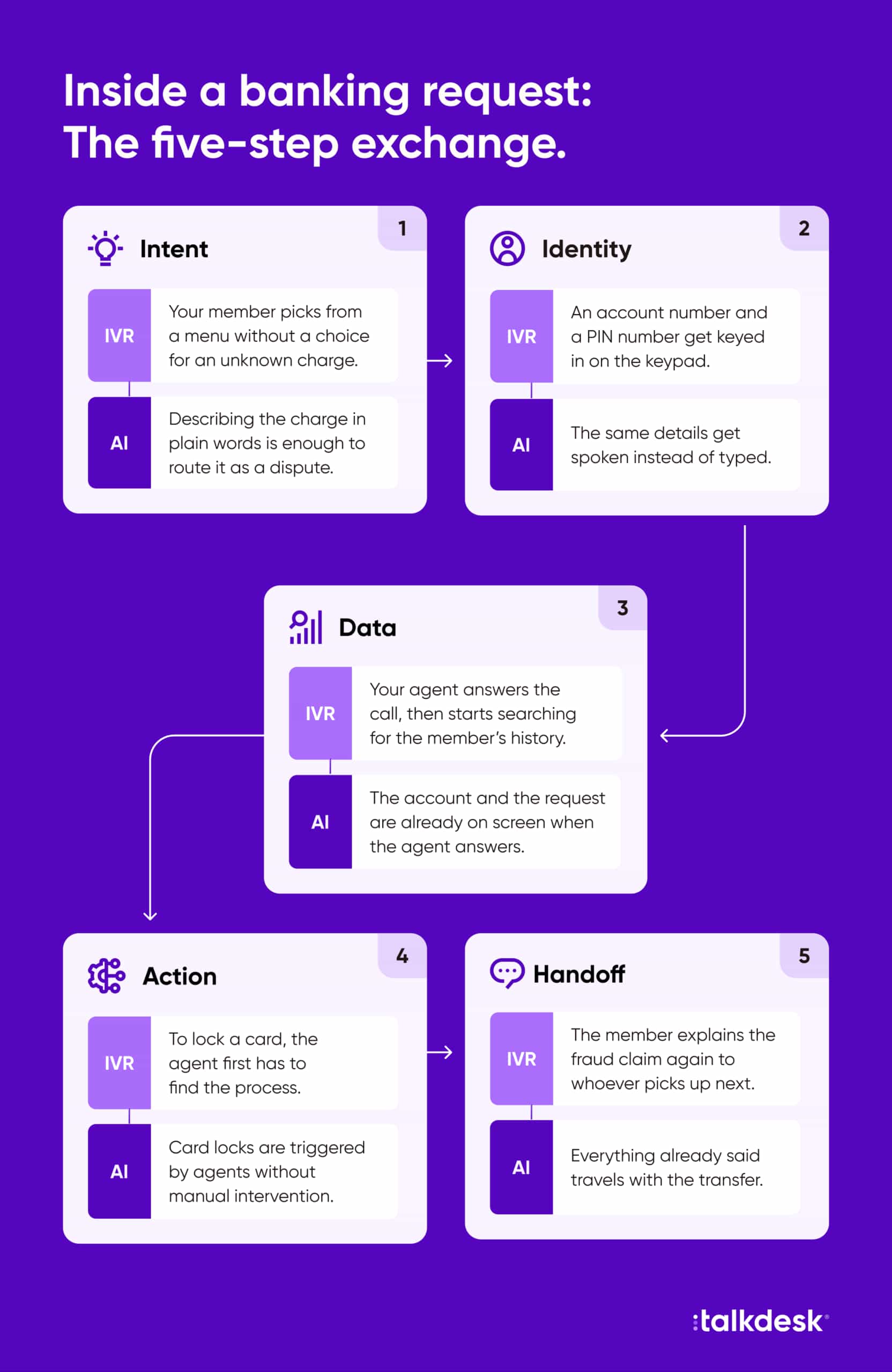
Within a single exchange, five things happen in just a few seconds:
-
Intent. The customer describes the problem in their own words instead of picking from a menu that has no option for it.
-
Identity. Verification happens in conversation, spoken rather than typed on a keypad.
-
Data. The account and the request are already on screen when the agent picks up.
-
Action. Card locks and similar tasks run automatically, without the agent looking up the process.
-
Handoff. The full conversation transfers with the customer, so nothing gets repeated.
Benefits of conversational AI in financial services.
AI in financial services has moved well beyond back-office fraud models and underwriting. On the front lines, conversational AI shifts customer service from a cost center to a trust and growth engine. Here is how it delivers measurable impact across seven key areas.
1. Higher containment on routine requests.
Balance inquiries, card locks, and statement requests don’t require human empathy or complex problem-solving.
Conversational AI resolves these tasks end to end across voice and digital channels with Talkdesk Autopilot. That frees advisors to handle high-value conversations that build relationships rather than put out fires.
2. Lower cost to serve.
Every self-service resolution cuts operating expenses. For requests that still reach an agent, Talkdesk Copilot surfaces answers in real time and automates post-call summaries, driving down average handle times and overall service costs.
3. Instant 24/7 resolution.
Urgent financial issues don’t follow business hours. Conversational AI resolves issues around the clock, removing hold times for critical events like lost cards or sudden fraud alerts.
Talkdesk Identity handles that verification up front, so sensitive requests start from a verified customer. That matters most for lost cards and suspected fraud, where waiting until morning has a real cost.
4. Consistent experience across channels.
Customers move seamlessly between SMS messaging, web chat, mobile apps, and voice. Talkdesk runs on a unified architecture that carries interaction history across touchpoints, ensuring members never have to repeat themselves.
5. Service touchpoints that drive growth.
Service conversations carry intent that routed queues discard along with the ticket. A customer calling about an overdraft fee, for instance, has told you something useful about their account.
Talkdesk Interaction Analytics surfaces that intent during the call, so you can offer solutions or incentives like an account upgrade. Acting on intent while the customer is still on the line builds trust and grows customer lifetime value.
6. Audit-ready compliance and fraud protection.
Voice biometrics and step-up checks actively mitigate account takeover risks. Every conversation generates a complete, searchable transcript, providing risk and compliance teams with instant, audit-ready records without manual call sampling.
Talkdesk Quality Management automates compliance scoring across 100% of interactions, giving compliance managers instant visibility into regulatory adherence without manual call sampling.
See what Talkdesk resolves in a financial services contact center.
How to implement conversational AI in a financial institution.
Conversational AI for finance deployments follows a consistent flow. Answer the questions below first, then work through these six steps to go from a single use case to measured results.
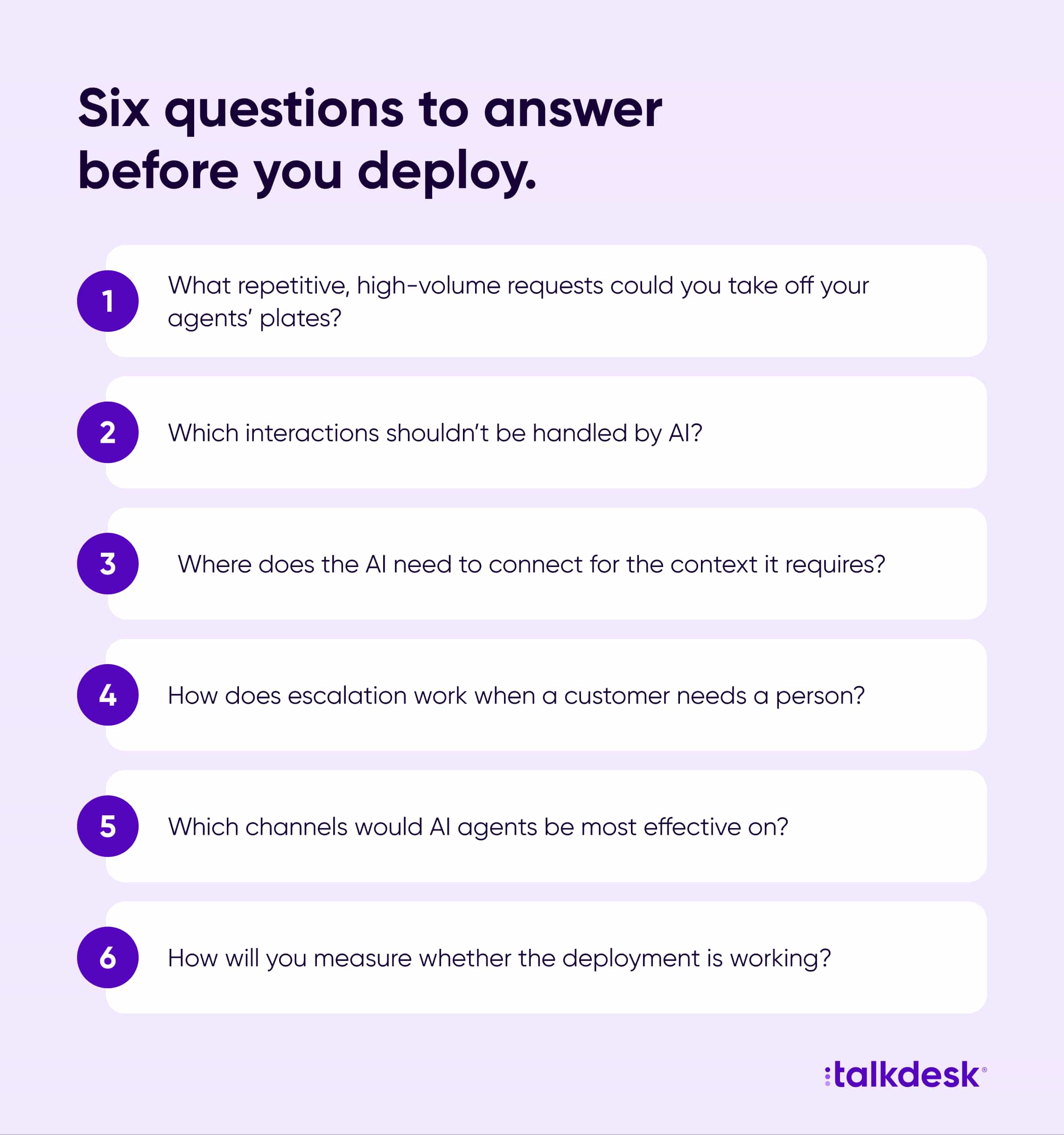
1. Start with a high-volume, low-complexity task.
Select high-volume inquiries requiring factual lookup rather than complex human judgment, such as account balances or card status. Predictable logic and structured data make these the lowest-risk place to start.
2. Decide what needs a human touch.
Draw the line before you build. Hardship conversations, complex disputes, and estate questions go to people, and the AI hands off the moment a conversation crosses that line.
Document explicit escalation triggers so agents, risk officers, and technical teams operate under identical routing guidelines.
3. Connect it to live data.
An AI that can’t see the account can’t help the customer. You can link the AI to your core banking, card management, loan systems, and CRM platforms, as well as your customer service software, so every answer reflects balances and payment dates as they stand right now. Stale data erodes trust fast.
4. Design the escalation path.
When the AI hands off, the agent sees the full conversation and the verified identity. The customer repeats nothing, and agents stop re-asking questions that the AI has already settled.
5. Deploy across channels.
Start with the channels your customers already use, including voice, web chat, messaging, and the mobile app, with the same logic behind each one. A card lock works the same way on the phone as it does in the app.
6. Measure resolution quality.
Resolution rate and repeat contacts tell you more than volume handled.
Best practices for conversational AI in banking.
Establishing conversational AI requires rigorous operational guardrails. Implementing the following ongoing management practices maintains system accuracy, compliance, and user adoption after initial launch.
-
Retrain on real conversation logs on a schedule. Customer questions shift with rate changes, product launches, and fraud cycles, and a system left alone quietly degrades.
-
Maintain explicit AI disclosure. Clear disclosure satisfies regulatory expectations—including guidance from the Consumer Financial Protection Bureau (CFPB) regarding consumer transparency—and ensures callers know how to reach a human representative.
-
Audit interactions weekly. Reviewing failed interactions reveals missing NLU intents, system integration gaps, and conversational drop-off points.
-
Validate speech recognition across demographic groups. Models evaluated only on aggregate performance metrics can mask high error rates for non-native speakers or diverse regional accents.
-
Keep the AI’s scope narrow and deep. Add intents only as fast as you can verify them. Ten intents that work beat forty that mostly work.
How to measure ROI of conversational AI in banking.
Measuring the ROI of conversational AI requires evaluating direct operational efficiency alongside broader business growth. Prioritize these primary indicators:
-
Cost per resolved interaction. Track fully automated, resolved requests against pre-deployment baseline costs to measure net operational savings.
-
True resolution rate. Pair containment metrics with 48-hour repeat contact rates to ensure interactions are genuinely solved, not just unassisted.
-
Reallocated advisor capacity and growth. Measure agent hours shifted to advisory roles and the resulting gains in cross-sell conversion, customer retention, account expansion, and customer lifetime value.
Inside the state of agentic automation in CX.
Keeping conversational AI secure and compliant.
In financial services, security is part of the product. Here are five areas to decide whether a deployment clears review:
-
Authentication. Verify identity before the AI discloses or changes anything. Voice biometrics confirm a caller from their voice, with no security questions for the customer to remember. Higher-risk requests, such as a wire transfer, step up to stronger checks.
-
Data redaction and access controls. Mask sensitive account numbers, payment credentials, and Personally Identifiable Information (PII) before storing conversation logs. Restrict transcript access using role-based permissions and enforce regulatory retention schedules.
-
Guardrails on accuracy. Ground every answer in approved content and live account data, and define what the AI declines to answer. When confidence is low, it hands off instead of guessing.
-
Auditability. Log every conversation, decision, and handoff so compliance teams reconstruct what happened and why. Auditors ask for exact wording, so keep the transcript, not a summary.
-
Regulatory obligation. CFPB expectations, PCI DSS for card data, and GDPR and CCPA for privacy apply to AI conversations the same way they apply to any other channel. Talkdesk supports PCI-compliant payments, and its certifications include ISO/IEC 42001 for AI governance.
Use cases of conversational AI in financial services.
Eight workflows make up the bulk of what conversational AI handles in retail banking.
-
Account and transaction inquiries. Provide real-time account balances, recent transaction lists, and digital statement access.
-
Identity verification. Authenticate member identity via voice biometrics or multi-factor one-time passcodes before initiating account workflows.
-
Card servicing. Lock, unlock, replace, and report a card lost or stolen in a single conversation.
-
Self-service transactions. Account transfers, bill payments, fee waivers, and scheduled payments completed without an agent.
-
Loan servicing, payoff quotes, and pre-qualification. Customers get a payoff figure or a pre-qualification answer without waiting on a callback.
-
Customer or member onboarding. Walks new customers through account opening and flags missing documents.
-
Dispute initiation and fraud alerts. Captures dispute details and confirms or denies suspicious activity the moment an alert goes out.
-
Appointment scheduling. Books branch visits and advisor calls against live calendars.
Commercial banking, credit unions, and insurers layer on workflows of their own, from wire confirmations to claim tracking.
Examples of conversational AI in financial services.
Here are two examples of financial institutions leveraging Talkdesk to transform contact center performance: a national commercial bank and a specialized retirement wealth manager.
BankUnited.
BankUnited is a national bank based in Miami Lakes, Florida, with banking centers across Florida, the New York metropolitan area, and Dallas, Texas. Trust anchors how the bank works with clients and employees.
As Jeiner Morales, SVP and director of data analytics and business systems, put it, “Trust is at the foundation of everything that we do.”
The bank runs Talkdesk Financial Services Experience Cloud with Autopilot, Copilot, Identity, and Interaction Analytics, all working under Talkdesk CXA. Autopilot delivers a 16% self-service rate. IVR containment is up 15% to 20%, and abandonment has dropped to 5.3%, which means fewer customers give up before reaching help.
Those gains come from design as much as technology. BankUnited built its customer journey deliberately and used AI to route each interaction to the right agent. Net Promoter Score (NPS) and customer satisfaction score (CSAT) rose along the way, both signals that trust is holding.
Nassau Financial Group.
Nassau Financial Group is a digitally enabled financial services provider managing $24.3 billion in assets. Founded in 2015, it helps customers move closer to their retirement goals through personalized service.
Nassau designed its customer experience around lower customer effort, cutting wait times while keeping every interaction personal. Talkdesk Autopilot, enhanced through customer experience automation (CXA), extends Nassau into new channels and self-service options.
Kathleen Genier, AVP at Nassau, said Talkdesk lets the company “interact with customers on their terms.”
Deployment resulted in a 90-second reduction in average handle time and reduced transfer rates to 4.5%. Shorter handle times and fewer transfers mean less effort for customers and faster resolutions, while freeing advisor time for complex planning.
Conversational AI that scales with your institution.
Conversational AI changes how your institution handles every customer conversation, across every channel, without loosening your security posture. That’s the standard for conversational AI in financial services and what Talkdesk builds toward.
Talkdesk Financial Services Experience Cloud unifies banking workflows into a single platform, making it easier for users to manage all their banking needs in one place. Talkdesk AI Agents for Financial Services execute core self-service requests including card servicing, balance checks, fee waivers, and payoff quotes.
Talkdesk Customer Experience Automation connects NLU intent, system data, and automated workflows across the contact center to ensure customers achieve full resolution rather than premature transfers.
Once conversational AI is part of a broader customer experience automation strategy instead of a standalone tool, every conversation feeds the next. Dispute patterns sharpen fraud rules, handoff data improves routing, and service becomes something your institution runs in real time.
FAQs.
Rule-based virtual agents and IVR menus follow fixed scripts. If a customer’s words don’t match a programmed path, the interaction stalls.
Conversational AI understands intent in natural language, holds context across turns and channels, and acts on live account data to finish the request. Customers talk the way they normally talk and still get a resolution.
Banks use it for account inquiries, ID&V, card servicing, transfers and payments, loan payoff quotes, onboarding, dispute initiation, and appointment scheduling. It resolves routine requests directly and hands complex ones to an agent with full context.
It removes the wait. Customers get answers in seconds, at any hour, on the channel they chose, and they don’t repeat themselves when a conversation moves to an agent. Agents spend their time on the conversations that need judgment and empathy.
Yes, when it’s built for the job. Identity verification comes first, sensitive data is masked in transcripts, answers are grounded in approved content, and every interaction is logged for audit. Talkdesk’s certifications include ISO/IEC 42001 for AI governance.
Conversational AI verifies identity before it discloses or changes anything. Methods include voice biometrics, one-time passcodes, hardware keys, and knowledge-based checks, matched to the risk of the request. A balance question and a wire transfer don’t carry the same bar.

About Celia Cerdeira
Célia Cerdeira has more than 20 years experience in the contact center industry. She imagines, designs, and brings to life the right content for awesome customer journeys. When she's not writing, you can find her chilling on the beach enjoying a freshly squeezed juice and reading a novel by some of her favorite authors.