Speech analytics software: A definitive guide
Speech analytics software uses AI to transcribe and analyze 100% of customer calls, sometimes in real time. Automatically translate raw conversation into targeted coaching opportunities and proactive risk prevention, safeguarding customer trust while driving long-term brand loyalty.
12:45 min read
Listen to article
12:56
Every unresolved issue in your contact center repeats until someone catches it. Manual QA only samples a fraction of your calls so recurring complaints look like isolated incidents until your CSAT scores drop.
Speech analytics software removes the sampling problem. It automatically analyzes 100% of your calls, giving your QA teams complete visibility into customer sentiment without adding to their workload or headcount.
In this article, we’ll explore how speech analytics software works, why you might integrate it into your AI customer service strategy, some real-world success stories, and what to look for when comparing solutions.
Key takeaways.
-
Speech analytics software uses speech recognition and AI to analyze 100% of your customer calls, going beyond manual sampling and simple keyword matching to understand the context of each conversation.
-
You can use those insights to identify FCR problems, catch compliance risks, find coaching opportunities, and reduce the need for disconnected point tools.
-
Some speech analytics companies analyze calls after they end, while others can surface issues during a live conversation.
-
When comparing platforms, look beyond transcription accuracy. You’ll want conversation insights to connect with the systems and workflows you already use, so you can understand what’s behind an interaction and act on it.
What is speech analytics software?
AI speech analytics software for contact centers uses artificial intelligence to analyze customer calls, turning conversations into data you can benefit from. It combines automatic speech recognition (ASR), natural language processing (NLP), and machine learning (ML) to transcribe conversations and identify signals such as sentiment, intent, customer behavior, and compliance risks.
The level of analysis varies by platform, though. Some focus on post-call transcription and detection, while others analyze conversations in real time, predict likely outcomes or automate QA.
What are the benefits of speech analytics software?
Speech analytics software helps you quality control your voice interactions. The same data informs your coaching and compliance, along with customer journey optimization and decisions made outside CX.
Here are some of the main benefits of speech analytics software:
-
Full call coverage: Speech analytics reviews every conversation, so a problem that appears in only a handful of calls still gets flagged.
-
Consistent QA scoring: Automated scorecards grade every agent against the same criteria, so results hold up when you compare people or teams.
-
Faster root cause analysis: Topic and sentiment grouping shows what a spike in repeat calls has in common, so you can lift first contact resolution (FCR) by fixing the cause.
-
Compliance monitoring: Automated checks flag calls that skip a required disclosure or mishandle payment details before they turn into a pattern.
-
Targeted coaching: Exact moments from customer interactions show your agents what happened and where they can improve.
-
Signals for teams outside CX: Conversation data turns raw voice into actionable insights for the entire business. For example, product teams can pinpoint usability bottlenecks, while marketing can refine messaging.
How speech analytics software works.
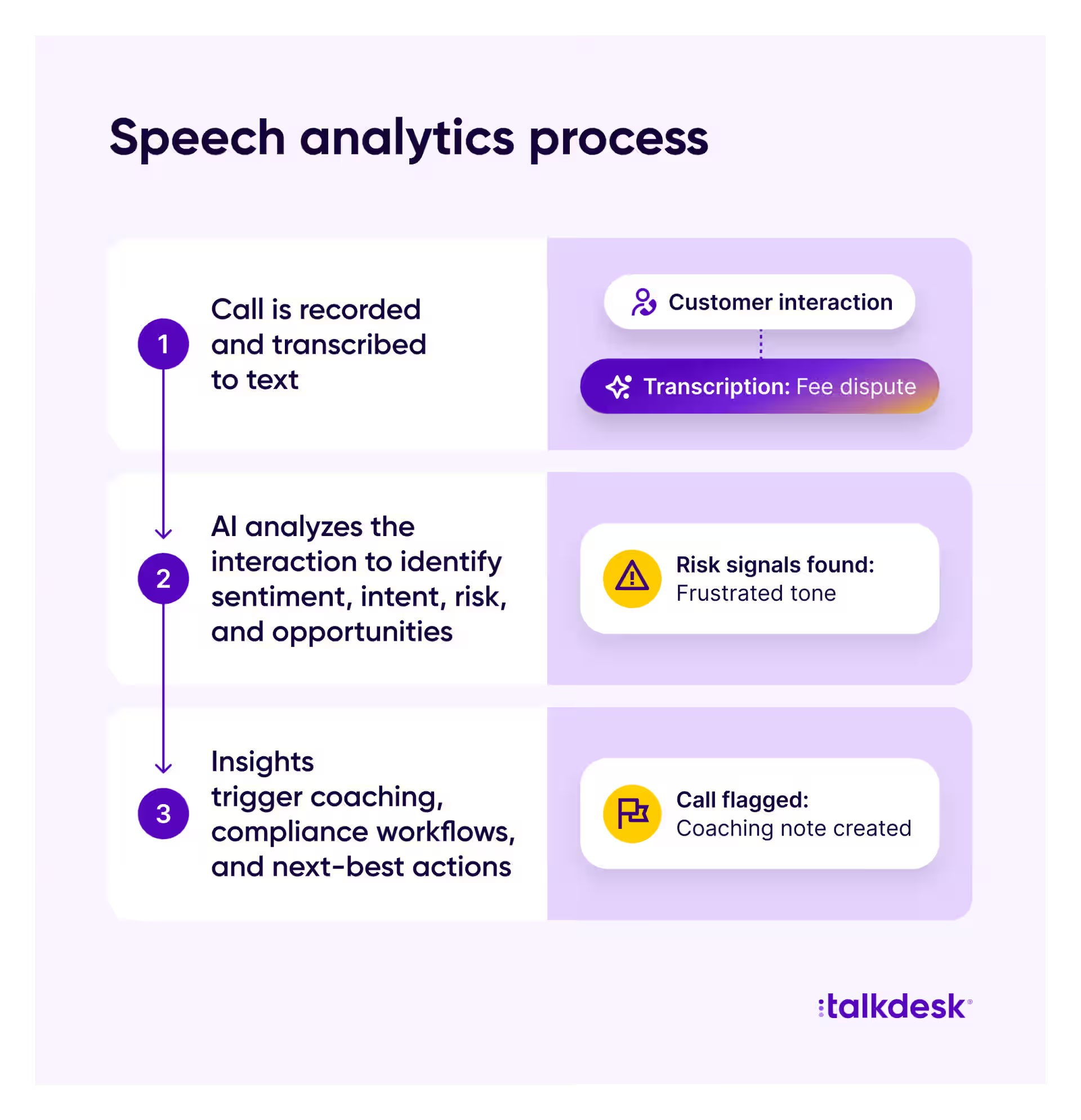
While the exact technology varies by platform, the basic process looks like this:
| Stage | Technology | What it does |
|---|---|---|
Transcription | Automatic speech recognition (ASR). | Converts spoken audio into searchable text. |
Analysis | Natural Language Processing (NLP) and Natural Language Understanding (NLU). | Identifies topics, intent, sentiment, and other linguistic signals. |
Pattern detection | Machine learning (ML). | Compares interactions to find recurring patterns, anomalies, and potential risks. |
Insight and action | AI analytics and automations. | Turns findings into QA scores, risk alerts, trend dashboards, or coaching recommendations. |
Newer platforms use agentic AI to turn those insights into automated actions, such as offering coaching feedback in real time or recommending next-best actions during a call. Some, like Talkdesk, go even further by surfacing hidden customer experience insights, like emerging topics and mood trends.
See how Talkdesk turns every conversation into insight.
Types of speech analytics software.
Speech analytics software comes in a few different forms. Here are some of the more common types. Here are some of the more common types:
-
Post-call analytics reviews completed interactions to find patterns in sentiment, intent, compliance, and agent performance.
-
Real-time analytics works during the conversation, so you can spot issues and respond while the interaction is still in progress.
-
Predictive analytics looks across interaction data to identify patterns that can help you anticipate outcomes, such as escalation or changes in customer behavior.
These approaches aren’t limited to voice. Conversation intelligence applies them to chat, email, and other digital channels, giving you one view of a customer’s history. That shared context matters most when a conversation passes between AI and human agents.
Talkdesk, for example, gives its hybrid AI-human workforce shared context, workflows, data, and governance. This ensures AI interactions are evaluated with the same focus on quality, performance, and risk as human interactions.
What to look for in a speech analytics solution.
A platform can analyze every call and still leave your team with shallow or misleading insights. So when you compare solutions, we recommend evaluating how much of the conversation they can understand and what context they can bring in.
Also consider whether those insights can support the business outcomes you care about and reach the teams responsible for acting on them.
Here’s what to look at when comparing speech analytics software for voice calls in your contact center:
-
Conversation coverage. Look for close to 100% coverage rather than a small sample, but also consider what the platform does with that volume. More conversations only help if the analysis can turn them into useful findings.
-
Native contact center integration. A standalone speech analytics tool can give you interaction data but miss much of the context around it. Native integrations with your contact center, however, can connect those conversations with the customer context and workflows your teams already use.
-
Compliance and QA depth. Go beyond keyword matching and basic sentiment scores. The platform should recognize multiple intents within the same interaction and provide QA and compliance teams with findings they can implement in their workflows.
-
Real-time vs. post-call analysis. Real-time analysis helps agents respond to issues before a difficult interaction escalates, while post-call analysis gives QA and operations teams a larger body of conversations to learn from. Ideally, you’ll benefit from a platform that supports both.
-
Multilingual support. If you serve customers in multiple languages, review not only how many languages the platform supports, but also how well it handles different accents and the nuances that affect sentiment and intent.
-
Unified data across the stack. Bring conversation data together with customer and operational data to understand what’s behind an interaction. For example, seeing that a customer has contacted the company several times about the same issue can point to a process problem rather than an isolated agent issue.
Speech analytics in action: Real-world examples.
Speech analytics can show you what’s really happening across customer conversations, including problems that aren’t obvious from traditional contact center metrics. Here are some examples showing how companies have used insights (like long silences and poor call routing) from contact center speech analytics software to improve customer experience and agent productivity metrics.
Serta Simmons Bedding.

When Serta Simmons Bedding expanded from B2B into direct-to-consumer sales, it had to revise its customer experience strategy to include both the dealer and the “sleeper.” Getting there meant first dealing with a fragmented CX operation. Different divisions were working across separate platforms, which made it difficult to share agents or get a consistent view of customer interactions.
So Serta Simmons Bedding unified its CX operation on Talkdesk. It also added two new capabilities to improve how teams managed customer interactions:
-
Interaction and quality analytics: Gave managers visibility into interaction quality and opened up coaching opportunities across individual agents and teams.
-
Copilot: Used context from connected systems such as Salesforce and Confluence to surface relevant information during interactions, so agents spent less time searching for answers.
All of this helped Serta Simmons Bedding reduce customer wait times by 30% and boost agent productivity by 25%. As Rita Michaud, the Director of CX Enterprise Project Management, puts it, their willingness to keep their mind open to new processes and capabilities has given them an opportunity to do things a better way.
BankUnited.

For BankUnited, a national bank headquartered in Florida, trust is central to its relationships with both customers and employees. But its customer service teams didn’t always have the visibility they needed to foster that trust. Without real-time insight, it was harder to both resolve customer queries and coach agents effectively.
The bank addressed that with Talkdesk Financial Services Experience Cloud, bringing together interaction analytics, autopilot, and copilot. These capabilities helped BankUnited optimize the customer journey, with a particular focus on self-service flows and intelligent routing.
Within months, call abandonment fell to 5.3%, while NPS jumped 104%, a testament to how those operational improvements translated into stronger customer experiences.
ServiceTitan.

ServiceTitan is a cloud-based software platform for contractors. Its old queue-based routing system didn’t take much customer or agent context into account. This meant longer waits and more difficult calls, ending up with the wrong agent.
So ServiceTitan replaced its fragmented contact center setup with Talkdesk, then connected it to Salesforce for additional customer context. This new setup could use information such as open cases and previous CSAT scores to route customers based on what they needed and which agents had the right skills.
ServiceTitan also added call recording and machine-learning tools to review recordings at scale. This gave the team both a broader and a deeper view of customer conversations than manual spot checks could.
The results went beyond just better visibility. FCR rose above the industry standard range of 70% to 79%. Similarly, average time to answer dropped by seven minutes, and average handle time (AHT) fell by one minute.
Improve customer experience with Talkdesk Interaction & Quality Analytics.
Contact center speech analytics software is more useful when it connects with the rest of your customer experience operation. Talkdesk Interaction & Quality Analytics brings conversation data into the broader customer experience automation (CXA) platform, so you can use speech insights alongside QA, coaching, real-time monitoring, and multi-agent orchestration.
United Rentals, one of North America’s largest equipment rental companies, shows how this can work at scale. With more than 1,400 locations and offshore BPOs, the company used Talkdesk’s AI-powered CXA platform to analyze 100% of customer interactions. They then fed these conversation insights into coaching and routing workflows. This reduced agent training time by 50% and achieved 76% routing accuracy.
Like United Rentals, you can use speech analytics in contact center software as part of a broader CX strategy, whether that’s identifying automation opportunities or supporting more revenue-generating interactions.
Speech analytics software FAQ.
Speech analytics software turns voice conversations into structured, searchable data. It reads both the transcript and the audio, so what was said and how it was said become things you can filter, sort, and trend over time.
Speech analytics continuously monitors your calls, so you can see which issues are gaining volume and address friction before they affect your retention. It also makes your call history searchable, so you can trace a complaint back through months of interactions.
When evaluating speech analytics software, look at how well it handles your actual conversations, including transcription accuracy and industry terminology. You’ll also want to see how easily it fits into your existing systems and whether it can scale with your call volume while meeting your compliance needs and regulatory standards.
They’re closely related, but speech analytics usually refers specifically to a contact center’s voice analytics (phone calls). Conversation intelligence is broader, as it brings together insights from both voice conversations and digital channels such as chat, SMS, social media, and email.
Basic call recording gives you the audio. Speech analytics companies turn that audio into readable text and actionable data. That way, you can search conversations, pick up changes in customer emotion, identify patterns across calls, and spot issues without manually listening to every recording.
Yes, many modern speech analytics vendors can support multiple languages, but accuracy depends on the language models behind the platform. It’s always best to check whether the software supports the languages your customers use and how well it handles mixed-language conversations, accents, and industry jargon.
Yes, but “secure enough” depends on speech analytics vendors and your specific compliance requirements. Look for controls such as end-to-end encryption and automated redaction, along with industry-specific protections for requirements such as HIPAA, PCI DSS, or GDPR.

About Celia Cerdeira
Célia Cerdeira has more than 20 years experience in the contact center industry. She imagines, designs, and brings to life the right content for awesome customer journeys. When she's not writing, you can find her chilling on the beach enjoying a freshly squeezed juice and reading a novel by some of her favorite authors.