Customer experience automation (CXA) platforms: What to look for in a vendor

By Celia Cerdeira
0 min read

Customer experience automation (CXA) represents the next evolution of customer service, orchestrating complex journeys across systems and teams to achieve end-to-end resolution.
For years, companies have explored countless tools to elevate customer experience, but many are discovering that the key to real improvement lies in addressing the workflow foundation beneath them. CXA delivers on this need with a unified, intelligence-driven approach that removes friction, connects journeys across systems, and resolves customer needs end-to-end with accuracy and speed.
Traditional customer experience platforms focus on managing contacts or tracking activity. CXA goes further, transforming how work happens across the entire organization. Automation becomes coordinated, journeys become proactive, and every interaction becomes more consistent, more personal, and more impactful at scale.
In this guide, we’ll break down what to look for in a customer experience automation platform, so organizations can choose a vendor that helps turn automation into tangible results.
What is customer experience automation?
Customer experience automation (CXA) is a new approach to customer service that uses autonomous, multi-agent orchestration to manage and resolve the full complexity of modern customer journeys. Instead of relying on manual coordination or disconnected workflows, CXA intelligently detects friction, reasons across systems, and executes end-to-end processes that deliver real outcomes, not just faster responses.
What is a customer experience automation platform?
A customer experience automation (CXA) platform is a system that uses AI to coordinate and execute the work required to resolve customer needs across channels, teams, and business systems. Instead of simply managing interactions like a contact center as a service (CCaaS) tool or storing data like a customer relationship management (CRM) tool, a CXA platform performs the underlying actions that make faster resolution possible. It brings together specialized AI agents that collaborate to complete tasks, streamline processes, and deliver accurate, consistent outcomes across the entire customer lifecycle.
GUIDE
Talkdesk CXA is built to solve one of the most persistent challenges in customer service: the tradeoff between scale and quality.
What are the benefits of using a customer experience automation vendor?
Customer experience automation (CXA) enables organizations to automate complex business outcomes. Here are the key benefits of working with a CXA provider.
1. Measurable financial and strategic impact.
For CX leaders focused on growth and efficiency, the right CXA vendor turns automation into bottom-line results.
-
Reduce costs across the enterprise. Automate high-volume tasks, including those that require multiple steps, data checks, or system coordination, to lower average handle time and reduce pressure on staffing resources.
-
Accelerate ROI and revenue growth. Through intelligent analysis of customer interactions, CXA uncovers upsell and retention opportunities, triggering proactive actions that increase revenue without added effort.
-
Mitigate risk with built-in compliance. Enterprise-grade security and AI guardrails safeguard operations, ensuring accuracy, consistency, and regulatory compliance.
2. Increased operational efficiency and agility.
CXA helps teams move faster, modernize legacy systems, and scale operations seamlessly.
-
Automate end-to-end workflows. CXA automates processes across the entire customer journey, bridging the gap between front and back-office operations. Specialized AI agents can be added on demand, expanding capabilities without redesigning complex workflows.
-
Innovate faster with low-code/no-code tools. Deploy improvements in hours instead of weeks. Low-code and natural language interfaces make it easier for teams to experiment, adapt, and innovate without IT dependencies.
3. Improved customer and employee experience.
The right CXA vendor empowers teams to deliver smarter service while reducing friction for both customers and human agents.
-
Deliver faster, more personalized support. Automated, intelligent routing and response capabilities help customers get accurate answers quickly, driving higher satisfaction and stronger loyalty.
-
Empower agents to do their best work. AI frees human agents from high-volume, repetitive work, reducing time spent on manual workflows and allowing them to focus on complex, high-value interactions. Real-time insights and recommendations give them confidence and clarity to handle any interaction.
-
Unlock context and real-time reasoning. Unified data gives agents a complete view of each customer, enabling accurate, informed responses and fewer handoffs.
4. Technical flexibility and adaptability.
Customer experience automation platforms need to integrate seamlessly with existing environments and adapt to an organization’s unique technology stack.
-
Modernize without disruption. Enhance existing contact center systems (on-prem, cloud, or hybrid) with automation, analytics, and intelligence without replacing existing infrastructure.
-
Integrate freely and avoid lock-in. Open APIs and AI gateways allow easy connection with third-party AI models and internal systems, giving teams more control over innovation.
-
Leverage industry-tuned AI. Pre-built, sector-specific use cases accelerate time-to-value for industries like healthcare, travel, and retail.
Partnering with a CXA vendor is like replacing a manual switchboard with a self-organizing digital team. The digital team brings together specialized AI agents that coordinate in real time, access shared data instantly, and evolve with every task to improve efficiency and consistency across interactions. For CX leaders, the result is a smarter, more resilient operation that delivers proactive, predictive experiences and a clear competitive edge.
8 key features to look for in a CXA vendor.
Before choosing a CXA vendor, it’s worth taking a close look at the capabilities that will set an organization up for lasting success. Explore these eight key features that define a modern, future-ready CXA platform.
1. Multi-agent orchestration.
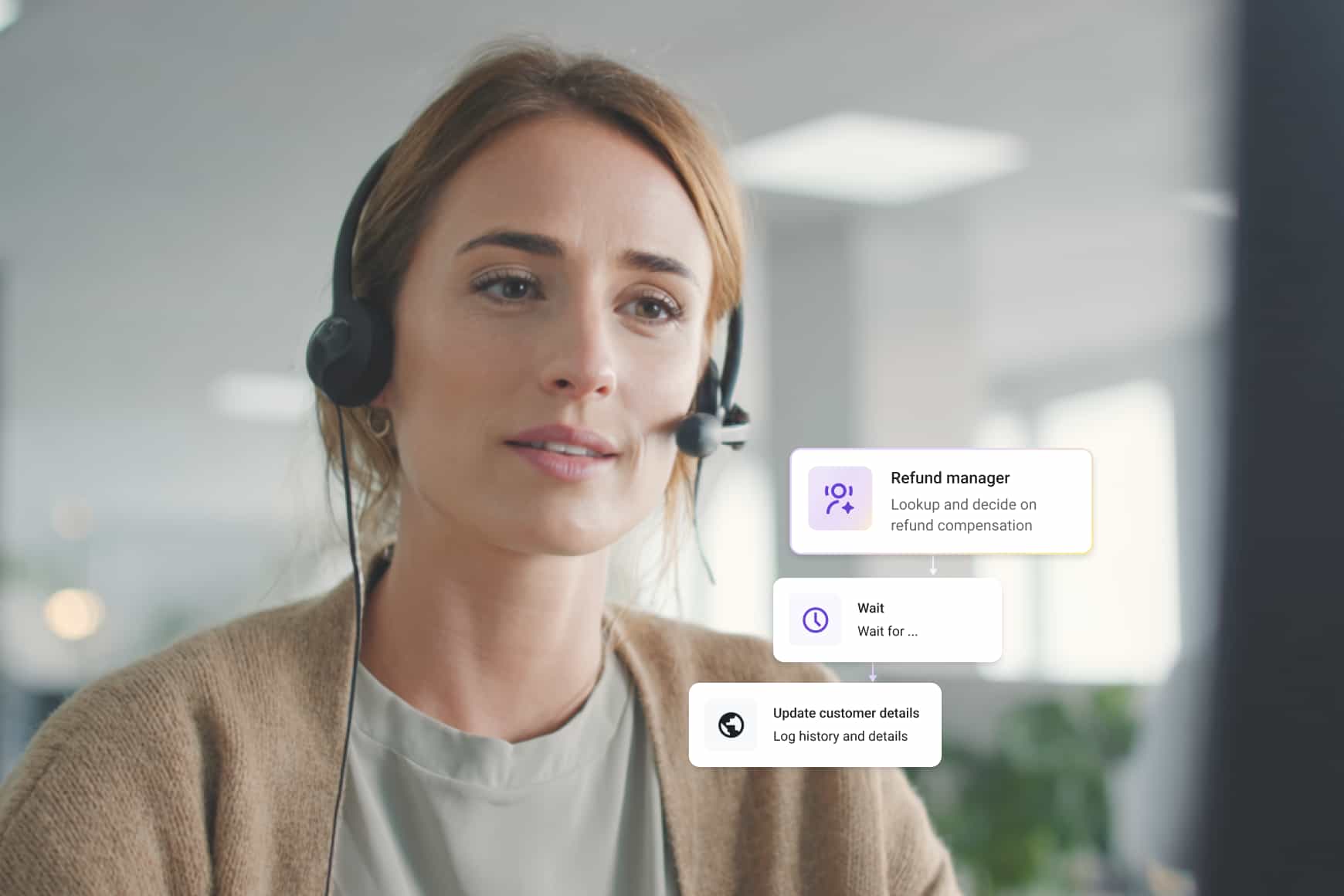
Multi-agent orchestration allows multiple AI agents to work together across a single, end-to-end customer workflow. Each agent is responsible for a specific task, such as validating identity, updating an order, logging a case, or triggering a back-office action, while an orchestrator coordinates how and when those tasks are executed.
Multi-agent orchestration ensures that no context is lost as interactions move between systems or channels. For CX teams, the result is faster resolutions, smoother handoffs, and conversations that feel more natural and authentic.
2. Omnichannel engagement.
No matter where a conversation begins, customers expect connected, effortless experiences. Omnichannel engagement delivers on that promise by creating seamless continuity across every interaction. A CXA platform unifies every channel within a single, intelligent system, allowing conversations to flow naturally without losing context or continuity.
CXA platforms maintain a complete view of the customer lifecycle, preventing customers from having to repeat information and allowing agents to respond faster with full situational awareness. With an omnichannel customer journey, organizations benefit from higher satisfaction, improved agent productivity, and a more cohesive brand experience.
3. AI-powered self-service options.
AI-powered self-service gives customers the flexibility to solve problems on their own—anytime, anywhere. A robust CXA platform delivers 24/7 support through AI agents that continuously learn from every interaction. With natural language understanding (NLU) and conversational AI, these systems provide contextual, human-like assistance that feels intuitive rather than scripted.
When customers need additional help, AI agents can seamlessly transfer the interaction to a live representative, carrying over full context so no details are lost. This combination of automation and empathy enables faster resolutions, higher satisfaction, and reduced operational strain.
4. Integration capabilities.
Modern CXA platforms should be able to integrate directly with systems and tools organizations already rely on, such as CRM, ERP, billing, marketing, and other vertical applications. These connections allow data and processes to flow seamlessly between platforms, driving greater automation and efficiency.
By synchronizing customer data across systems, CXA platforms create a single source of truth and deliver complete visibility into every interaction. This eliminates redundant work, improves reporting accuracy, and enables predictive service models that anticipate customer needs before they arise. The best CXA vendors don’t add another layer of complexity; they simplify it. Choose partners that integrate openly with the organization’s tech stack, rather than siloing data.
5. Security and compliance tools.
Security and compliance are non-negotiable for any enterprise-grade customer experience automation platform. Leading solutions provide comprehensive data protection through encryption, access controls, and detailed audit trails that safeguard every interaction. These built-in security layers ensure that sensitive customer and business information is handled responsibly across all channels and integrations.
A mature CXA platform also adheres to globally recognized compliance standards, including GDPR, HIPAA, and SOC 2, as table stakes. Service-level agreements (SLAs) guarantee uptime of 99.9% or higher and include disaster recovery protocols to maintain business continuity even under pressure.
6. Real-time analytics and dashboards.
Real-time analytics give CX leaders the visibility they need to measure, understand, and continuously improve performance. A strong CXA platform tracks key performance indicators (KPIs), such as customer satisfaction (CSAT), net promoter score (NPS), average handle time (AHT), and first contact resolution (FCR) across every channel. These insights should be displayed in customizable dashboards that surface trends instantly, helping teams respond proactively instead of reactively.
Beyond standard reporting, advanced CX analytics provide a far richer view of customer sentiment than simple positive or negative scores. Modern systems analyze every interaction to identify topics, intent, and emotional signals, capturing nuances like frustration, confusion, confidence, or relief across voice and digital channels. This level of emotional intelligence reveals trends and hidden friction points that aren’t typically visible.
7. Easy, fast implementation.
Implementation should be simple—not a months-long project. A CXA platform that is designed for quick deployment and intuitive setup helps organizations see value sooner. Rapid implementation reduces IT dependency, accelerates adoption across teams, and ensures automation delivers measurable results right from the start.
CXA platforms should include guided onboarding, visual workflow builders, and low-code tools that make configuration accessible to both technical and non-technical users. Combined with responsive vendor support and ongoing enablement, these features help organizations evolve their customer experience strategy with ease. When deployment is simple and fast, teams adopt more readily, and ROI arrives sooner.
8. Compatible with any contact center.
CXA platforms should work with what’s already in place at an organization. Compatibility with existing contact center infrastructure, whether cloud-based, on-premises, or hybrid, allows organizations to modernize operations at their own pace. Flexible deployment makes it possible to improve customer experience without the disruption, cost, or risk of a full “rip and replace” transition.
CXA connects human and AI agents under a single platform, ensuring that automation complements rather than competes with the contact center. Overall, the right CXA vendor enhances existing workflows, strengthens team collaboration, and extends the value of prior investments.
How to evaluate and compare CXA vendors.
Finding the right CXA vendor can feel like a challenge. Each promises to transform customer experience, but not every platform delivers lasting value. Here’s a five-step framework CX leaders can use to evaluate vendors confidently.
1. Understand the AI architecture.
Not all AI is created equal, and CXA depends on the right kind. A true CXA platform relies on multi-agent orchestration to reason, act, and collaborate across workflows. During evaluation, confirm whether the vendor uses scripted automation, generative AI, or a fully agentic AI architecture.
Key questions:
-
Can the system adapt when customers deviate from expected flows?
-
Does it understand context, reason across systems, and take coordinated action?
-
Does the vendor clearly explain how outputs are generated?
-
Is the AI compliant, predictable, and explainable enough for enterprise use?
This is the difference between AI that responds and AI that resolves.
2. Validate integration depth and scalability.
CXA only works if AI agents can act across the full customer journey, which requires deep integration into systems of record, business logic, and operational workflows.
Key questions:
-
Does the platform integrate with your CRM, ERP, billing, ticketing, and industry-specific tools?
-
Does data flow bi-directionally, enabling AI agents to write back, update records, and complete actions?
-
How easily can new integrations be added as the business evolves?
-
Can the platform scale across teams, regions, and high-volume processes?
A CXA vendor must bridge the gap between the front office and the back office, rather than operating as an isolated layer.
3. Assess adaptability and continuous improvement.
AI should get smarter over time, not stagnate. CXA platforms must continuously improve as workflows evolve and customer needs shift.
Key questions:
-
How does the system incorporate feedback and learn from interactions?
-
Are updates automated, or will you need data scientists to tune models manually?
-
How quickly can you update business rules, logic, and workflows?
-
Does the system improve with scale—more data, more interactions, more patterns?
A CXA vendor should offer learning automation, not rigid scripts with AI branding.
4. Examine governance, safety, and controls.
AI-driven automation touches sensitive customer data and mission-critical processes. Strong governance is mandatory.
Key questions:
-
What guardrails enforce compliance and policy adherence?
-
How does the platform prevent hallucinations, bias, unsafe outputs, or toxic language?
-
How easy is it for humans to intervene, override, or audit the system?
-
Is there a transparent governance framework for monitoring and accountability?
Without governance, customer experience automation can scale mistakes instead of outcomes.
5. Measure ROI with real, verifiable data.
The strongest CXA platforms show measurable improvements in resolution rates, efficiency, and customer satisfaction through real-world data.
Key questions:
-
Which KPIs does the platform influence most directly?
-
How does the vendor track efficiency gains, CSAT improvements, or cost reductions?
-
Are there benchmarks or case studies from organizations similar to yours?
-
What is the total cost of ownership, including scaling and maintenance?
A data-backed view of performance ensures organizations choose a CXA partner capable of delivering meaningful, lasting value.
Empower every interaction with the right AI-driven CXA platform.
Selecting the right customer experience automation (CXA) platform involves aligning technology, usability, and partnership to create lasting business impact. The strongest solutions evolve with organizational needs, scaling automation intelligently while keeping people at the center of every interaction. For instance, consider these real-world examples:
-
United Rentals, North America’s largest equipment rental company, partnered with Talkdesk to modernize its customer experience at enterprise scale. Using Talkdesk CXA, the company achieved 100% call recording with automated quality analysis, a 50% reduction in agent training time, and 76% routing accuracy—with a roadmap to reach 80%. By unifying workflows and leveraging tools like Talkdesk Navigator and Talkdesk Copilot, United Rentals enhanced agent productivity and consistency across 1,400+ locations.
-
Arbella Insurance, a leading New England property and casualty provider, undertook a bold “Big Bang” transformation—replacing its UCaaS, CCaaS, and CRM systems in one coordinated rollout. Powered by Talkdesk CXA, the company unified channels for 1,000 employees and agency partners, creating a single, connected service ecosystem. With AI-powered tools enhancing speed and consistency, Arbella achieved a 20% improvement in service levels, reduced average handle time by 45 seconds, and increased customer satisfaction by 3%.
Explore how Talkdesk Customer Experience Automation (CXA) empowers leading brands to turn every interaction into a competitive advantage.
Customer experience automation (CXA) platform FAQs.
Find answers to the most common questions about customer experience automation platforms.
Customer experience automation (CXA) uses AI, multi-agent orchestration, and analytics to automate and optimize the customer journey. It connects people, processes, and data across every channel to deliver faster, more personalized, and consistent service at scale.
A customer experience automation (CXA) platform unifies AI agents, workflow orchestration, and data analytics within a single system to automate and manage the entire customer experience. By centralizing these capabilities, a CXA platform enables organizations to coordinate interactions, monitor performance, and continuously improve service quality across channels.
While CRMs manage customer records and contact center platforms handle interactions, a CXA platform goes further by performing the work behind those interactions. It activates AI agents to automate tasks, guide agents, and orchestrate experiences across systems for smarter, end-to-end engagement.
Customer experience automation improves operational efficiency, reduces costs, and improves both customer and employee experiences. By combining automation with intelligence, it helps organizations deliver faster, proactive service while scaling personalization and consistency.
Businesses should look for a platform that integrates easily with existing systems, meets enterprise security standards, and aligns with their long-term CX strategy. Ease of use, scalability, and proven results through customer success stories are also key indicators of a strong CXA partner.
CXA success can be measured through a combination of KPIs, such as reduced handle time, higher CSAT and NPS, improved first contact resolution, and increased agent productivity. Over time, these metrics demonstrate how effectively automation translates into measurable business outcomes.