Where AI belongs in patient support programs
AI can reduce administrative work and improve patient support, but not every interaction should be automated. Discover five ways life sciences companies can use AI to streamline patient support programs, coordinate follow-up, and ensure nurses and case managers remain involved when human judgment matters.
06:48 min read
Listen to article
06:37
Only 22% of life sciences leaders say they have scaled AI successfully, and just 9% report significant returns, according to Deloitte’s 2026 Life Sciences Outlook.
In patient support programs (PSPs), most stalled AI pilots fail at the handoff. The AI handles the conversation well, but the next step depends on another system or another person, and the work stops there.
When we started building for life sciences at Talkdesk, we expected most patient services teams to want as much of the patient conversation automated as possible.
Time with patient services leaders changed our view. The bigger opportunity is taking administrative work off their teams, and knowing when to hand a patient to a nurse or case manager.
Patient support programs need people in the loop.
Regulation. Any scripted or automated message a patient receives goes through medical, legal, and regulatory (MLR) review first. In practice, automated messages draw from an approved content library, and anything outside that library goes to a person.
Patient conversations can also surface potential adverse events, which have to reach pharmacovigilance (PV) with the original interaction preserved. AI can spot that language and route it to the safety team, but the assessment stays with them.
Human moments. A patient a few days away from their first self-injection of a biologic says, “I’m scared of this injection.” An automated reply is more likely to add to that fear than ease it, while a nurse who has time to talk it through can calm it.
Fear is only one example. A daughter might call for her father, who is newly diagnosed and overwhelmed by the paperwork, or a patient might mention in passing that they skipped last week’s dose because of how the previous one made them feel.
Neither shows up as a field in the customer relationship management (CRM) system, but either one should change what the program does next, and a good nurse or case manager will catch it.
Meanwhile, the administrative load keeps growing. In a BCG survey, 90% of biopharma and medtech omnichannel leaders cited siloed systems as a top barrier. Those silos are why a hub agent still re-keys faxed enrollment forms while the patient waits.
AI should take the predictable, rule-based work so people have time for the conversations that need judgment or empathy. Five practices make that work in a PSP.
Five ways to put AI to work in patient support programs.
1. Automate PSP enrollment and intake.
An enrollment form arrives by fax, and a hub agent re-types the patient, prescriber, diagnosis, and insurance details into the CRM before the benefits investigation begins.
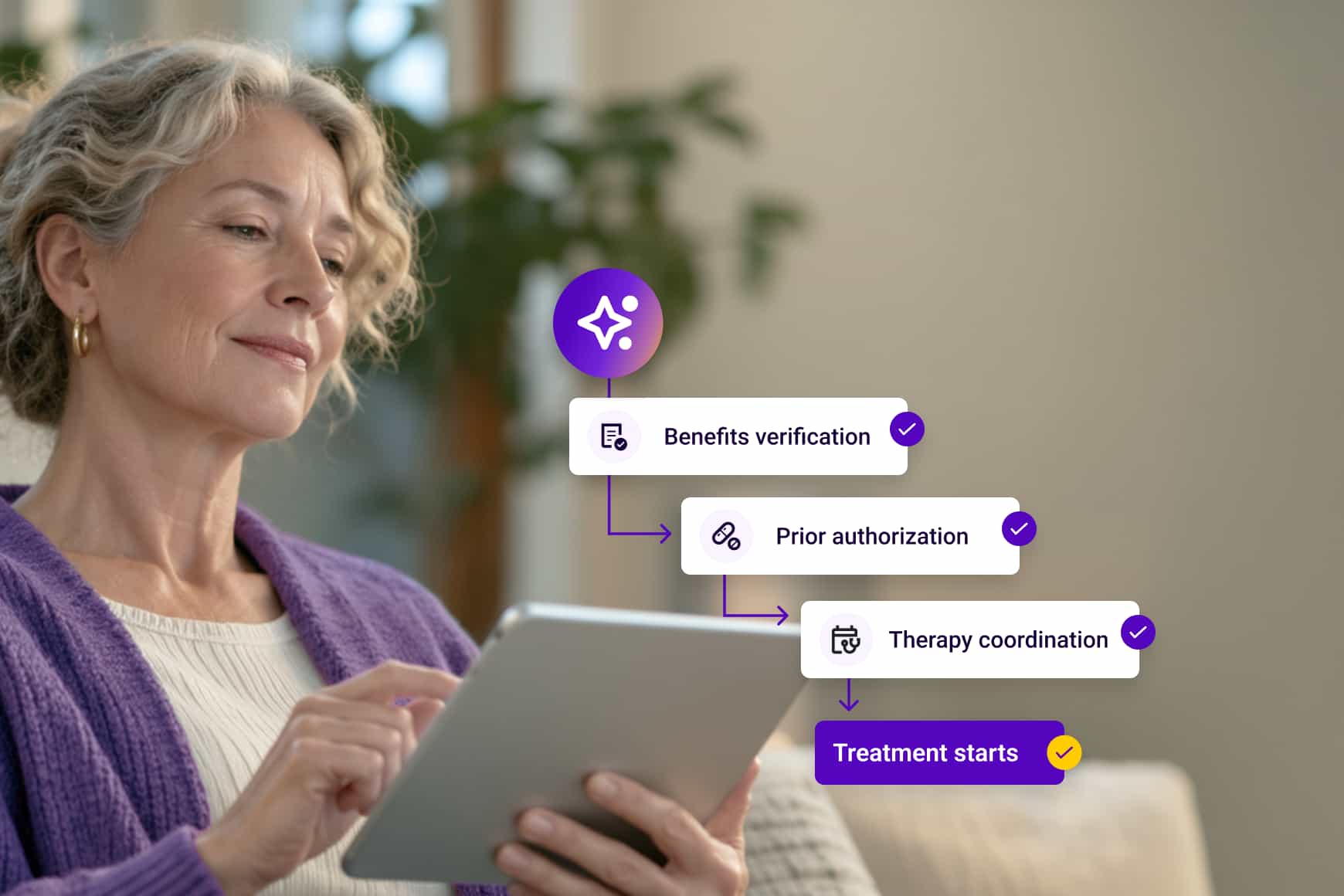
AI extracts those details as the form arrives, collects e-consent where the program allows it, starts the electronic benefits check, and notifies the patient automatically when a signature is missing.
2. Stay ahead of reauthorizations and refills.
The same pattern shows up after the first dose. Prior authorizations expire, copay assistance resets with the new plan year, and refills slip when the specialty pharmacy can’t reach the patient.
All of this is predictable, yet most of it still gets handled after the patient misses a dose. Tracking reauthorization dates, sending approved reminders, and confirming shipments are strong jobs for AI because the rules are clear and late action is expensive.
3. Set clear handoff triggers for nurses and case managers.
The system needs to recognize when a conversation calls for a person, including when a patient:
-
Expresses distress.
-
Asks a clinical question.
-
Mentions missed doses.
-
Describes something that could be an adverse event.
At that point, AI hands the patient to a nurse or case manager along with what they said, where the case stands, and what’s already done, so the nurse picks up exactly where the conversation left off.
4. Use AI to surface potential adverse events for PV review.
When we tested this with a leading biotechnology company across thousands of patient services calls, the system identified nearly 9 in 10 of the potential adverse events the company’s reviewers had already found and routed them into its existing PV workflow.
The system took over the search for those events, and the safety team still made every assessment.
5. Connect AI to the systems patient services already runs.
AI handles the conversation itself well, but to finish the job it needs access to the systems behind that conversation.
A voice agent that explains a copay program but can’t see whether the benefits investigation is finished ends most calls by promising a callback.
Talkdesk Voyager in Life Sciences Experience Cloud is built for that handoff. It connects the patient interaction to the work that follows, using the CRM, hub, and safety systems teams already rely on. Those systems stay the source of record, and regulated decisions stay with MLR, PV, and clinical staff.
Where to start with AI in patient support.
The pilots that go well start narrow: one program and one workflow, with a baseline everyone agrees on and a named owner for each handoff. Enrollment intake and benefits follow-up are common first choices because volume is high and delays are easy to measure.
Bring MLR and PV in before building anything. Agree on which moments trigger a human handoff, who receives it, and what information they need to act.
Those decisions matter more than which AI model a team picks.
We’d like to hear from other patient services leaders: where is your team drawing the line between what AI handles and what stays with people?
See how Life Sciences Experience Cloud supports patient services teams.

About Matt Yeoh
Matt Yeoh is Head of Product for Life Sciences at Talkdesk, where he leads product strategy and delivery across the life sciences portfolio. Before Talkdesk, he led Life Sciences product at Salesforce Health Cloud, setting product direction and bringing Patient CRM and automation to many of the world’s top pharma companies. Earlier, he held product and services leadership roles at Veeva Systems. Matt is passionate about patient access innovation in life sciences. He builds modern solutions that help regulated organizations connect with and serve patients, with a particular focus on using AI to create seamless, personalized, and compliant experiences that help people get the medications they need. He is committed to helping life sciences organizations deliver better outcomes for their patients.