The real measure of enterprise agentic AI maturity
The real measure of agentic AI maturity isn’t how many agents a business deploys, but how much work they can get done. Unlocking its full potential means rethinking business processes, bringing humans and AI together, and measuring success by outcomes, not automation activity.
07:07 min read
Listen to article
08:31
Nearly every company has adopted AI for customer experience. Far fewer have figured out how to make it work autonomously across the business. According to the 2026 The state of agentic automation in CX report, 98% of companies use AI in customer experience, yet only 15% combine agentic AI with autonomous cross-departmental execution. Conducted by NewtonX, the study surveyed 252 senior decision-makers responsible for CX, IT, operations, and AI strategy across North America, EMEA, LATAM, and APAC.
For technology leaders, this gap raises a question that goes beyond adoption. If AI is already everywhere, why are so few companies operating it at scale?
The answer lies in how we define enterprise agentic AI adoption. The capabilities of individual AI agents matter, but they are no longer enough to distinguish the companies making real progress. What matters is whether AI agents can execute complex work across systems and collaborate with human agents to deliver measurable outcomes.
Agentic AI is revealing the limitations of business processes designed around human execution. The opportunity now is to rethink those processes rather than simply automate them.
The state of agentic automation in CX.
See where your automation maturity stands, how you compare to peers, and what it takes to move from routing to resolving.
AI adoption is no longer a competitive advantage.
When nearly every company has AI, deployment alone tells you very little about its ability to deliver business value.
Consider an airline customer requesting a flight change after a cancellation. An AI agent might understand the request, retrieve booking information, and identify alternative flights. But completing the request also requires updating reservations, processing payments, adjusting loyalty benefits, and notifying other systems.
The benchmark reveals how limited autonomous execution still is. While 64% of respondents use specialized AI agents that hand off work between functions, only 35% have agents capable of maintaining context and acting across systems. Just 23% operate persistent, long-running workflows.
End-to-end execution requires more than capable AI agents. A multi-agent architecture enables specialized agents to collaborate, while orchestration coordinates their actions across systems, workflows, and human employees.
For the airline, this could mean coordinating the entire flight-change process rather than requiring a customer service employee to complete each step. But orchestration alone can’t deliver that outcome. AI also needs access to accurate customer information, trusted knowledge, and the systems where transactions take place. Without these foundations, even sophisticated agents stay limited to isolated tasks.
Modernizing CX requires a new maturity model.
The benchmark report shows that companies combining agentic AI with cross-departmental automation achieve stronger business results by coordinating human and AI work, integrating data across departments, and measuring business impact rather than AI activity.
To evaluate CXA maturity, the report introduces a five-stage framework, ranging from isolated AI applications to autonomous execution across departments and systems.
CXA maturity curve.
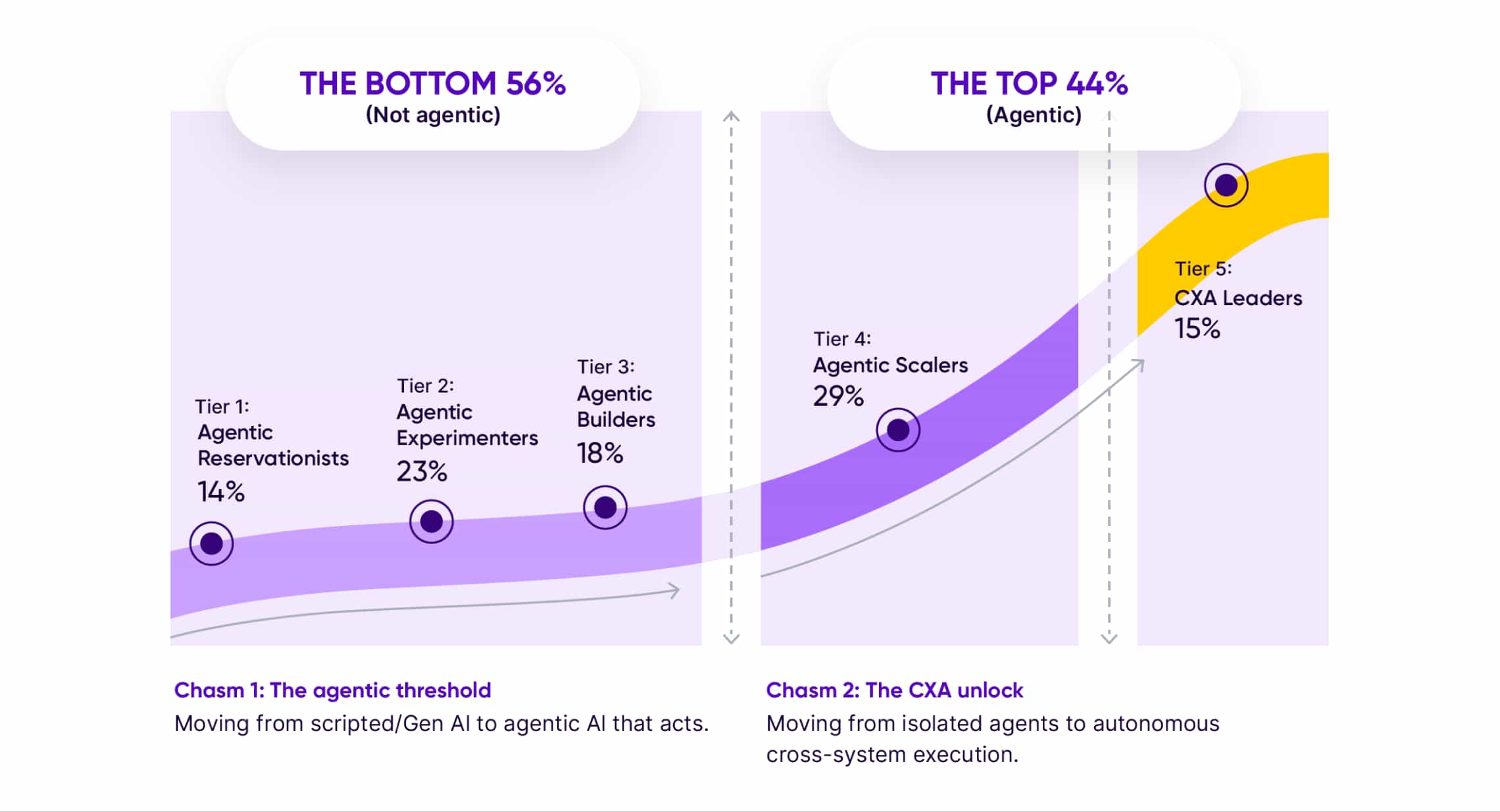
At the top of that framework sit CXA Leaders, the same 15% who combine agentic AI with autonomous cross-departmental execution. They’re approximately four times more likely than Agentic Scalers to report major improvements in customer satisfaction or Net Promoter Score. And 38% resolve more than 40% of customer issues autonomously. Yet across all respondents, only 5% can clearly quantify AI’s business impact, highlighting the need to measure outcomes rather than automation activity.
The difference goes beyond technology. Traditional enterprise software helps employees execute predefined processes. Agentic AI can reason, make decisions, and take action across systems, allowing companies to automate work that previously required human coordination.
Deploying agents capable of performing individual tasks is not the same as giving AI responsibility for an entire business process. The challenge is to define which outcomes AI can own, which systems and information it needs to access, and when human intervention is required.
Reliability is equally important. An AI agent that performs well in a controlled demonstration may get unexpected customer requests, incomplete information, or conflicting instructions in production. Building reliable AI agents requires continuous testing, evaluation, and improvement as agents operate in real-world conditions. Scaling agentic AI requires an operating environment where agents can execute work reliably and autonomously across the business.
A hybrid human-AI workforce is a strategic priority.
As AI agents start working independently, companies must reconsider how to distribute responsibilities between humans and AI. The benchmark found that 99% of respondents recognize the benefits of a hybrid human-AI workforce. Among those already using AI agents, 57% report that human agents are moving toward more complex work.
Managing the hybrid workforce requires clear responsibilities, coordinated workflows, and a shared approach to performance and accountability. AI agents need defined boundaries for autonomous decision-making, while human agents must be able to intervene when judgment or expertise is required.
Performance measurement must also evolve. Traditional customer service metrics, such as containment and escalation rates, reveal little about whether AI has actually resolved a customer’s problem. Evaluating autonomous AI requires visibility into the quality of decisions, completed work, and customer outcomes.
The benchmark reinforces the importance of AI agent governance. With compliance (50%), security (48%), and trust in AI decision quality (52%) among the leading concerns, enterprises need ways to manage the risks of greater autonomy. Continuous evaluation, observability, and defined risk boundaries provide that oversight, allowing AI agents to make decisions and execute work within established limits. Governance is what enables enterprises to scale autonomy responsibly, not simply a set of constraints.
The questions worth asking now.
The benchmark shows that 83% of respondents expect autonomous resolution rates to increase over the next two years. But automation volume and business value aren’t the same thing. Scaling one doesn’t guarantee the other.
The more meaningful question isn’t how much AI can do. It’s whether what AI does matters. Which decisions should AI make independently? Where does human judgment add value? And how should success be measured? These questions should guide how we design processes, assign responsibilities, and evaluate outcomes.
The biggest mistake isn’t moving too slowly. It’s moving fast in the wrong direction. Using agentic AI to automate processes designed around human limitations risks preserving the very inefficiencies the technology could eliminate. The opportunity is to rethink how work gets done, not simply make existing processes run faster.

About Pedro Andrade
Pedro Andrade is vice-president of AI at Talkdesk, where he oversees a suite of AI-driven products aimed at optimizing contact center operations and enhancing customer experience. Pedro is passionate about the influence of AI and digital technologies in the market and particularly keen on exploring the potential of generative AI as a source of innovative solutions to disrupt the contact center industry.