Building an AI agent doesn’t make it ready
Building AI agents seems almost too easy. Give the model a role, tell it what to do, connect it to the systems, test it a few times, and send it into the world. The demos are fantastic, and the promise is even better.
09:54 min read
Listen to article
07:53
Production has proved considerably more complicated, though.
An AI agent that performs brilliantly in a controlled environment can behave very differently when real customers start throwing real problems at it. Instructions that seemed perfectly clear suddenly aren’t. Conversations enter loops, agents follow the rules but completely miss the point, and interactions end abruptly because someone forgot an edge case nobody knew existed.
The uncomfortable truth is that building an AI agent is easy, but building one you can trust with your customers is incredibly hard.
AI agents are five-year-olds with superpowers.
There is an analogy I often use when explaining this. Imagine telling a five-year-old: “Jake, tidy your bedroom and get your school bag ready for tomorrow.”
You come back and the bedroom looks spotless. The clothes are off the floor, the toys have disappeared, and the school bag is sitting neatly by the door. Then you open it and find the toys, yesterday’s dirty T-shirt, and a pair of socks inside. Did Jake ignore you? Not exactly. He tidied the room and got the bag ready. He just connected those two instructions in a way you never anticipated. What you meant was obvious to you, but it wasn’t contained in what you actually said.
Large language models have a similar talent for exposing everything we leave unsaid. They will try very hard to satisfy the objective we give them, but what we mean and what we actually instruct them to do are not necessarily the same thing. In customer service, those unintended interpretations have real consequences.
We underestimated the expertise problem.
Take something apparently simple: “Help customers who want a refund.” Anyone who has worked in customer service knows there is an entire world hiding inside that sentence. Which customers qualify? Which products? Within what period? What if the customer used the product? What if the policy says no but there is an exception? When should the AI stop making decisions and bring in a human?
An experienced operations person understands much of this instinctively because years of interactions and business knowledge inform the decision. An AI agent doesn’t have that accumulated experience. Everything that matters has to somehow find its way into how the agent is instructed and how its behavior is evaluated.
For now, much of that work depends on specialists who know how to translate business requirements into precise prompts, workflows, guardrails, and instructions. That can work when you’re building five agents. It becomes a very different proposition when you need 500.
You can’t put every employee through weeks of AI training, nor can every project depend on the handful of people who really understand how these models behave. If AI agents are going to become a workforce, building them can’t be a specialist craft.
We need to stop thinking about prompts.
Much of the conversation about AI agent development still revolves around the prompt. Write better instructions, improve the prompt, add another guardrail. But that represents only a fraction of what has to happen before an AI agent can reliably do a job.
First, you need to identify the right use case. That means understanding the conversations behind it, finding where customers encounter friction, and determining whether automation can make a meaningful difference. You also need to know what good performance looks like.
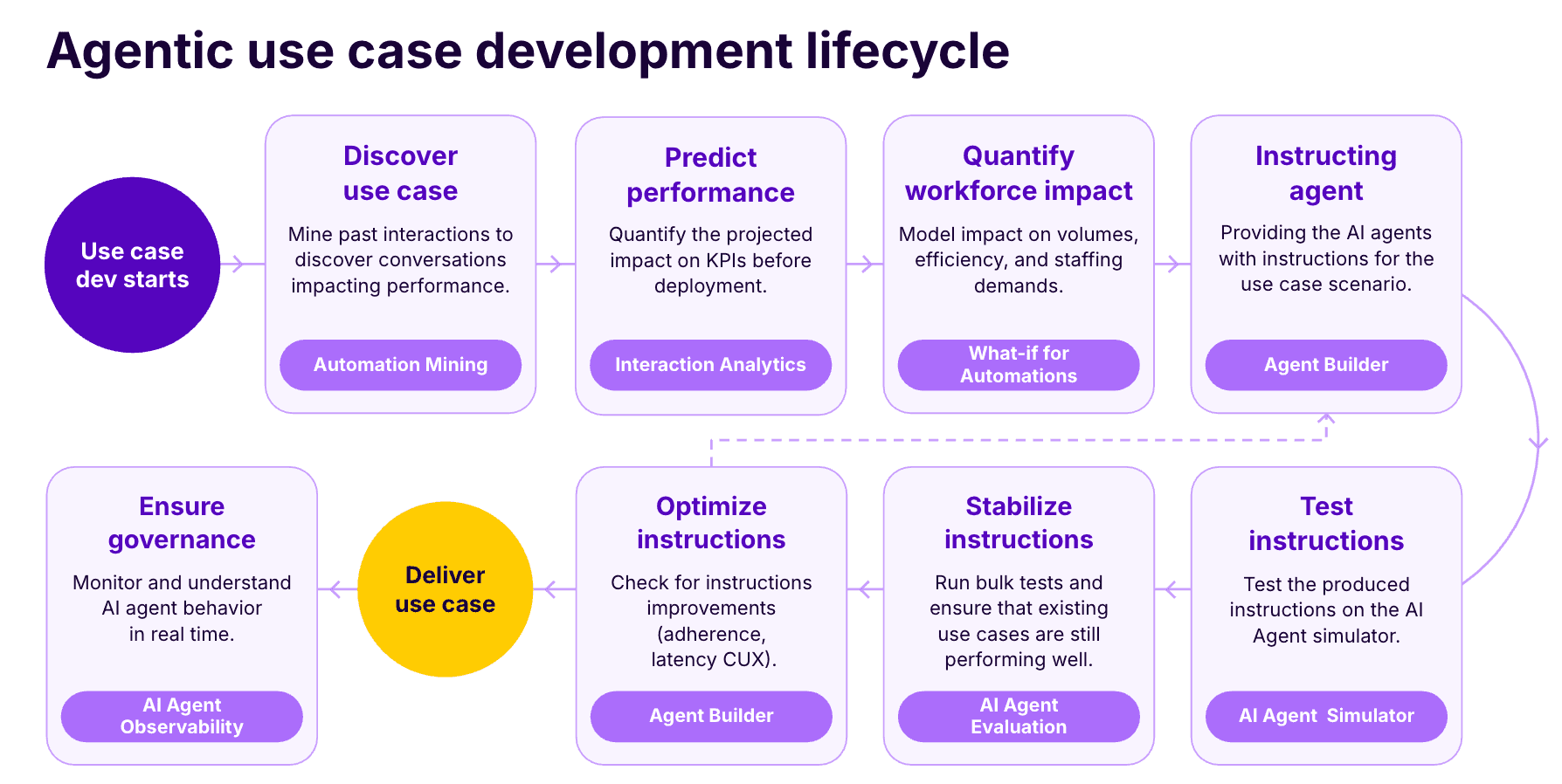
Only then do you get to the instructions. And those instructions have to survive situations nobody anticipated: missing information, contradictory requests, unusual customer behavior, policy exceptions, and all the other scenarios that appear as soon as an agent meets the real world.
Testing needs to do more than prove that an agent can complete the happy path. It should expose ambiguities, conflicting instructions, and missing information before they reach customers. AI can review instructions for consistency and completeness, identifying weaknesses that even experienced teams may overlook.
If something goes wrong, AI can also help find why. Rather than requiring a specialist to work backward from every failure, it can diagnose the likely cause, recommend a correction, and validate the revised instructions, while people retain control over what goes into production.
Deployment doesn’t end the process. Real conversations reveal new behaviors and edge cases that feed into subsequent versions of the agent. Validation and troubleshooting continue as those scenarios emerge and the business changes. Building an AI agent isn’t a prompt. It’s a lifecycle.
AI needs to become its own expert coach.
There is an interesting irony in all of this: AI created much of this complexity, and AI is also the best way to manage it.
General-purpose AI models are already helping to write and improve instructions, and even that can make a significant difference. Think of it as using a wrench instead of trying to tighten a bolt with your hands. The wrench helps, but if you are going to perform the same specialized job thousands of times, you eventually want a tool designed specifically for it.
That’s where I believe AI agent development is heading. Specialized AI can understand how other AI agents work and help humans build, test, diagnose, and improve them. Instead of teaching people to think like prompt engineers, we can give them an AI expert that understands what they’re trying to accomplish and helps translate their customer and operational expertise into instructions an AI agent can reliably execute.
The people closest to the customer shouldn’t need to become AI specialists. The technology needs to be able to capture what those people already know.
From building agents to building an AI workforce.
Talkdesk Agent Builder enables operations teams to describe an agent’s role, behavior, policies, and edge cases in plain language. Agent Builder translates that intent into precise instructions, automatically reviews them for consistency and completeness, and surfaces gaps or ambiguities before the agent reaches production.
The same applies when an agent gets something wrong. Agent Builder can work backward from the behavior, identify where the instructions may have failed, and suggest changes that can be tested before another version goes live. The technology does the investigative work, while people remain in control of what gets deployed.
But Agent Builder represents one part of a broader change in how AI agents need to be developed. The process extends from discovering and quantifying the right use cases to instruction, simulation, evaluation, optimization, deployment, and ongoing governance. Each stage addresses a different part of the reliability problem, and together they make the expertise behind successful AI agents easier to scale. The number of AI agents is going to grow much faster than the number of people with the specialist expertise to build them.
We spent the last few years making AI smart enough to do the work. The next challenge is making the expertise required to teach it scale just as fast.

About Pedro Andrade
Pedro Andrade is vice-president of AI at Talkdesk, where he oversees a suite of AI-driven products aimed at optimizing contact center operations and enhancing customer experience. Pedro is passionate about the influence of AI and digital technologies in the market and particularly keen on exploring the potential of generative AI as a source of innovative solutions to disrupt the contact center industry.
Agent Builder FAQs.
A no-code AI agent builder is a platform that lets operations leaders build, configure, and deploy AI agents without writing code. Users describe agent behavior, customer intent, and escalation logic in plain language. The platform translates those inputs into working agent architecture.
Most AI agents underperform because operational knowledge passes through too many intermediaries during development. Engineers interpret secondhand requirements, and the resulting AI reflects documentation rather than the judgment experienced teams carry. Closing that gap is the core purpose of no-code AI agent platforms.
An AI agent validation tool tests AI agent behavior against real-world scenarios before deployment. A CX AI agent validator specifically checks whether the agent responds in ways that align with operational expectations, surfacing edge cases and behavioral gaps before they affect customers.
Operations teams should define AI agent behavior. They carry the customer knowledge, exception handling experience, and business judgment that decides whether an AI agent performs well. Technology handles implementation. A no-code AI agent platform makes that division of responsibility practical.
Zero-prompt AI agent development removes the requirement for prompt engineering expertise. Operations managers describe agent objectives and behavior in natural language, and the platform generates the underlying configuration. This model puts subject matter expertise, not technical skill, at the center of AI development.