Beyond the contact center: Connecting the sales floor to the customer journey
Retailers capture rich customer context in their contact centers and digital channels, then lose it the moment a customer walks into a store. Talkdesk for Stores extends AI-powered customer intelligence directly to the sales floor, giving store associates the same conversation context and decision support used by contact center associates.
07:48 min read
Listen to article
08:14
When a customer calls support, chats with a digital AI agent, or resolves an issue online, that context is captured in detail. But despite 83% of U.S. retail sales still happening outside of e-commerce, the moment that same customer walks into a brick-and-mortar store, they cross an invisible barrier. To the store associate standing in front of them, they are a complete stranger. And when the store visit ends? Everything that was said, recommended, or resolved simply disappears.
Brick-and-mortar remains a brand’s most powerful differentiator, but treating the sales floor as a disconnected silo fragments the entire customer journey. To deliver a connected customer journey for retail stores, brands must take customer experience intelligence beyond the contact center and bring it directly onto the store floor.
The cost of the
in-store disconnect.
Having spent the first half of my career on retail sales floors and in corporate merchandising before transitioning over to enterprise software, I have seen how this operational divide hurts the retail store customer journey. Today, the contact center and the physical store operate in parallel universes:
-
Contact center associates have zero visibility when a customer spends 45 minutes in a flagship store trying on apparel or troubleshooting a product earlier that afternoon.
-
Store associates don’t know that the customer was on live chat 20 minutes ago trying to resolve a delayed shipment or exchange request.
The disconnect leaves store teams without the context they need to deliver a personalized experience. Only 35% of retail executives say their staff have the tools and information needed to personalize customer experiences.
Customers feel that disconnect when they walk into a store and the context from their previous interactions doesn’t come with them, or when the engagement in the store is invisible to the teams supporting them later. They have to repeat information, explain previous interactions, or start again because the context from one touchpoint hasn’t followed them to the next. The friction can have consequences beyond a frustrating interaction as 29% of consumers say they have stopped using or buying from a brand because of a poor customer experience, either online or in person.
Create connected customer experiences in every store.
Deliver personalized experiences, strengthen customer relationships, and make every in-store interaction visible and measurable.
Owning the continuous conversation.
When retailers realize their store associates and managers are flying blind while contact centers sit on rich customer context, the instinct is to buy yet another standalone app. But layering point solutions onto the sales floor only deepens the divide:
-
Commerce apps manage POS transactions.
-
CRMs warehouse static customer records.
-
Clienteling tools capture isolated task lists.
Each solves part of the problem, but none of them own the full conversation. Personalizing the physical store experience with AI isn’t about adding another app to an associate’s device, but connecting every touchpoint, from AI agents and contact center specialists to store associates on the sales floor, into a single, ongoing dialogue. That’s commerce orchestration intelligence for stores, and it’s what separates a fragmented channel strategy from a truly connected customer journey.
Talkdesk for Stores: CXA beyond the contact center.
Talkdesk for Stores extends the Retail Experience Cloud onto the physical sales floor. It gives store teams the same AI-powered workflows and customer intelligence already used in the contact center.
By giving store associates access to the same AI-powered workflows, customer intelligence, and omnichannel context previously reserved for contact center agents, retailers can unify customer engagement into a single platform:
1. Context at the point of walk-in.
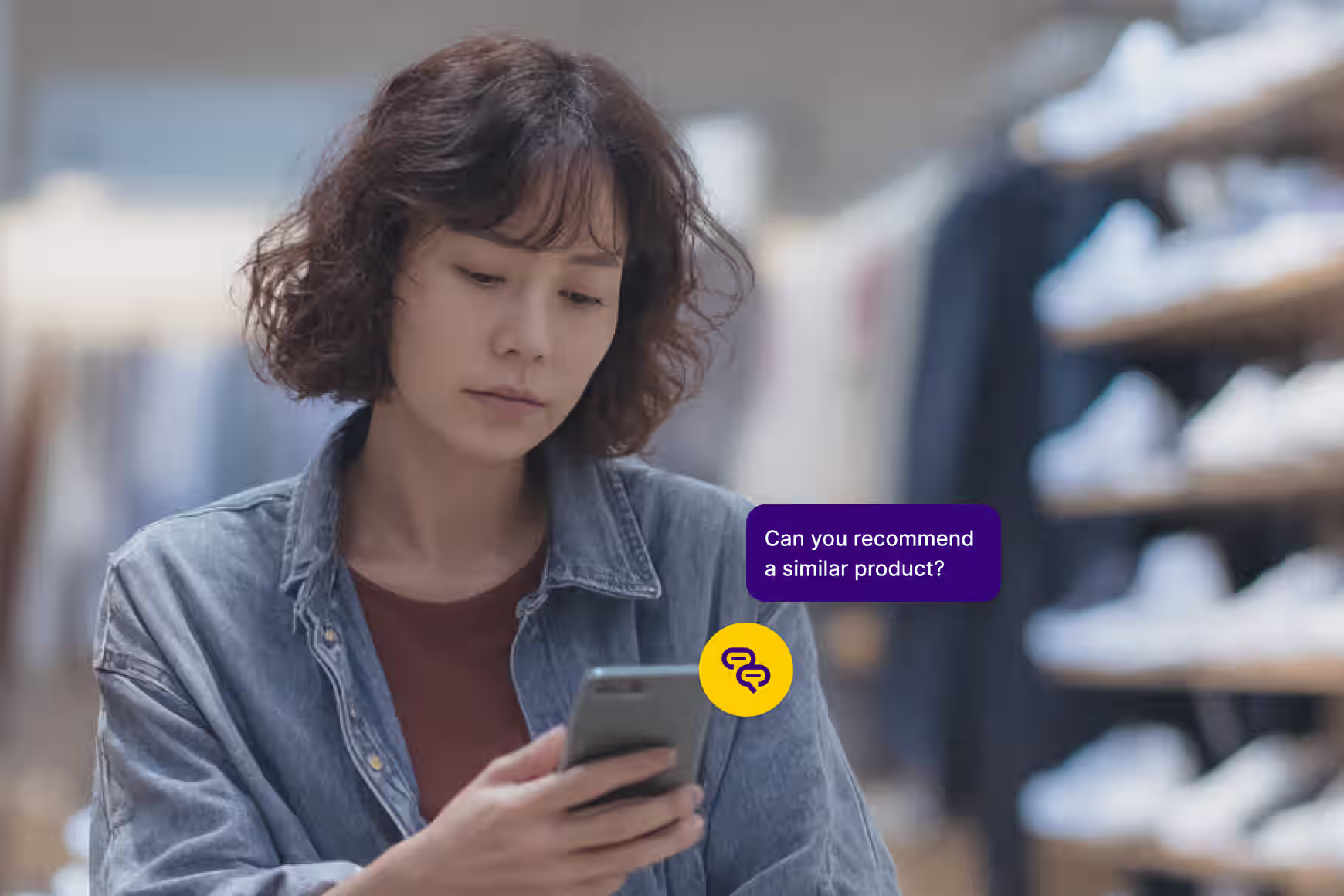
Associates can open the purpose-built retail workspace and search for any customer by name, phone, email, or loyalty ID independently of an active transaction. In seconds, the associate sees past support tickets, online order history, and preferences, transforming a generic “Can I help you find something?” into a personalized, informed consultation.
2. Personalizing physical store experience with AI.
The integrated AI-powered copilot acts as a real-time digital assistant for associates on the sales floor, surfacing guided workflows, personalized product recommendations, and next-best actions. Personalizing the physical store experience with AI gives seasonal hires and veteran associates alike the real-time knowledge needed to advise shoppers.
3. The store visit as an interactive engagement channel.
Walk-in traffic is no longer a data black hole. Associates initiate a structured in-person visit session to capture visit drivers, product preferences, and outcome notes. When the interaction ends, automated SMS surveys instantly capture CSAT and NPS feedback, turning foot traffic into measurable customer experience intelligence for store managers.
4. Appointment scheduling for stylists, technicians and specialist consultations.
Whether a customer needs dedicated styling advice, a design consultation, or in-store technical diagnostics and repair services, associates can schedule in-person and virtual appointments directly from the retail workspace. Every booking syncs to the customer’s cross-channel timeline, ensuring technical specialists and store staff have full context and troubleshooting history before the appointment begins.
5. Store and service directories with real-time inventory lookup.
Associates should never have to turn a customer away without a solution. Through integrated store and service directories and direct commerce integrations (Shopify, Salesforce Commerce Cloud, Adobe Commerce), staff can look up full catalog details, online product availability, pricing, variants, and alternative items. If an item isn’t on the shelf, associates can check online inventory or connect shoppers with experts across sister locations.
6. Closed-loop omnichannel continuity.
Every in-store interaction instantly generates an activity card on the customer’s unified timeline. If a customer leaves the store and subsequently calls customer service, the contact center agent sees the exact in-store notes, tried-on items, and visit outcomes. Every channel builds on the last, maintaining a single, uninterrupted customer dialogue.
Turning store visits into lasting relationships.
While retailers continue to invest in elevating the physical store experience, in-store touchpoints are still fragmented from the online journey. As shoppers seamlessly move between digital channels, contact center, and physical aisles, the experience must feel like one continuous relationship, not separate, siloed events.
When your most loyal customer walks through your doors today, are you treating them like a valued regular or a complete stranger? Products can be replicated, and pricing advantages rarely last. But the ability to remember, understand, and create an unbroken conversation across every digital screen and physical aisle is a brand differentiator.
Explore Talkdesk for Stores to learn more or schedule a personalized walkthrough with our team.

About Michael Klein
Michael Klein is the Head of Retail, Travel & Hospitality Product Marketing for Talkdesk, a leader in Contact Center Software. Michael is a trusted executive advisor to enterprise brands and was named a 2025 Top Retail Expert by Rethink Retail for the second consecutive year. As a global business leader with deep expertise in the technology and consumer industries, he is known for authenticity and getting to the heart of the matter. He has a wealth of experience in marketing, merchandising, technology, customer experience, Ecommerce, and digital transformation. Prior to Talkdesk, Michael was the Global Director of Industry Strategy & Marketing for the Adobe Digital Experience Cloud, where he led the GTM strategy targeting retail, travel, and consumer goods clients. Michael’s retail expertise is vast. He was a senior merchant and marketer for specialty brands including William-Sonoma, Harry & David, Discovery Channel Stores, eLuxury.com (LVMH Group), Dean & DeLuca, and wine.com where he consistently delivered positive comp store sales and margin growth for these specialty retailers. As a thought leader in global commerce Michael regularly contributes to industry events. He is an active member of the NRF Digital Council and the Retail Cloud Alliance Advisory Council. Michael also sits on the board of Visional, a video commerce platform and AndesML, a retail media platform.