Conversational AI in retail: How it impacts your customer experience
From answering product questions to tracking orders and processing returns, conversational AI helps retailers manage customer conversations more naturally and efficiently. Here’s how it works, why retailers are adopting it, and what it takes to implement it successfully.
11:36 min read
Listen to article
11:51
Key takeaways.
-
Conversational AI understands shopper intent and context, enabling natural conversations across channels rather than relying on scripted workflows.
-
Retail brands can use conversational AI to support agents in real time and deliver faster, more personalized service across the shopping journey.
-
Retail is one of the largest adopters of conversational AI, with the segment accounting for 21.1% of the global market in 2025.
-
When evaluating a platform, look beyond chatbots to capabilities such as omnichannel support, real-time business data, and integrations with your retail technology stack.
Every conversation with a customer is an opportunity to move the shopping experience forward. A question about sizing can influence a purchase. A request for a recommendation can lead to product discovery. And the right support after a sale can determine whether a customer comes back.
Conversational AI in retail gives retailers a way to make more of those interactions useful, relevant, and personalized at scale. From product discovery and purchasing to post-sale service, it’s creating more connected and personalized AI customer experiences throughout the shopping journey.
In this guide, we’ll look at where conversational AI delivers the most value for retail brands and what to consider when choosing a conversational AI solution.
What is conversational AI in retail?
Conversational AI in retail enables customers to interact with retailers using natural language through voice or text. It uses technologies such as natural language processing (NLP), machine learning, and generative AI to understand customer intent, maintain context, and respond in a natural way.
It can support customers across the shopping journey, for example, helping them discover and compare products, checking availability, answering questions, tracking orders, processing returns, and providing post-purchase support.
While a traditional rule-based chatbot is limited to predefined responses and conversation paths, conversational AI connects to your inventory platform, order management software, and CRM, so it can answer based on real-time data.
How conversational AI works in retail.
Conversational AI follows the same process on every request. It identifies customer intent, retrieves the relevant context, and determines whether it can resolve the request or if it should involve a human.
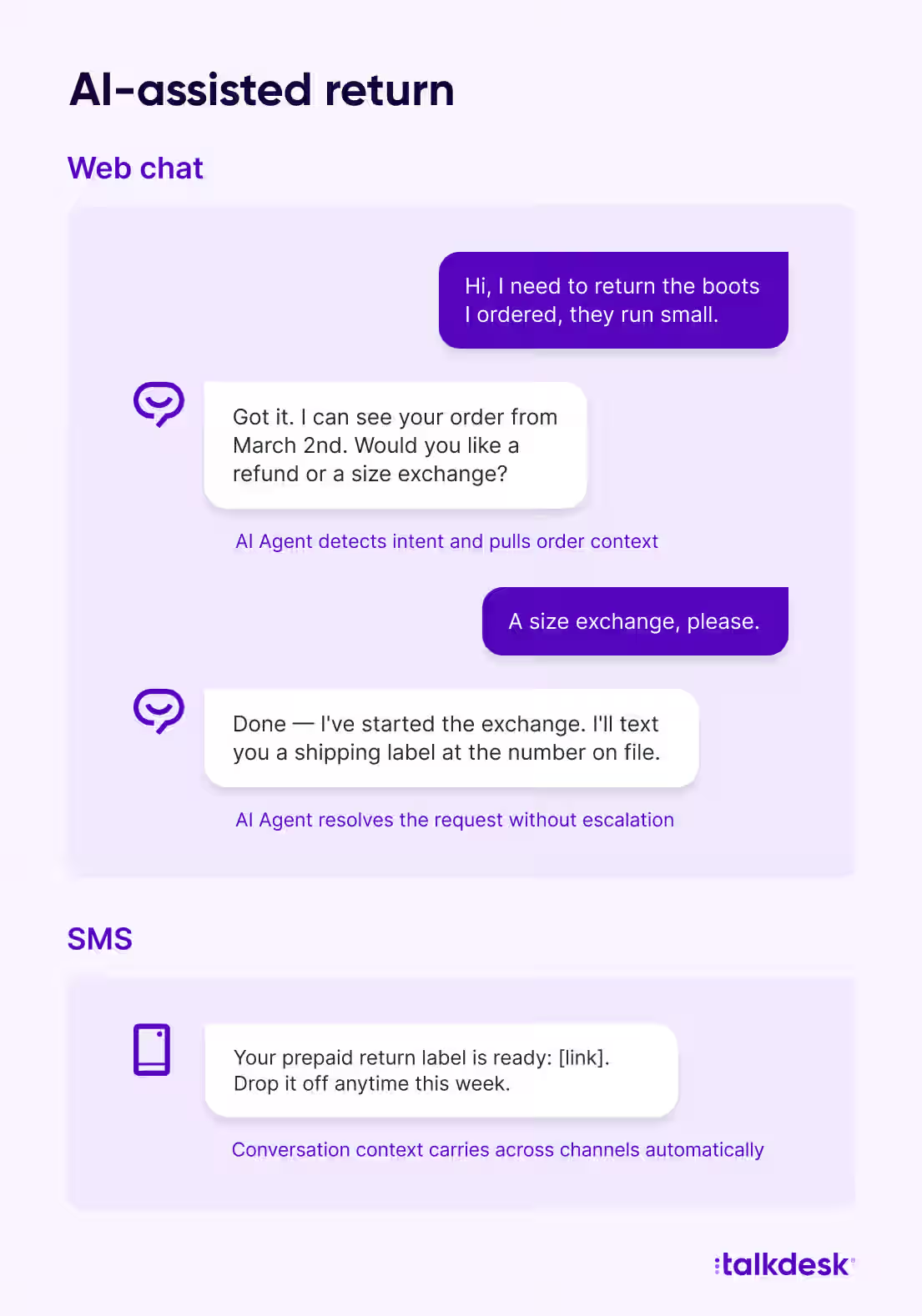
Here’s how conversational AI supports better retail customer experiences:
-
Understanding the request. The conversation starts with AI identifying the customer’s intent. That could mean checking product availability, tracking an order, starting a return, booking an appointment, or asking a product question.
-
Building context. AI gathers the information it needs to respond accurately. It usually pulls together data from your CRM, commerce platform, inventory system, loyalty program, and previous conversations.
-
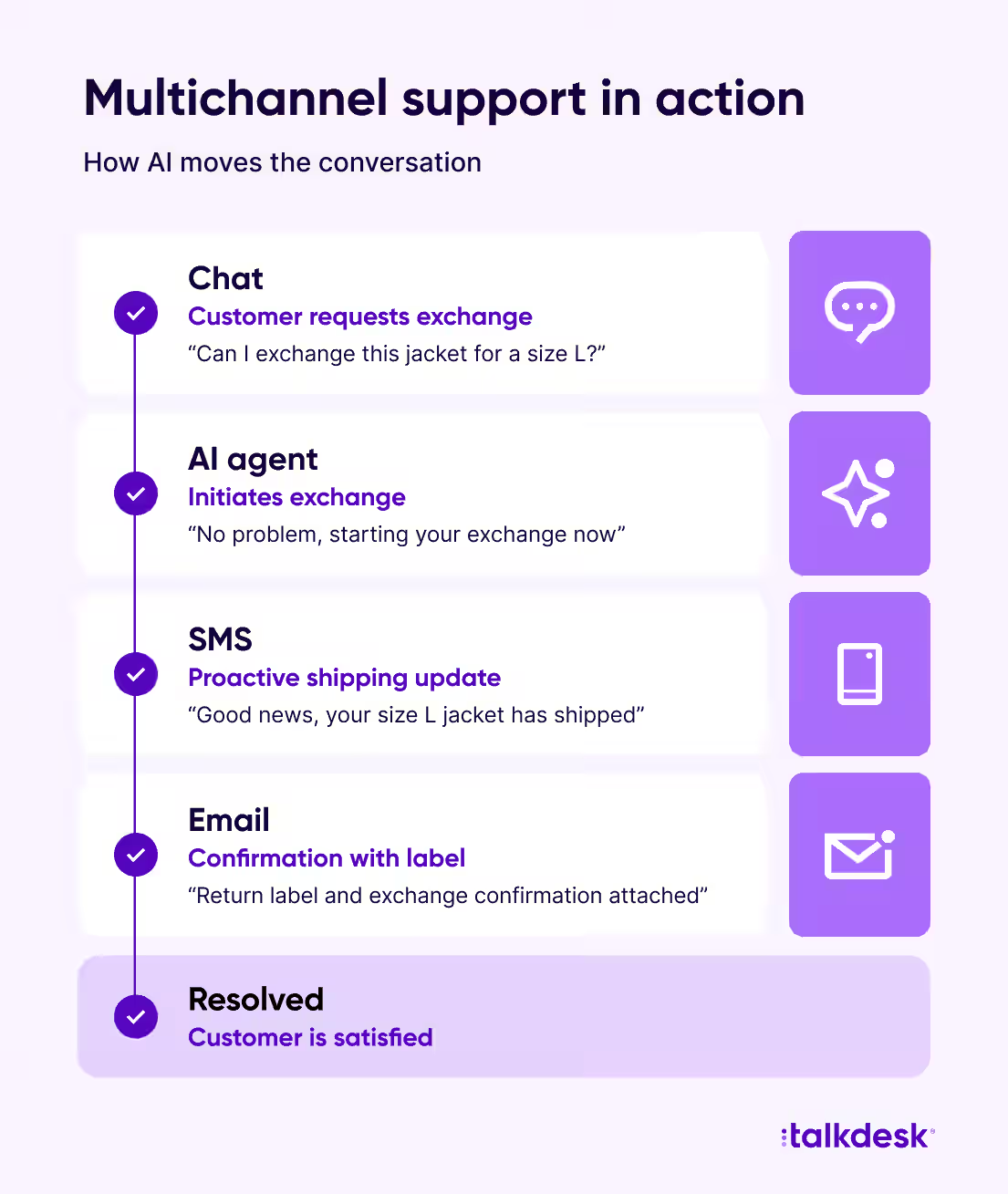
Adapting the conversation. Your AI agent interacts with customers across chat, socials, messaging, and voice. As the conversation moves between channels, it retains context and responds based on everything already discussed.
-
Resolving or escalating. If the AI agent can complete the request, it does. If the customer needs human support, it transfers the conversation to an agent, along with the customer’s history and conversation context.
Deliver better customer experiences with Talkdesk CXA.
Benefits of conversational AI in retail.
Retailers typically need to support two missions: convenience and discovery. Conversational AI helps in both cases by making everyday service interactions faster and creating more personalized shopping experiences for curious shoppers and casual browsers alike.
Some ways that conversational AI can support popular retail customer experience trends are:
-
Faster resolution. Handling routine questions and order updates in real time helps customers complete tasks quickly and reduces wait times.
-
Lower service costs. Automating high-volume inquiries and self-service requests means fewer conversations need a live agent. This, in turn, helps support teams scale more efficiently.
-
Personalized discovery. Using customer preferences alongside real-time inventory data helps recommend the right products and reduce out-of-stock frustration.
-
Consistent conversations across channels. Carrying context across channels means customers don’t have to repeat themselves when they switch channels.
-
24/7 support. Providing automated around-the-clock assistance means customers can get help whenever they need it, while human agents focus on more complex conversations.
Conversational AI in retail: Real-world examples.
Every retail business has a different reason for investing in conversational AI. The following examples show how Talkdesk customers have used conversational AI to expand support channels and deliver faster customer service.
Rocky Brands.
Rocky Brands has been selling footwear and apparel for more than 90 years. As its e-commerce business grew, the company wanted to use conversational AI to expand customer support beyond phone and email without adding complexity.
Instead, its first chat rollout failed within 30 days because agents had to work across multiple disconnected systems. That’s when they turned to Talkdesk. In addition to replacing more than 20 legacy tools with Talkdesk, Rocky Brands rolled out AI-powered agents, Talkdesk Copilot, and AI writing assistance to support both customers and agents.
Together, these changes allowed them to automate 40% of chat interactions, reduce email response times by 70%, and keep abandonment rates below 10% during peak seasons.
Michaels.
For Michaels, one of North America’s largest arts and crafts retailers, the goal with conversational AI was to reduce the cognitive load on agents. Handling a high volume of inquiries across a catalog of more than 40,000 products meant agents spent too much time searching for information and completing post-call work.
So Michaels used Talkdesk Copilot to surface relevant information in real time and automatically summarize calls. This reduced after-call work by 93%, enabling Michaels to maintain high service standards even during peak periods like Black Friday.
What to look for in a conversational AI retail solution.
McKinsey predicts that the next generation of shoppers will raise the bar for retail experiences. They’ll expect convenience for everyday purchases and digital experiences that feel connected.
Not every platform is built to support conversational AI commerce. Here are some capabilities worth looking for in your conversational AI solution.
Looking beyond keywords to intent and sentiment.
Customers don’t always know exactly what they’re looking for. They compare products, ask follow-up questions, change their minds, and sometimes express frustration without saying it directly. That requires understanding customer intent throughout the conversation, then responding based on the customer’s goals and context.
For example, Talkdesk AI Agents use NLP to understand customer intent and sentiment as part of retail-specific AI workflows. Combined with customer and inventory intelligence, the AI agents can personalize interactions and take the next-best action in real time.
Omnichannel shopping experiences.
Customers don’t think in terms of channels. They think in terms of shopping journeys. They might browse online, check availability at a nearby store, ask a question over chat, and complete the purchase in person. Look for conversational AI that supports this journey without losing context or sending customers to different teams.
Talkdesk approaches this by unifying customer engagement and commerce. Retail Experience Cloud connects multiple commerce platforms into a single support experience, while Service Directories help AI agents and chatbots guide shoppers to the right store or specialist based on their location.
Real-time retail intelligence.
Retail experiences depend on reducing search friction. Customers expect answers immediately, whether they’re checking if an item is in stock or seeing if it’s available for store pickup. Meeting those expectations requires access to live business data, so responses reflect current inventory options.
That’s where native integrations make the difference. Talkdesk integrations, for example, connect AI agents to commerce, inventory, POS, and CRM systems, giving the systems the context to answer questions accurately, personalize recommendations, and guide customers towards their next purchase.
Context-aware agent handoffs.
A customer disputing a return or dealing with a complex order may need help from a human agent. Your conversational AI should recognize those moments and transfer the conversation before the experience starts to break down.
Not every conversational AI platform handles handoffs the same way. Some only offer simple AI-to-human agent escalation workflows. Others, like Talkdesk, support more complex commerce orchestration, where specialized AI agents work together behind the scenes before handing the conversation to a human when necessary. This expands the scope of automation, enabling AI agents to handle complex workflows across multiple systems and business processes.
Data privacy and AI guardrails.
Customers need to trust both the answers your AI provides and the way their data is handled. As conversational AI becomes a bigger part of the shopping experience, retail businesses need safeguards that protect customer data, prevent fraud, and ensure that AI behaves consistently and responsibly.
Talkdesk supports this with enterprise security, voice biometric authentication, PCI-compliant payments, and a broad set of security and compliance certifications, including ISO/IEC 42001 for AI governance.
Conversational AI that scales with your retail business.
Every customer conversation has the potential to influence both what they buy and whether they come back. That’s why conversational AI in retail is becoming an integral part of the shopping experience itself.
Talkdesk Retail Experience Cloud helps retailers support by combining retail-specific workflows, live customer and commerce data, and fluid AI-to-human workflows.
See Talkdesk CXA in action.
FAQS.
Traditional chatbots follow predefined rules and work best for simple, predictable queries. Conversational AI, on the other hand, understands natural language and can adapt as the conversation evolves.
That means conversational AI can support complex shopping and service journeys instead of simply answering FAQs.
Depending on how it’s implemented, conversational AI can answer product questions, recommend products, track orders, process returns, schedule appointments, route customers to the right store or specialist, and resolve common support requests. Some platforms can also orchestrate multiple AI agents for advanced service workflows.
The cost depends on the platform, the complexity of your use case, and the systems you need to integrate. Many retailers start with a specific conversational AI use case, such as customer support or order tracking. Once they see measurable value, they can expand to additional use cases and automate more customer interactions.
The easiest way to see whether conversational AI is impacting customer experience is to measure the outcomes customers actually experience. Look at metrics such as customer satisfaction score (CSAT), first contact resolution, customer effort score (CES), and response or resolution times. If conversational AI is working well, customers should get faster, more accurate answers with less effort and fewer escalations to human agents.
Implementation timelines for conversational AI in retail can vary depending on your goals, existing technology, and the amount of integration required. A focused deployment for a single use case can often go live much faster than a broader rollout that spans multiple channels, systems, customer journeys and retail locations.
It depends on the vendor, but most enterprise conversational AI platforms can integrate with your existing retail technology stack. Some offer native integrations with e-commerce, CRM, inventory, and order management systems, while others rely on APIs or custom implementations.
Enterprise conversational AI platforms typically include security and governance features to help protect customer data. When evaluating vendors, look for capabilities such as identity verification, encryption, role-based access controls, compliance certifications, and responsible AI governance.

About Celia Cerdeira
Célia Cerdeira has more than 20 years experience in the contact center industry. She imagines, designs, and brings to life the right content for awesome customer journeys. When she's not writing, you can find her chilling on the beach enjoying a freshly squeezed juice and reading a novel by some of her favorite authors.