What is a customer experience (CX) platform?
A customer experience platform helps enterprises manage and optimize every customer interaction across every channel. Here’s what it includes, how to evaluate your options, and what to look for in a modern CX platform.
14:30 min read
Listen to article
15:05
Key takeaways.
-
A customer experience platform aligns all customer interactions across all channels into a single, connected, intelligent system.
-
The best platforms combine omnichannel communication, self-service, journey mapping, analytics, and AI automation to deliver faster, more personalized service.
-
Choosing the right platform means evaluating AI maturity, scalability, integrations, agent usability, and compliance requirements for your industry.
-
Talkdesk CXA goes beyond traditional CX platforms by deploying specialized AI agents that resolve issues, automate workflows, and orchestrate outcomes end-to-end.
A customer experience (CX) platform is a powerful tool that streamlines workflows, reduces response times, and enhances productivity for agents and organizations. For customers, it translates to quicker resolutions, more personalized interactions, and higher overall satisfaction.
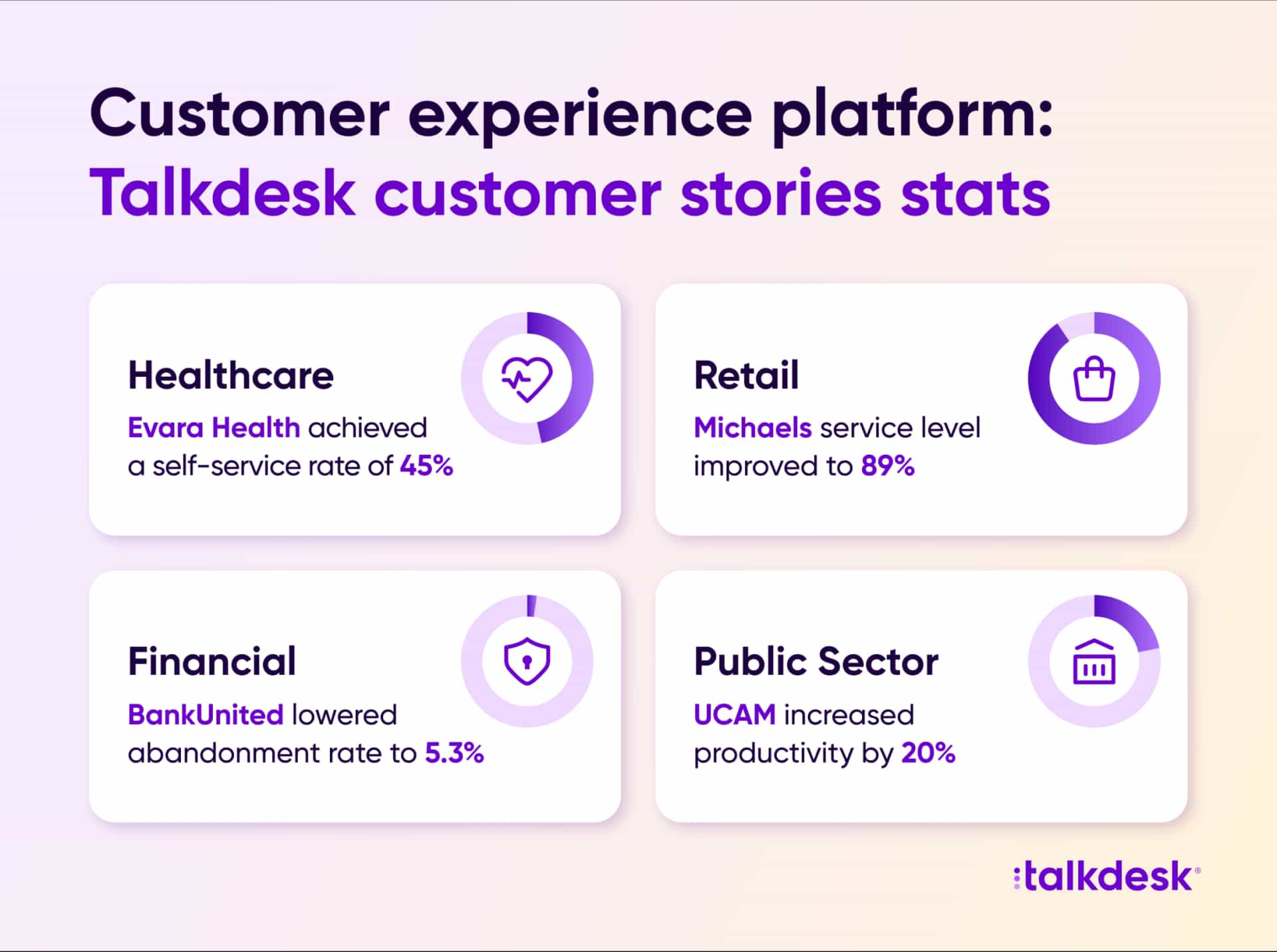
The impact is visible across industries. Talkdesk customers like Municipal Credit Union have achieved a 64% self-service rate, while healthcare systems like Memorial Healthcare System have lowered their abandonment rate by 69% and reduced average handle time by 24%. With Talkdesk CXA, organizations can go further by automating the work behind every interaction.
In this guide, you’ll learn what a customer experience platform includes, what separates a good one from a great one, and how to choose the right fit for your organization.
What is a customer experience platform?
A customer experience platform helps organizations unify every customer interaction across all channels and touchpoints, from in-store experiences to digital. It integrates AI-driven analytics, omnichannel communication, and automation into a single system.
While the core components of a customer experience platform are consistent, usage shifts by industry. Healthcare organizations prioritize streamlining patient interactions, such as appointment scheduling, and contact centers use these processes to reduce wait times and speed up resolution.
Customer experience platforms are evolving beyond managing interactions to orchestrating them through customer experience automation (CXA), using specialized AI agents to automate the work behind every touchpoint:
-
Faster issue resolution across voice and digital channels.
-
Reduced operational costs through automation of routine interactions.
-
Real-time visibility into performance and ROI across every workflow.
AI AGENTS
Meet the AI agents built for your industry.
Pick one, run a pilot in your environment, and prove ROI in 30 to 45 days.
What are the benefits of a customer experience platform?
A customer experience solution gives your organization the tools to deliver faster, smarter, and more consistent service at scale. Key benefits include:
-
Faster resolutions through automated workflows and AI-powered routing.
-
Personalized interactions powered by a unified view of every customer’s history.
-
Omnichannel consistency across phone, chat, email, and social.
-
Lower operational costs through self-service and AI automation.
-
Higher customer satisfaction, reflected in CSAT, NPS, and loyalty metrics.
-
Scalability to meet changing demand without costly infrastructure investment.
-
Actionable insights from real-time analytics that drive continuous improvement.
Core components of a customer experience platform.
The best customer experience platforms share a common set of core components that work together to deliver seamless, intelligent service across the customer journey.
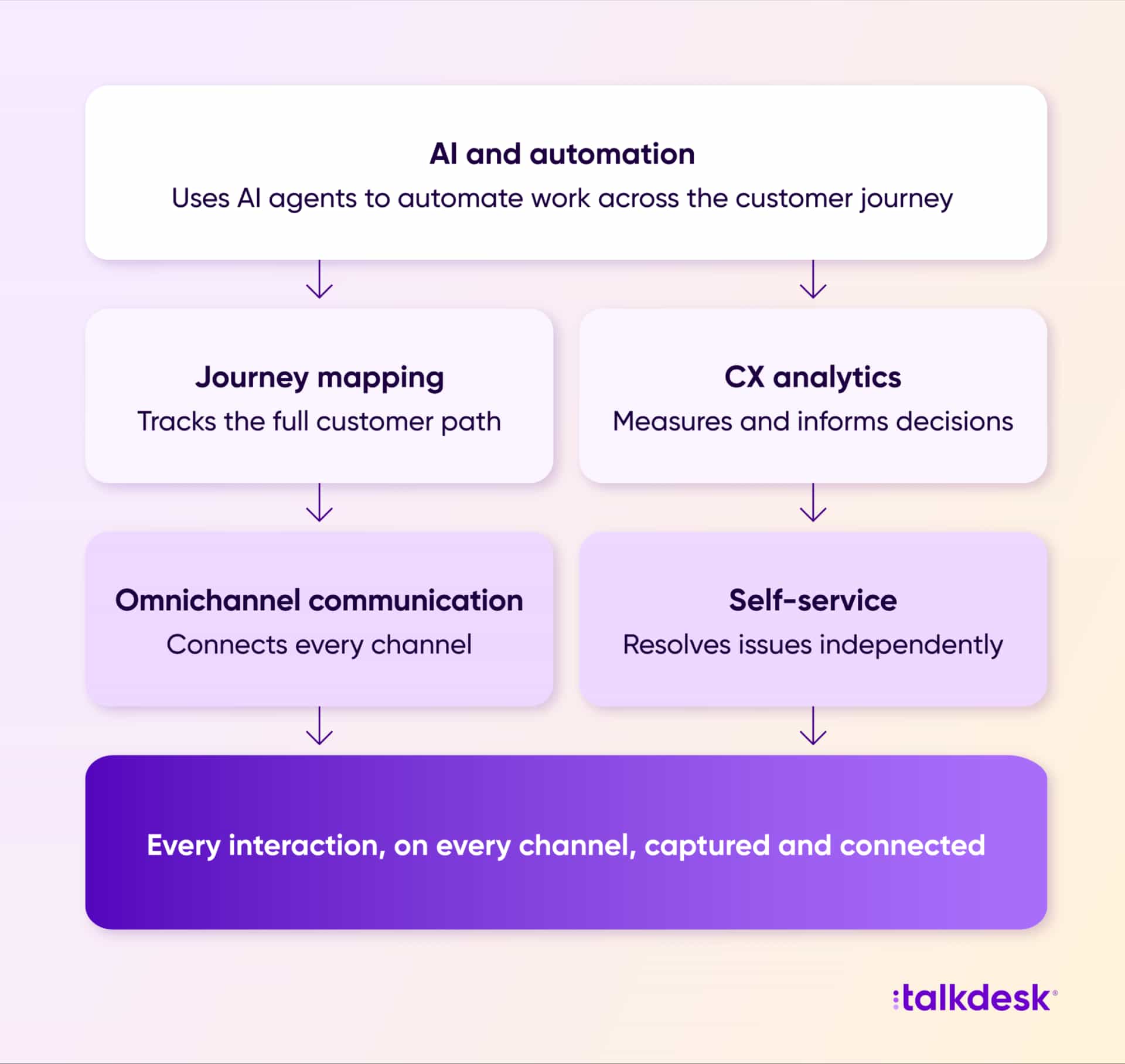
Omnichannel communication.
Phone calls are just one of many ways customers expect to reach you today. Omnichannel communication empowers businesses to meet customers where they are, on their preferred channels, at their preferred times, whether that’s phone, text, social media, email, or live chat.
With this unified approach, businesses can seamlessly pick up conversations whenever a customer switches channels. Agents have a complete real-time view of each customer’s journey, preferences, and history, regardless of how the conversation started.
Talkdesk Copilot takes this further by surfacing real-time context and next-best-action recommendations, so agents can jump straight into the conversation without asking redundant questions.
Self-service features.
Customers need assistance at all times of the day, and they want it quickly. Self-service features empower customers to find answers and resolve issues independently, without waiting for a representative, whether it’s the middle of the night or the peak of the holiday season.
Typical self-service features include knowledge bases, FAQs, and automated workflows that guide customers through troubleshooting steps or common inquiries. AI-powered self-service takes this further. Talkdesk Autopilot instantly responds to every customer query with a two-way natural dialogue across voice and digital channels, handling common inquiries end to end.
Self-service reduces agent workload significantly, freeing your team to focus on complex, high-value interactions and ultimately lowering the cost of service delivery.
Customer journey mapping.
Customer journey mapping helps companies capture and analyze customer interactions, from the first point of contact through the end of the interaction and into any subsequent engagement.
Journey mapping gives organizations a complete view of their customers’ experiences, helping them measure satisfaction, uncover pain points and bottlenecks, and make data-backed improvements. The result is a smoother experience at every touchpoint, including reduced wait times, fewer dropped interactions, and a more connected customer journey overall.
Customer experience analytics.
Customer experience analytics provide contact center teams with actionable insights from customer interactions. This helps to make data-driven decisions that enhance overall CX.
Teams can track key performance indicators, including customer satisfaction score (CSAT), Net Promoter Score (NPS), first contact resolution (FCR) rates, average handle time (AHT), containment rate, and more.
Analytics also help identify trends and potential issues before they escalate. For example, if a product update triggers a spike in contacts or a drop in satisfaction, teams can quickly investigate and address the cause.
CX analytics also enable more personalized interactions by providing insights into individual customer preferences, past behaviors, and potential needs. This helps contact center agents tailor their approach and build stronger relationships.
AI and automation.
AI and automation are core components of any modern customer experience management platform, moving beyond simple chatbots to intelligent systems that actively resolve issues and orchestrate outcomes.
Talkdesk CXA does this through multi-agent orchestration, deploying a network of specialized AI agents that work across systems and channels to complete complex tasks end to end.
Bring AI to every customer interaction.
How to choose the right customer experience platform.
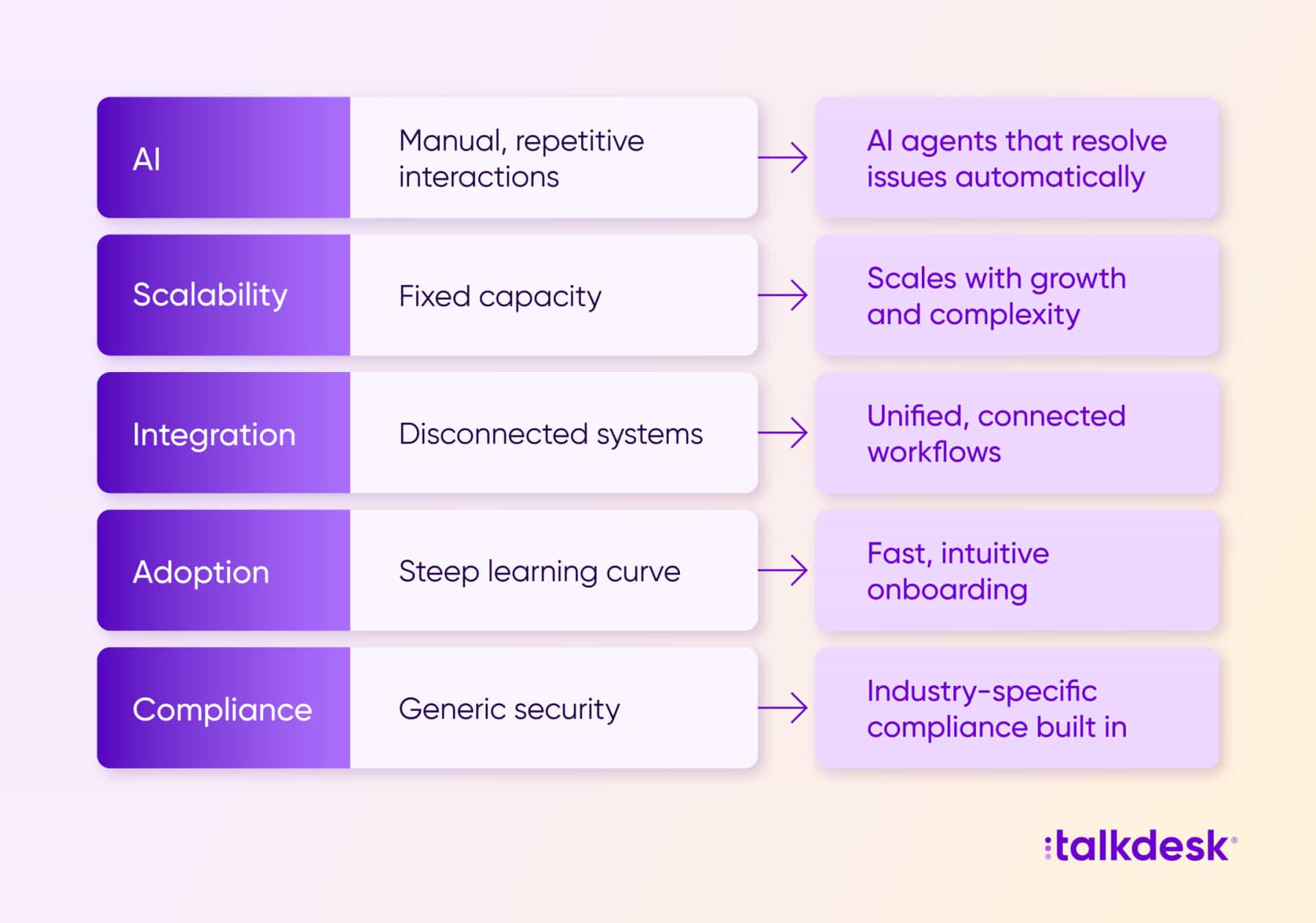
With numerous options available, it’s essential to consider factors like AI capabilities, scalability, integration, ease of use, and security. By evaluating these key elements, you can select a platform that improves customer satisfaction and drives long-term success for your organization.
Look for AI-powered capabilities.
Not all AI-powered platforms are built the same way. Some rely on scripted prompts dressed up as automation to improve customer experience, while others use AI that can actually reason through an issue and act on its own.
Push vendors on three things:
-
Is their AI agentic?
-
Can it coordinate multiple AI agents to solve complex problems?
-
What percentage of issues does it resolve autonomously versus simply deflecting or routing to a human?
Evaluate platform scalability and flexibility.
Businesses are constantly growing and evolving, and their customer experience platform needs to do the same. Cloud-based platforms offer that flexibility, letting businesses scale capacity, add features, and handle spikes in interactions without investing in costly infrastructure upgrades.
But cloud-based alone doesn’t guarantee a platform can handle your specific volume, growth trajectory, or global complexity.
-
Ask vendors what happens at 10x your current volume, not just what the platform supports today.
-
Push on how the platform handles multi-region deployments, language support, and compliance requirements if you operate or plan to operate across borders.
-
Get specific on whether scaling means a seamless backend expansion or a disruptive migration to a higher tier.
Check if the platform integrates with any existing systems.
Organizations should prioritize how well a customer experience platform integrates with their existing systems. Seamless integration with tools like CRM systems eliminates data silos, providing a unified view of the customer journey.
Be specific before you commit. Ask whether the platform integrates natively with the tools you already run, like Salesforce, ServiceNow, or Confluence, or whether it requires custom middleware to connect.
You should also get clarification on what implementation actually requires:
-
A pre-built connector that works out of the box.
-
Weeks of engineering time to get data flowing correctly.
Test if the platform is easy for your agents to use.
Customer experience systems should have an intuitive interface to reduce the learning curve and speed up implementation. A user-friendly interface increases employee adoption rates, ensuring agents use the platform to its full potential rather than working around it.
Ease of use is worth pressure-testing before you sign. Ask questions like:
-
What does onboarding look like for a new agent cohort, and how long does it typically take to reach full proficiency?
-
How does real-time AI agent assist work in practice?
-
What does the learning curve include for supervisors and admins, not just frontline agents?
Confirm the platform meets your industry’s compliance requirements.
Security and compliance are non-negotiable when selecting a customer experience platform, especially in industries where customers are particularly concerned about data protection, such as finance, government, or healthcare. A CX platform should enable an organization to handle sensitive customer information with the utmost care.
Rather than accepting a generic compliance checklist, ask vendors to demonstrate how they meet the specific standards your industry requires:
-
Healthcare: Does the platform meet HIPAA requirements for handling protected health information, and how is that enforced at the data layer, not just in the contract?
-
Financial services: Is the platform PCI-DSS certified, and what does that mean in practice for how cardholder data is handled during a customer interaction?
-
Public sector: Does the platform hold FedRAMP authorization, and at what impact level?
Beyond industry-specific standards, look at the vendor’s own security posture. Ask whether they have a dedicated security team, how frequently they audit their systems, and what certifications they hold.
Calculate the total cost of ownership and ROI.
The sticker price is rarely the real cost. Before committing, factor in implementation time, onboarding, ongoing training, and whether getting full value requires professional services or additional engineering support.
On the return side, get specific. Ask vendors for customer examples that reflect your industry, team size, and use case.
The metrics worth tracking are:
-
Handle time.
-
First contact resolution.
-
Agent utilization.
-
Customer satisfaction scores.
The best vendors will connect their platform’s capabilities directly to improvements in each of these areas.
Transform your customer experience with Talkdesk.
The right AI customer experience platform helps organizations offer seamless interactions across all channels and deliver faster, more personalized experiences that leave a lasting impression.
Talkdesk CXA is a customer experience automation platform that combines agentic AI, omnichannel engagement, workforce management, and real-time analytics in one unified platform. Teams can automate more, resolve faster, and scale without adding complexity.
United Rentals is one example of what that looks like in practice. After deploying Talkdesk CXA across more than 1,400 locations, the company achieved 76% intelligent routing accuracy with Talkdesk Navigator, getting customers to the right agent faster, alongside a 50% reduction in agent training time, delivering consistent, scalable service at enterprise scale.
See what a modern customer experience platform can do for your organization. Request a Talkdesk demo today.
Customer experience platform FAQs.
A customer experience platform (CXP) is a tool that helps businesses manage and improve every interaction with their customers. It brings together data from different channels, like CRMs and analytics tools, to provide insights and streamline workflows.
By using features like real-time feedback, AI recommendations, and automation, a CXP makes it easier to personalize experiences, resolve issues quickly, and build lasting customer relationships.
A customer experience platform (CXP) addresses critical challenges such as data silos, disjointed customer journeys, and inconsistent personalization by centralizing data from marketing, sales, and support into a unified system.
With advanced analytics, CXPs provide a holistic view of the customer journey, helping businesses understand behaviors, anticipate needs, and deliver consistent, tailored experiences.
While both customer experience platforms (CXPs) and CRM tools focus on improving customer interactions, they serve different purposes. A CRM primarily manages customer data, tracks sales pipelines, and supports relationship-building.
A CXP goes further. It integrates analytics, AI, and automation to deliver personalized, seamless experiences across all touchpoints, with a focus on real-time insights and optimizing the entire customer lifecycle, not just managing relationships.
Customer experience automation platforms make it easier for businesses to connect with their customers. By centralizing data and offering real-time insights, they help companies better understand customer needs and behaviors.
These platforms also boost satisfaction by enabling personalized interactions across channels. Automation handles repetitive tasks, freeing your team to focus on delivering top-tier support. Plus, these platforms allow for consistent communication, so a brand always feels unified and trustworthy.
The cost of a customer experience platform varies widely depending on the features, scalability, and provider. Factors like the number of users, integration capabilities, and advanced features like AI or real-time analytics can influence costs.
Some platforms offer tiered pricing, allowing businesses to start small and scale as needed. Additional expenses, such as onboarding, customization, or ongoing support, may also apply.

About Celia Cerdeira
Célia Cerdeira has more than 20 years experience in the contact center industry. She imagines, designs, and brings to life the right content for awesome customer journeys. When she's not writing, you can find her chilling on the beach enjoying a freshly squeezed juice and reading a novel by some of her favorite authors.