How does low-code workflow automation drive enterprise business processes

By Rui Biscaia
0 min read
In the last couple of years, organizations have invested heavily in automation and AI to improve customer experience. Intelligent routing, virtual assistants, and workflow automation are now widely deployed, allowing interactions to be handled more quickly and efficiently than ever before.
Today, building a workflow is rarely the obstacle. Low-code workflow automation tools and no-code workflow automation platforms have democratized process design. Business teams can model logic visually, and IT can expose systems securely. Changes are deployed in days, rather than quarters, and automation is now expected infrastructure. However, as automation capabilities have expanded, so has the complexity beneath them. The challenge is no longer how to start a workflow; it’s how to carry it through.
Interactions are immediate, but enterprise business processes are not. And the architectural layer required to manage that difference is becoming a strategic priority for modern enterprises.
The real question behind “What is workflow orchestration?”
The industry often asks, “What is workflow orchestration?” The better question is: what problem is it solving?
Automation connects systems, and orchestration governs execution. In most environments, teams design workflows around events. A customer submits a request, the system updates a record, and a notification goes out. Clear logic drives an immediate action, and the process ends. This model works well for immediate, transactional tasks, but in enterprise operations, interactions are rarely isolated events.
Approvals introduce delays, compliance checks require external validation, and dependencies span CRM systems, billing engines, identity providers, and third-party services. A process may begin in one channel and end in another days later.
Orchestration supports workflows to persist, adapt, and progress over time. It coordinates triggers, logic, and system actions while maintaining the state. It allows a process to pause, branch, resume, and evolve without losing continuity.
This is the shift from event handling to lifecycle management.
Connecting those systems is complex, but connecting them is not enough. Work must move coherently across them, especially when dealing with proportional complexity and even more so when it unfolds over extended durations. Workflow orchestration tools exist to manage that coherence.
Designing for processes that don’t behave linearly.
When workflows can span across systems and timeframes, execution can’t sit quietly in the background.
Consider a mortgage refinancing journey. A customer receives an outbound email about rate changes and calls to explore options. An AI agent handles the request, pulls payment history from backend systems, and triggers a follow-up SMS. The customer submits the required documentation, while compliance runs validation asynchronously. Underwriting then reviews the file and makes a decision. Finally, the platform notifies the customer and updates the CRM and loan systems to move the operation to any other needed dimensions of the business.
From the outside, this feels like a single experience. Underneath, it is a multi-step, multi-system, long-running process with dependencies, conditional branching, and data synchronization requirements.
Without a dedicated orchestration layer, pieces of the process live in different places—a status update in one system, decision logic in another, conditional rules buried inside separate automations. Over time, fragmentation introduces friction. Continuity depends on loosely connected components behaving flawlessly under changing conditions. A small adjustment in one environment can ripple unpredictably across others.
The real shift is architectural. Orchestration transforms automation from a collection of connected events into a governed lifecycle with state, traceability, and control. Instead of reacting to isolated triggers, the system manages progression from initiation through resolution as a coherent whole. In mature enterprise architectures, orchestration becomes the control plane for automation—the layer that enforces consistency, governance, and continuity across systems.
This is what allows workflows to pause, branch, resume, and complete without losing integrity, even as complexity increases.
Governance to enable growth.
As no-code workflow automation becomes more accessible, teams iterate quickly, and process variations multiply. This agility is valuable, but without structure, it introduces fragility. Scaling safely requires more than speed.
-
IT leaders need testing before deployment, version control over time, and observability into live execution. Changes can’t destabilize active flows, and troubleshooting can’t require tracing logic across disconnected tools.
-
CX leaders face a similar issue. Customers measure experience by resolution, not response speed. Engagement must align with backend completion, and status updates must reflect actual progress, not isolated events.
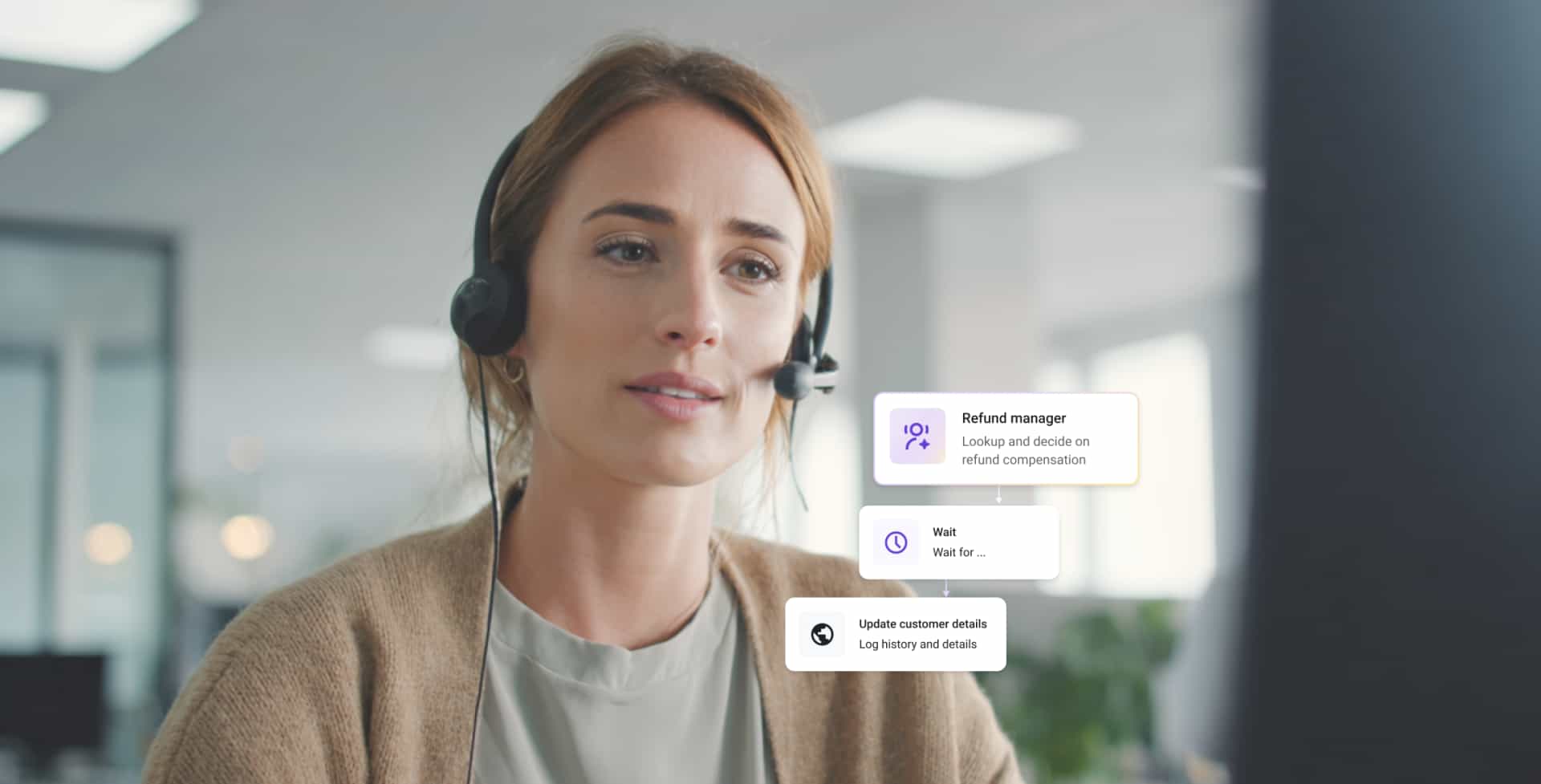
Automation Flows addresses this architectural gap not by adding more automation, but by centralizing execution into a governed layer. It enables multi-step processes triggered by customer interactions to execute reliably across backend systems, supporting both agentic AI and traditional event-driven automation.
Teams can test workflows before release, manage versions as processes evolve, and leverage AI-assisted flow creation to accelerate design while maintaining control. Long-running processes unfold predictably, even as conditions change.
The cost of scaling automation.
The expansion of automation across systems and teams increases complexity. When organizations rely on simple, point-to-point integrations, logic becomes fragmented. A single customer journey might be powered by five different tools, each holding a different piece of the “truth.”
If a business rule changes, teams must hunt down and update every disconnected automation rule, creating a massive surface area for operational risk and architectural drift.
The challenge isn’t visibility into individual steps; it’s confidence in the entire journey.
Instead of managing a web of triggers across disparate systems, orchestration centralizes execution into a unified lifecycle. This “single pane of glass” for execution reduces logic debt, enables safe iteration, and preserves architectural integrity as automation scales.
From automation to outcomes.
AI and automation investments are accelerating across industries. As organizations embed intelligence into customer journeys, recommendations and decisions become faster and more personalized. Low-code workflow automation improves build velocity. Workflow orchestration ensures business outcomes.
Automation Flows serves as the execution backbone within the Talkdesk CXA (Customer Experience Automation) platform. Interactions can start, pause, or resume flows based on backend progress. Processes carry forward across minutes, days, or weeks without manual intervention. Customers engage once outcomes are secured, not simply when workflows start, making execution outcome-driven rather than event-driven.
Leading organizations won’t be those deploying the most common or standard automations but those ensuring every initiated process reaches completion reliably, visibly, and at scale.
From execution to advantage.
As automation becomes infrastructure, the differentiator shifts to how consistently processes move from initiation to resolution. Automation Flows brings orchestration into the core of customer experience operations, providing a governed foundation for long-running, cross-system execution. It enables organizations to design processes as they truly operate—across time, systems, and conditions—without sacrificing control or agility. For leaders focused on delivering measurable business outcomes, the next step is not more automation, but better execution.
That is the evolution from workflow automation to workflow orchestration—and it is redefining how enterprises design, scale, and measure customer experience.
Learn more about Automation Flows and how orchestration supports customer experience automation at scale.