Build trust and improve answer rates with enterprise call authentication
Have you ever received a call from an unknown number on your phone? What’s your first reaction when you see it? Skepticism, frustration?
08:32 min read
Listen to article
09:32
I generally feel both, especially with the sheer volume of these calls I receive per day. The modern public switched telephone network (PSTN) faces a massive trust deficit. Due to a surge in illegal spoofing and robocalls, carriers and analytics engines have implemented aggressive automated spam-filtering algorithms.
Consequently, 86% of unknown calls go unanswered and 73% of surveyed individuals assume that an unknown caller is a robocall or an unwanted sales pitch. Malicious parties pretend to be our bank, a logistics company, our healthcare provider, or they simply want to sell us something we’re not interested in. So we don’t answer phone calls. What’s the flipside? We miss legitimate calls we need to receive. That follow-up to a doctor’s appointment last week, or the technician calling us from the utility company we hired. Both businesses and people miss an opportunity when a legitimate phone call isn’t answered.
There are a handful of frameworks active today to attempt to solve this problem, with low to moderate success rates.
Why existing call authentication methods aren’t enough.
Caller name delivery (CNAM) and STIR/SHAKEN help establish trust in voice calls, but neither provides the complete picture recipients need.
Caller name delivery (CNAM) provides limited context.
Caller name delivery provides the name of the calling party in a phone call. CNAM allows businesses to add the name of the calling party independently while they place a phone call to a destination. It is the responsibility of the terminating carrier to retrieve the name of the caller by contacting and looking up the CNAM database of the originating carrier. Additionally, CNAM is only displayed if the recipient has enabled the CNAM feature on their phone through their carrier.
While CNAM is a step in the right direction, it has its problems. First, it relies on a database of names maintained by the originating carrier. There is no standard database across carriers or a central database that a terminating carrier could look up. This introduces incorrect or outdated caller name information if the originating carrier doesn’t update its database or the terminating carrier doesn’t look up the name correctly.
Second, CNAM only delivers the name. There is no mechanism to deliver rich call data (RCD) such as the business’ logo, picture or the reason for calling. RCD provides data, establishing greater legitimacy.
STIR/SHAKEN verifies the number, not the business context.
Secure telephone identity revisited (STIR) and signature-based handling of asserted information using tokens (SHAKEN) are two industry frameworks that have been defined by the IETF and ATIS over the last few years to combat spoofing and increase trust in public telephone networks. The frameworks contain a set of well-defined protocols to indicate ownership of phone numbers. The frameworks were built to work with session initiation protocol (SIP) which is the primary protocol used by carriers to route calls within their networks.
Despite the introduction of these frameworks and strong adoption within the United States over the last 5 years, there are still problems with public telephone identity.
While STIR/SHAKEN works on SIP, which is used by carriers globally, it does not extend to over the top (OTT) networks such as WhatsApp or Skype that provide calling services over the internet. Waiting for each of these services to work with STIR/SHAKEN will lead to a significant delay.
STIR/SHAKEN is not a standard across the world. It has been primarily adopted in North America thanks to the FCC’s mandate in 2020 and other developments like the US certificate authority framework (STI-PA/STI-CA). Due to this, the frameworks help cut down on spam calls domestically, but can’t apply the same restrictions to international calls.
The attestation information is lost when a call transitions through a legacy public telephone network between two carriers that support STIR/SHAKEN. As legacy networks can’t adapt to the new framework, this leaves gaps in the implementation in end-to-end flows.
Add identity and purpose to authenticated calls.
Enterprise call authentication is an out-of-band mechanism that allows a VoIP service provider to authenticate outbound calls before routing them to their destination. Today, there are two methods to achieve this: using an API or SIP.
A VoIP service, such as the one provided by Talkdesk, sends an envelope with the calling and called phone numbers to a call authentication vendor such as First Orion, TNS, or TransUnion. These vendors are responsible for depositing the envelope securely to the terminating carrier.
The VoIP service routes the call to the destination once it receives a response from the vendor. When the call reaches the terminating carrier, the carrier is already aware of the call. With this knowledge, the terminating carrier is able to make a decision to either display RCD or label the call as spam, and even block the call from reaching the recipient. The vendors offer services on top of call authentication such as branded logo delivery, spoof protection for authenticated numbers as well as reputation monitoring. Businesses choose the service on their phone number range based on their needs.
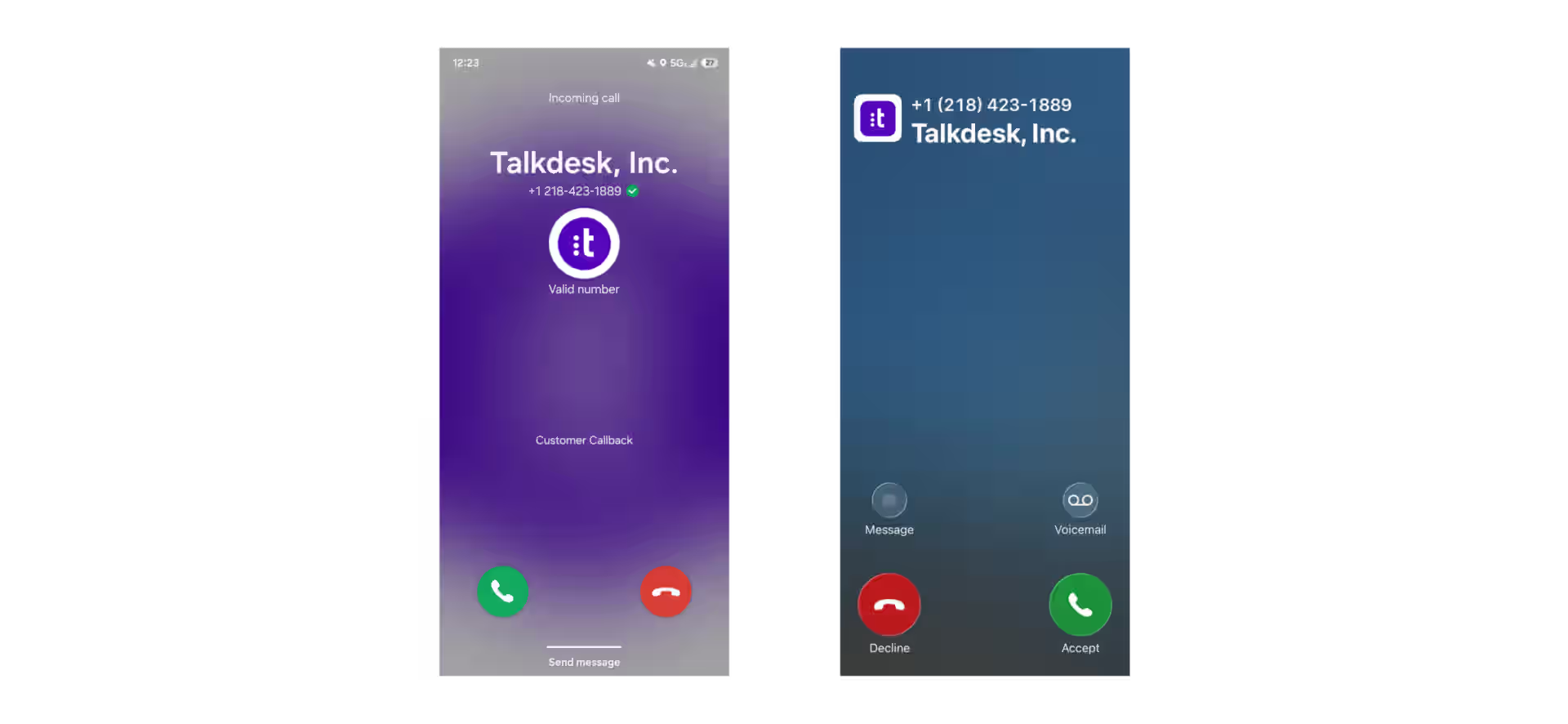
Enterprise call authentication is driven by commercial partnerships, not open standards. Each vendor partners with carriers as well as MVNOs within a given country. The vendors maintain commercial partnerships with each other to boost coverage across as many recipients as possible. They also collaborate with OEMs to ensure that brand names, logos, and call reasons render seamlessly across every major smartphone brand. Before any of this data reaches a consumer endpoint, the vendors conduct thorough vetting to verify the legitimacy of each business.
Does enterprise call authentication replace STIR/SHAKEN?
No. The two operate at different layers and solve different parts of the problem.
-
STIR/SHAKEN answers the question: is this caller entitled to use this number? It does that in-band, cryptographically, as the call traverses the network, and it produces an attestation level that the terminating carrier can act on.
-
Enterprise call authentication answers a different question: who is this, and why are they calling? It carries no proof of number ownership on its own.
In practice, they reinforce each other rather than compete. A call that arrives with full attestation and a registered brand record is far more likely to be rendered with a name and logo than one that arrives with partial or gateway attestation. Weak attestation, or a number carrying poor reputation history, can cause branding to be suppressed even when the business has paid for it. The out-of-band envelope tells the carrier what to display; the in-band signature is part of what convinces the carrier to display it at all.
Branded calling is not a shortcut around telephony hygiene. Number ownership, attestation, and reputation still need to be in order. Enterprise call authentication makes a trustworthy call recognizable; it does not make an untrustworthy one credible.
What enterprise call authentication can’t fix.
Answer rates will not increase if the underlying reason for the call is poor. Displaying a logo on an unwanted call may accelerate brand damage rather than prevent it. Low reputation phone numbers will still be marked as Spam unless the business changes its behavior.
Turn more outbound calls into answered conversations.
78% of US adults would be more willing to answer a call if the name and logo of a brand they recognize appear on their incoming screen. If you operate in the United States or Canada, here is how to take advantage of branded calling:
-
Analyze and identify use cases within your business processes that could drive up revenue with higher call answer rates.
-
Identify a team and a specific set of phone numbers that you’d like to pilot branded calling with.
-
Choose one of the authentication vendors currently operating in the United States/Canada. Identify the services that you’d like to enable on these phone numbers such as branded calling with logo and caller-ID spoofing protection.
-
Use monitoring services from these vendors to track line health as you start the program.
Enterprise call authentication is already expanding to other regions, such as Canada, UK, and other parts of Europe.
Ready to fix your outbound call delivery? Talkdesk Trusted Calling is currently available in Preview for select accounts in the United States. Learn more about Talkdesk Trusted Calling and how it can help legitimate outbound calls earn trust before the conversation begins.

About Sreekanth Narayanan
Sreekanth Narayanan is a principal product manager for the global communications network at Talkdesk, where he owns the products built directly on the voice layer: carrier connectivity (BYOC), emergency services routing, and CXA Standalone. He brings 15 years in VoIP and SIP engineering to the problems that surface at carrier scale; interoperability across carrier boundaries, failover, and call quality under load.