AI in customer service: The ultimate guide
AI in customer service handles repetitive requests, giving agents more time to focus on customers who need their expertise. Here’s how it works, what it delivers, and how to roll it out.
16:31 min read
Your customers expect not to repeat themselves when they’re transferred between agents and to have their issues resolved quickly, anytime, and on their preferred channels. Meeting those expectations is what defines great customer service. But delivering great service is challenging when contact volume grows faster than headcount and customer context is scattered across systems.
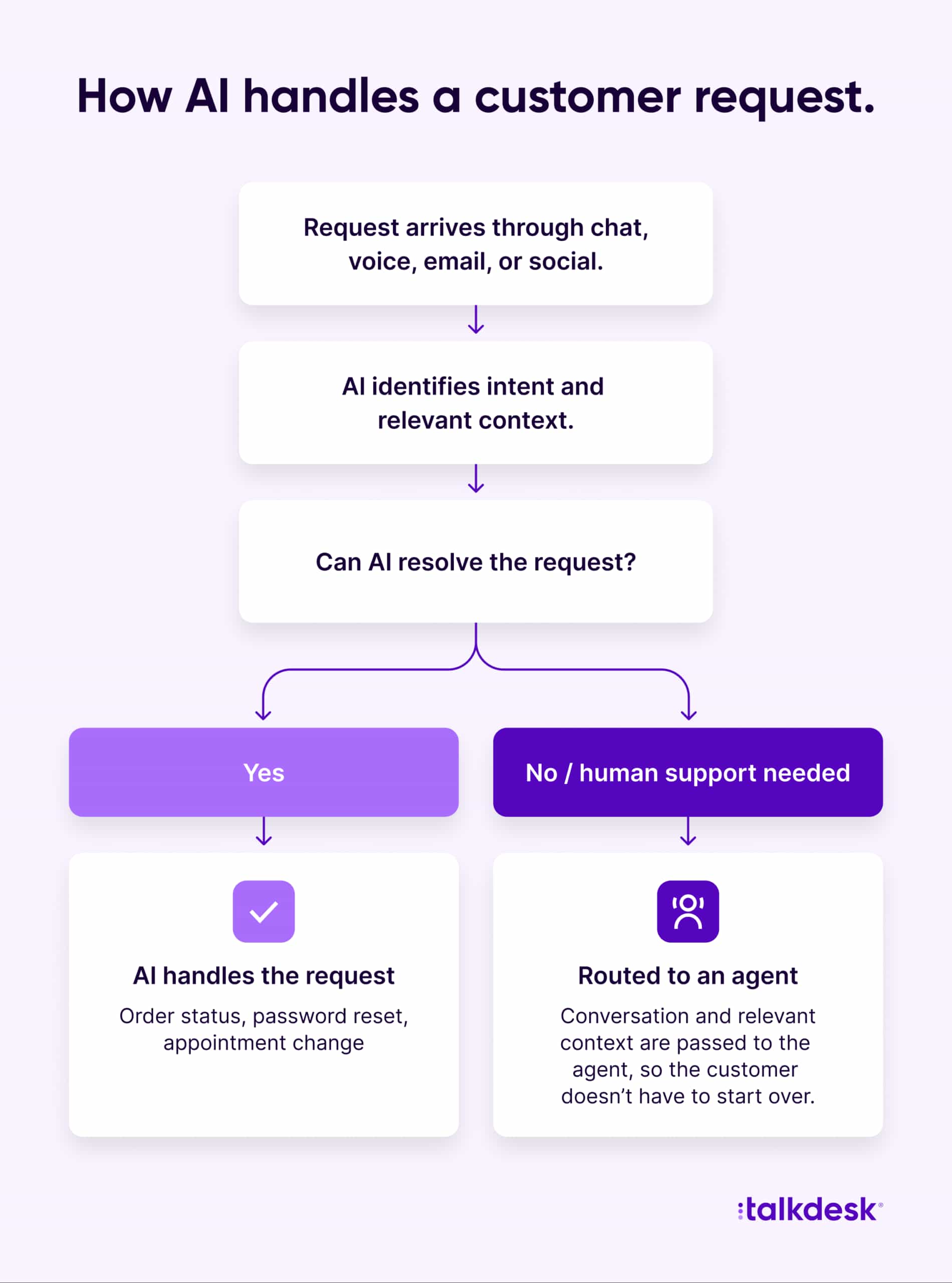
AI in customer service resolves the routine requests, freeing agents for the ones that need human input. It reads customer data in real time and acts on it, handing off anything complex with full context attached. That’s how BankUnited brought its abandonment rate down to 5.3%.
Here’s how AI in customer service works, what it delivers, the tools behind it, and how to put it to work across your customer experience strategy.
Take the next step with AI in customer service.
Organizations leading in customer experience automation are 4x more likely to report major CSAT and NPS gains. Discover what sets them apart.
What is AI in customer service?
AI in customer service is the use of agentic AI, machine learning, and automation to understand customer requests and respond to them faster.
AI tools anticipate needs based on past behavior and resolve requests on their own, helping support teams work more efficiently. Whether it’s an AI agent answering a simple question or a system analyzing customer sentiment to escalate a conversation to a human agent, AI improves both speed and quality of service.
As part of a hybrid workforce, AI automates repetitive tasks (like ticket tagging or pulling up order details), freeing agents to focus on more complex, meaningful conversations. It also ensures that customers are connected to the right resources faster, reducing wait times and frustration.
Eight ways that AI powers customer service.
AI helps you meet rising customer expectations for fast, personalized service while reducing the burden on your agents. Here are eight ways that agentic AI is already enhancing customer support.
-
AI generates summaries to reduce post-interaction work. Instead of typing notes after every call, agents receive a concise summary. Documentation and handle time drops, and customer records stay consistent.
-
AI analyzes customer sentiment. Speech analytics reads tone, language, and behavioral cues across channels to reveal customer mood in the moment. When someone’s patience runs out, the conversation escalates to a human or the automated tone adjusts.
-
AI gives virtual agents conversational context. AI agents manage conversations by drawing on context, history, and intent. If a customer’s issue changes mid-conversation, AI pivots with it.
-
AI responds to customer reviews. Review platforms get monitored for new feedback, and a timely response goes out before anyone on your team notices it posted.
-
AI powers knowledge bases. Gaps get identified, outdated content gets updated, and the right article surfaces during live interactions.
-
AI informs training materials for agents. Performance data shows where agents are struggling, then AI assigns microlearning, updates onboarding tracks, and simulates coaching conversations without a manager stepping in.
-
AI resolves requests before they reach an agent. Self-service lets customers handle things like order tracking or appointment changes on their own.
-
AI forecasts volume and staffing needs. Interaction patterns and seasonal spikes are read automatically and worked into staffing plans.
While AI handles routine tasks well, many customers still want the option to speak with a live agent when an issue is complex or sensitive. Automating repetitive interactions reduces agent workload and wait times, making it easier for your team to deliver human-to-human service where it matters most.
Evaluate AI in CX. Build the case for action.
Compare AI approaches, tie them to business outcomes, and get from pilot to ROI.
Benefits of AI for customer service.
AI-powered customer service changes what your team can handle, from reducing after call work to routing customers to the right place. Here are the benefits that matter most to customer service operations.
-
Lower cost to serve. AI resolves requests alongside your team, so you handle more without a matching increase in cost.
-
Capacity that flexes with demand. When volume surges, AI virtual agents take the overflow instead of your team working overtime.
-
Serve every channel consistently. Customers reach out by chat, phone, social, or email, and get consistent, personalized support every time. AI is what makes omnichannel customer experience possible.
AI customer service solutions and tools.
A customer service AI stack usually means more than one tool, and how well those tools share data matters as much as what each one can do on its own.
Which pieces you need depends on your channel mix, but a customer who explains a problem in chat shouldn’t have to explain it again when they call. That handoff is what omnichannel engagement covers. Here’s what each category handles and where it fits.
| Tool category | What it does | Common use cases |
|---|---|---|
Resolves customer requests across chat and voice without an agent. | High-volume, routine inquiries. | |
Reads intent and directs requests to the right agent or self-service path. | Operations with complex skill-based staffing. | |
Detects tone and emotion in real time. | Escalation triage and quality monitoring. | |
Surfaces relevant answers during live interactions. | Technical support and detailed product questions. | |
Forecasts volume and builds schedules against it. | Teams managing seasonal or unpredictable demand. |
How to implement AI in customer service.
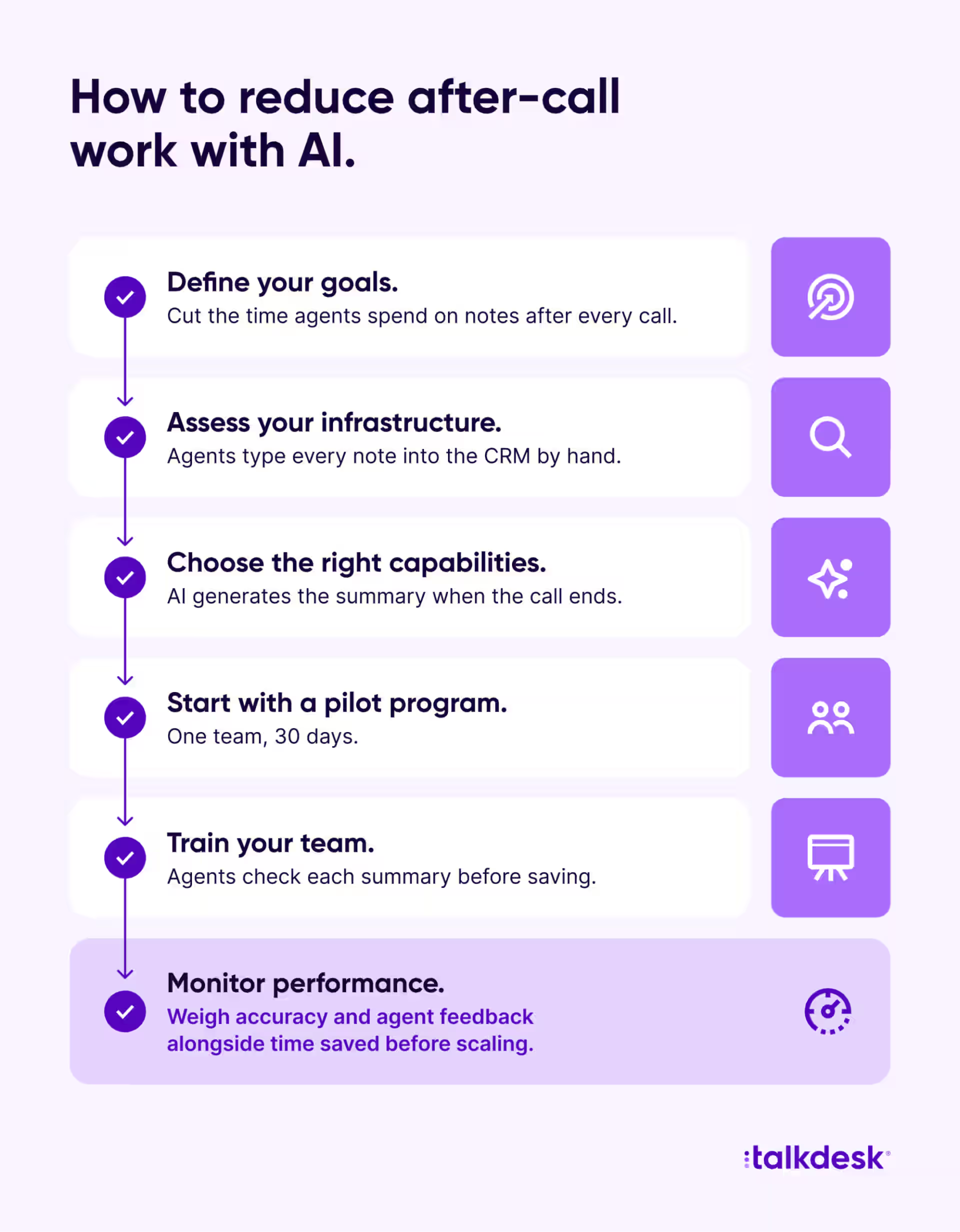
A successful rollout starts small and scales on evidence. Once you know where AI fits, here’s the sequence for getting it live.
-
Define goals. Start by identifying the key pain points or opportunities in a customer service operation. Whether the objective is to reduce wait times, enhance self-service, lower operational costs, or improve customer satisfaction, clearly defined goals will guide the AI strategy and provide benchmarks for measuring success.
-
Assess the current CX infrastructure. Businesses should take stock of their existing tools, workflows, and data systems. It’s important to consider how AI can integrate with current platforms, including CRM systems, knowledge bases, and communication channels to enhance performance without disrupting core processes.
-
Choose the right AI capabilities. Selecting the most appropriate AI tools depends on a business’s goals whether that’s improving response times, enhancing customer satisfaction, or streamlining support operations. Technologies like virtual agents, sentiment analysis, and knowledge management automation can help achieve those outcomes.
-
Start with a pilot program. Begin small by applying AI to a specific use case, such as automating post-call summaries. A controlled pilot can help businesses evaluate impact, gather feedback, and make adjustments before a full rollout.
-
Train the team. Ensure agents, supervisors, and admins understand how AI tools work and how they’ll support their roles. Training and change management are essential to adoption and long-term success.
-
Monitor performance and feedback. Use analytics dashboards and agent/customer feedback to track performance. Keep an eye on key performance indicators (KPIs) like handle time, resolution rate, and customer satisfaction to see how AI impacts service.
Examples of AI in customer service.
AI can enhance customer service regardless of industry. Here are a few examples, some with results from Talkdesk customers who implemented our AI solutions.
Empower autonomous decision-making with AI agents.
AI agents observe, analyze, and act based on conditions and context. Whether they’re prioritizing incoming support tickets, deciding when to escalate, or selecting the right self-service content, agentic AI removes the delays that come from waiting on a person.
One example of this is Memorial Healthcare System, which uses Talkdesk Autopilot to autonomously handle appointment confirmations, cancellations, and rescheduling. AI now resolves 67% of inbound scheduling calls without human intervention, freeing staff to focus on more complex patient needs.
Those agents can also be chained together. One detects a drop in customer sentiment during a live chat, another escalates to a human agent, and a third drafts a follow-up email or logs a case. The workflows learn as they run, so decisions improve over time.
Forecast, schedule and assign agents with AI-powered workforce management.
Workforce management is a balancing act of the right number of agents, timing, and the right skills. Talkdesk Workforce Management analyzes historical trends, including seasonal spikes, volume patterns, and year-over-year changes, to forecast staffing needs instead of leaving you to crunch the numbers manually.
From there, AI builds the schedule, factoring in agent availability, skills, contract requirements, and calendar conflicts. It also handles the harder part: matching agents to the tasks their experience and performance suit them for. The result is a smoother operation and better coverage during your busiest hours.
Strengthen your knowledge base.
With AI, your team doesn’t have to sift through documentation or guess which article fits a customer’s issue. AI delivers context-relevant answers directly to agents or customers based on the intent behind the question, past interactions, or current context. Talkdesk Knowledge Creator lets you publish AI-generated answer cards instantly or author them manually, with routing rules that send the right information to the right team.
AI also consolidates what’s scattered. Knowledge base connectors unify content from third-party platforms into one system, eliminating silos so agents and AI systems can find accurate information fast. Talkdesk Knowledge Management converts uploaded FAQ files into usable answer cards, expanding your content library without the manual work.
Improve the efficiency, scale, and quality of customer feedback.
AI turns customer feedback collection from a manual process into a continuous loop. It generates personalized survey questions based on a customer’s recent interactions, purchase history, or support journey, then automates deployment across channels so surveys land at the right moment.
On the analysis side, AI processes survey data and unstructured feedback to identify trends, pain points, and emerging opportunities. It surfaces customer satisfaction score (CSAT), Net Promoter Score (NPS), and customer effort score (CES), then uses sentiment analysis and natural language processing to explain the why behind each one.
Provide real-time agent assistance.
AI-powered live assistance gives every agent an expert beside them. Rather than pausing to search for information or escalate a case, agents get real-time support mid-conversation. AI listens, reads the context, and suggests next steps so agents respond quickly and accurately. That’s the shift Michaels made with Talkdesk Copilot, giving agents better tools for managing customer interactions. Service levels improved from 20% to 89% year over year.
Real-time guidance reduces average handle time (AHT), raises first contact resolution (FCR), and makes expert-level knowledge available to your whole team, not just your most tenured agents.
Exploring the future of AI in customer service.
AI already handles the customer service tasks covered above. What changes next is the level of autonomy, as AI takes on more work without requiring manual prompts at every step.
-
Multi-agent orchestration. Chains of AI agents hand work between themselves, so a sentiment drop triggers an escalation, a case log, and a follow-up with no one routing between steps.
-
Anticipatory service. AI reads account signals and reaches out before the customer does, whether that’s a failed payment, a lapsing warranty, or a usage pattern that predicts a support call.
-
QA that covers AI interactions. As more conversations run without a human involved, scoring and coaching extend to automated agents, holding both to the same standard.
-
Voice catching up to chat. Voice models are closing the gap on accents, noise, and interruptions, opening up the channel where most complex service still happens.
Improve your customer service with Talkdesk CXA.
Your customers already expect faster resolutions, consistent answers across channels, and agents who know their context before the conversation starts. A hybrid workforce makes that possible, with AI agents and human agents working as one connected team.
Talkdesk Customer Experience Automation (CXA) and Talkdesk CCaaS put that to work. Deploy AI customer service agents to resolve requests on their own and hand off the ones that need a human, with full context attached.
See Talkdesk CXA in action.
AI customer service FAQs.
AI in customer service is the use of agentic AI, machine learning, and customer experience automation to understand customer requests and respond to them faster. It resolves routine requests on its own and routes the rest to an agent with full context attached, so customers wait less and agents spend their time where judgment matters.
AI should support human agents rather than replace them at the center of customer interactions. By automating administrative tasks such as data collection and routine problem-solving, AI allows agents to focus on complex issues like escalated complaints or billing disputes. This balance improves both operational efficiency and customer satisfaction.
AI brings major benefits to customer service by making it faster, more efficient, and cost-effective. It helps support teams manage more inquiries by automating repetitive tasks, delivering real-time assistance, and tailoring training to each agent’s needs. Plus, with 24/7 coverage across all channels, customers can get help whenever they need it.
No, AI is designed to enhance, not replace human agents. While AI can handle repetitive tasks and automate simple interactions, customers still prefer human support for complex or sensitive issues.
AI makes agents more effective by acting like a smart assistant during every interaction. It can surface the right information in real time, suggest next best actions, and summarize previous conversations so agents have full context without digging through records. It also handles repetitive tasks like logging notes or tagging tickets, freeing agents to focus on complex, high-value conversations.
You should start by identifying key areas where AI can make the biggest impact, like automating repetitive tasks, improving self-service, or supporting agents in live conversations. From there, you can roll out AI tools gradually, beginning with a small pilot before expanding. It’s also important for AI to integrate well with your existing systems like CRMs and knowledge bases. Most importantly, train your team to work alongside AI, so it enhances their performance rather than disrupts it.
The best AI tools for customer service are those that help teams work more efficiently while improving the customer experience. From virtual agents to knowledge base automation and real-time agent assistance, these tools can simplify support, reduce wait times, and personalize every interaction. Talkdesk offers an AI-powered CX platform that brings all of these capabilities together, helping businesses deliver faster, smarter support.
AI will shape the future of customer service by making the job of human agents easier. By taking care of repetitive tasks, offering real-time insights, and helping with decision-making, AI gives agents more time to focus on what they do best: helping people. As agentic AI evolves, businesses will be able to automate even more complex workflows, predict what customers need before they ask, and deliver support across every channel without missing a beat.

About Celia Cerdeira
Célia Cerdeira has more than 20 years experience in the contact center industry. She imagines, designs, and brings to life the right content for awesome customer journeys. When she's not writing, you can find her chilling on the beach enjoying a freshly squeezed juice and reading a novel by some of her favorite authors.