What is an omnichannel contact center? Benefits and features
An omnichannel contact center unifies phone, email, chat, SMS, and social into a single system where customer context follows the conversation across every channel.
11:58 min read
Listen to article
11:27
Most of us still remember when reaching customer service meant calling the toll-free number and hoping the agent who picked up the call could solve the issue. If they couldn’t, you waited for another agent and explained the issue again. Customer service has since moved beyond that single channel. Today your customers can choose between multiple platforms, and with that flexibility, they expect context to move with them.
Below, we’ll break down what an omnichannel contact center is, the benefits and key features that define it, and the challenges most teams face along the way.
What is an omnichannel contact center?
An omnichannel contact center is a customer service hub that integrates multiple communication channels, allowing customers to switch between channels while maintaining the context and continuity of their conversation. It provides a consistent and unified customer experience, regardless of the channel used for interaction.
The state of agentic automation in CX.
Agents lose up to 35% of their day switching between disconnected systems. See the benchmark data on how leaders are building a unified contact center omnichannel to reclaim that time and boost resolution.
What are the key features of an omnichannel contact center?
The right omnichannel setup depends on which capabilities you have in place. These six do the most work.
AI and automation.
AI-powered automation resolves routine requests without an agent, handling things like order status checks and password resets on whichever channel the customer starts on. That frees your agents to spend their time on the interactions that need their judgment.
CRM integration.
Your omnichannel platform should integrate with your CRM so agents see account details, past orders, and open cases alongside the conversation. With that history in view, they can personalize each interaction and tailor solutions to what the customer actually needs.
Centralized customer profiles and data.
Omnichannel contact center solutions centralize customer data, removing the silos that often prevent context from carrying across communication channels. Your agents can see past conversations, open cases, and account history in one place, so they can provide personalized service and resolve issues quickly.
Intelligent, contextual routing.
Intelligent call routing assigns customer queries to the most suitable agents based on availability and customer context, which means customers reach the most appropriate resource the first time. That translates to faster resolution times and more productive agents.
Survey tools.
Survey tools collect and analyze customer feedback whenever a customer interaction occurs. Because omnichannel spans the full customer journey, you can pinpoint which channels and handoffs frustrate customers instead of guessing which step lost them.
Real-time analytics and reporting.
Real-time analytics show what’s happening across all your channels as it occurs. You see where customers stall or spend the most time, which tells you where to shift resources and how to improve customer service at the points that need it most.
What are the benefits of an omnichannel contact center?
Connecting your channels changes how quickly issues get resolved and how much your agents can handle. Here’s what that looks like in practice.
Faster, more effective customer support.
One of the main benefits of omnichannel contact centers is the ability to provide more effective and efficient customer support. When your customers choose the channel that fits the request, demand spreads across channels instead of stacking up on the phone line, and people get help sooner.
Enhanced agent engagement.
Your agents aren’t limited to one conversation at a time. On asynchronous channels like chat and email, a single agent can manage multiple conversations simultaneously, increasing their productivity and allowing them to build better customer relationships.
Improved organizational KPIs.
When customer support becomes more efficient, metrics like customer satisfaction score (CSAT) and Net Promoter Score (NPS) improve. These improvements help you track your progress and understand what’s working.
Fewer abandoned interactions.
Long wait times and unnecessary friction can cause customers to abandon an interaction before getting the help they need. Connected channels on contact center software keep the conversation moving, protecting the revenue that stalls when customers abandon an interaction.
Challenges with implementing an omnichannel contact center.
Recognizing these obstacles early lets you build around them rather than react to them. Here’s what to watch for.
Integration complexities.
One of the biggest challenges is integrating different communication channels, legacy systems, and outdated technologies. This can be both complicated and time-consuming, requiring technical expertise and careful planning. It can also result in data silos, where information is confined to individual systems and is difficult to access or share.
Talkdesk unifies those channels on a single platform, with AI-powered routing that carries context across them rather than relying on hand-built connections between systems. Our team of experts can help you navigate the complexities of integration during implementation.
Data privacy and security concerns.
With the increase of digital channels and the escalating amount of consumer data being collected, securing and managing data across multiple channels is essential. You must comply with regulations such as the General Data Protection Regulation (GDPR) or the California Consumer Privacy Act (CCPA), which mandate strict data privacy and security standards.
Implementing quality security measures and ensuring compliance with these regulations requires ongoing attention. Talkdesk ensures compliance with these regulations and provides security measures to protect your customer data.
Lack of visibility across distributed teams.
Agents working across multiple locations shouldn’t cause customers to have different experiences depending on who picks up. Shared interaction context keeps every location working from the same customer record, so conversations carry across sites and managers have a consistent basis for quality assurance and performance management.
Talkdesk gives you a single view across all sites. Workforce compliance monitoring reports login status, connection quality, and activity history for every agent, so problems surface before they affect service.
How do you implement an omnichannel contact center?
Here’s how to implement an AI-powered omnichannel contact center in five steps.
1. Assess organizational goals and readiness.
Start by auditing your existing customer support channels, then map customer preferences against what those channels currently deliver. Whatever your channels don’t cover becomes your scope.
From there, define what success looks like using metrics such as increased customer satisfaction or higher agent productivity. Naming the target upfront helps you measure success later.
2. Define technology requirements.
Map what you’re running today, starting with your CRM systems, contact center software, and communication channels. For each one, note whether it can share data with the others, since these should be able to integrate to give customers a unified experience.
3. Establish cross-functional collaboration.
Bring customer service, marketing, and IT into the decision before you shortlist vendors. Service owns the workflows, marketing owns the channels customers use, and IT owns whatever has to connect. Keep those stakeholders in the loop through rollout, so the people responsible for making it work aren’t hearing about changes secondhand.
4. Develop training programs.
Start agent training with the workflows that change most: picking up a conversation mid-thread from another channel, reading customer history before responding, and knowing when to switch channels rather than forcing one. Features and functionalities of the solution can come next, along with how to address common problems as they surface in the first few weeks.
5. Monitor, measure, and continuously improve.
Track customer satisfaction, first contact resolution, response time, and channel utilization against the baseline you captured in step one. Channel utilization is the one most teams skip, and it tells you whether customers are adopting the channels you built.
Use real-time analytics tools, like the Talkdesk real-time dashboard, to monitor performance and catch problems while they’re still small.
Omnichannel contact center in action.
Here’s what the shift looks like for two Talkdesk customers:
Michaels.
Michaels lifted service levels from 20% to 89% year over year and cut after-call work by 93%. With more than 1,200 stores across North America, the arts and crafts retailer came to Talkdesk to transform its customer experience with AI. Talkdesk Copilot became the cornerstone of that strategy, giving agents real-time support during customer interactions and handling the manual work that used to pile up after every call.
ServiceTitan.
ServiceTitan, which builds software for contractors in the trades, needed more than a basic call center. It also needed dynamic routing, call recording, and workforce management to schedule support staff.
By integrating Talkdesk CX Cloud with Salesforce, ServiceTitan was able to give its agents the context they needed to identify who was calling and why before they picked up.
Now, the company resolves issues on first contact above the 70–79% industry standard, with average time to answer down by 7 minutes and average handle time down by 1 minute.
Build your omnichannel contact center on Talkdesk.
An omnichannel solution gives customers the flexibility to reach you on the channels they prefer without losing context along the way.
Delivering that experience requires a platform that brings those channels together and adds customer experience automation to help manage interactions across the customer journey.
Talkdesk’s contact center platform brings customer interactions, data, and workflows into a unified environment. It helps you address integration complexities, data privacy concerns, and the challenges of maintaining service consistent across locations while delivering better customer experiences.
See Talkdesk Agent Workspace in action.
A self-guided look at how managers give agents what they need to deliver great customer service across every channel.
Omnichannel contact center FAQs.
An omnichannel contact center is a customer service hub that integrates multiple communication channels, allowing customers to switch between channels while maintaining the context and continuity of their conversation.
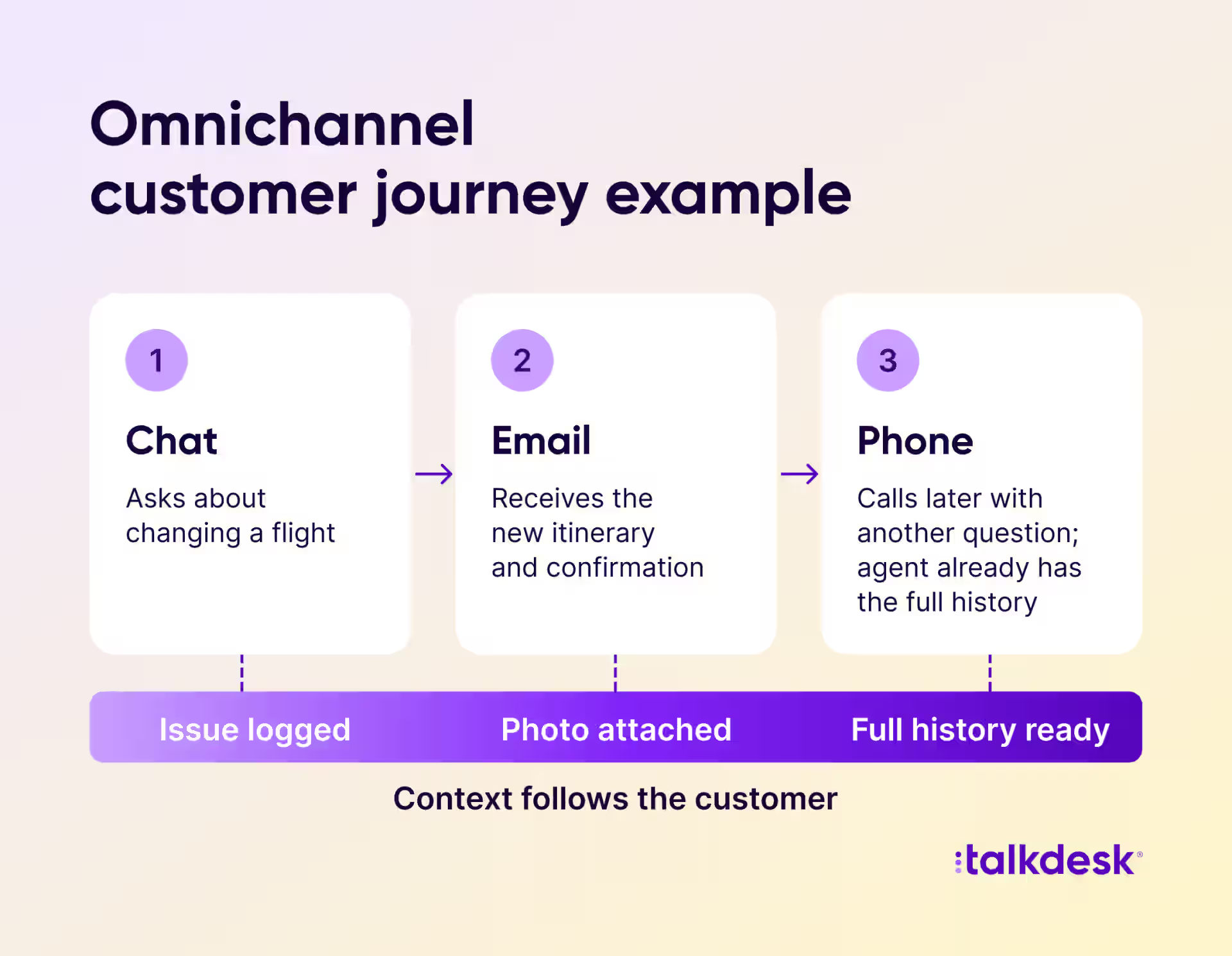
Say a customer starts a chat on your website but has to leave before the issue is resolved. When the customer calls the support line later that week, the agent already knows what happened in the unfinished chat and picks up from there.
An omnichannel contact center connects every channel so customers get help faster, agents handle more conversations at once, and fewer interactions stall before they’re resolved.
A multichannel contact center operates each channel independently, so if a customer sends an email about a problem and later calls the customer service line about the same issue, they will have to explain their situation again. An omnichannel contact center integrates all communication channels to provide a consistent customer experience, carrying context from one conversation to the next.
An omnichannel contact center collects context across every channel, and AI acts on it. Talkdesk Navigator routes each interaction based on context, AI agents resolve common requests without a human and Copilot surfaces customer history and next-best actions while an agent is still on the call.
Any industry with high interaction volume and complex customer journeys sees the biggest gains, particularly financial services, healthcare, retail, and the public sector. These are also sectors where regulatory requirements make a unified record of every customer interaction valuable beyond service quality alone.
Timelines depend on how many systems need to connect and how complex your existing setup is. A cloud deployment with a small number of integrations can go live in weeks, while enterprise rollouts across multiple regions and legacy systems typically run several months.

About Celia Cerdeira
Célia Cerdeira has more than 20 years experience in the contact center industry. She imagines, designs, and brings to life the right content for awesome customer journeys. When she's not writing, you can find her chilling on the beach enjoying a freshly squeezed juice and reading a novel by some of her favorite authors.