AI agents for customer service: A definitive guide
AI agents for customer service are autonomous software systems that understand customer intent, access live business data, and resolve issues end-to-end without a human managing each step. Here’s what you need to know.
10:06 min read
Key takeaways.
-
AI agents for customer service offer greater depth than chatbots. Where chatbots follow scripts, AI agents perceive intent, reason through problems, and take autonomous action to resolve them.
-
Enterprises see measurable service level gains with AI agents. For example, Michaels improved from 20% to 89% year-over-year using Talkdesk.
-
Talkdesk CXA goes beyond individual interactions, automating entire customer journeys across every channel at enterprise scale.
The use of AI in customer service has moved well beyond answering questions. AI agents for customer service now connect to your live business systems and act on customer needs in real time, resolving issues end-to-end without a human managing every step. With 68% of all customer service interactions predicted to be handled by agentic AI by 2028, the shift is already underway.
In this guide, you’ll learn what AI agents are, how they work, what to look for in an enterprise-grade platform, and how customer experience automation accelerates resolution at scale.
What are AI agents for customer service?
An AI customer service agent is an autonomous system that perceives customer intent and reasons through the best course of action. It then acts across connected business systems without requiring a human to manage each step.
Where chatbots are limited to fixed scripts, Talkdesk AI agents use live data from your CRM, order management system, and knowledge base to understand and respond to customers. For your team, that means:
-
Processing refunds and updating account information.
-
Verifying customer identity and managing sensitive transactions.
-
Rebooking shipments, scheduling callbacks, and handling multi-step service requests.
-
Escalating complex issues to the right specialist with full conversation context intact.
This is the foundation of Talkdesk Customer Experience Automation, and the result is real resolution and more capacity for your team. Instead of routing interactions, Talkdesk CXA deploys AI agents that complete the work across every channel, at enterprise scale, without adding headcount.
How do customer service AI agents work?
At a high level, every AI agent interaction follows four steps:
-
Interpret intent. The AI agent identifies what the customer needs, even when the language is informal, incomplete, or in a foreign language.
-
Access live data. The AI agent pulls relevant information from your CRM, knowledge base, and order management system to understand the full context.
-
Reason through the best action. Rather than pulling from a fixed script, the AI agent determines the most appropriate next step.
-
Execute or escalate. The AI agent completes the action autonomously or transfers to a human agent, with full conversation context already in place.
Talkdesk CXA uses multi-agent orchestration, where specialized AI agents coordinate behind the scenes to complete multi-step tasks. The result is a single, continuous experience for the customer, regardless of the complexity behind it.
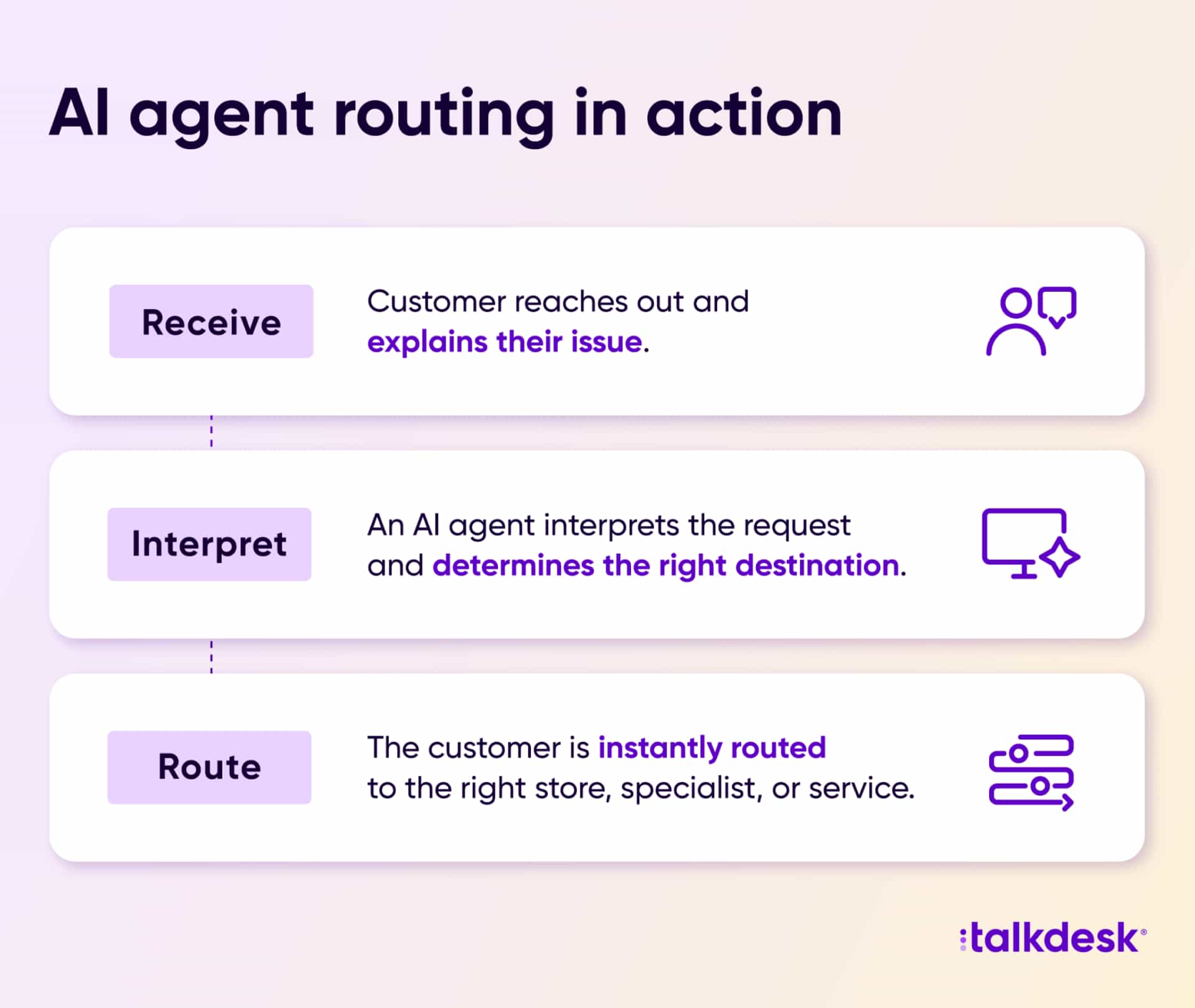
On the customer-facing side, Talkdesk Autopilot handles interactions across voice and digital channels from start to finish. Behind the scenes, AI Copilot for customer service automation supports your human agents in real time, surfacing the right information so they can stay focused on the customer.
See how Talkdesk Autopilot resolves customer issues across every channel, automatically.
Key capabilities to look for in an AI agent platform.
From AI copilot agents for customer service automation to fully autonomous resolution, here is what to look for in a platform built for enterprise scale:
Omnichannel support.
Customers reach out on whatever channel is most convenient, and the right AI agents move with them seamlessly, across voice, chat, SMS, and email. Look for platforms with purpose-built voice capabilities, not voice added as an afterthought.
Deep system integrations.
AI agents are only as effective as the systems they can access. Without live connections to your CRM, order management system (OMS), ERP, and knowledge base, agents can answer questions but can’t take action. Look for platforms with pre-built connectors and a low-code integration layer to reduce IT lift and get to value faster.
Escalation with context.
When an interaction requires a human, the best platforms make that transition seamless. Full conversation context, customer history, and sentiment transfer automatically to the receiving agent, so the customer feels heard from the very first word.
Enterprise-grade guardrails.
At scale, AI agent behavior must be predictable, auditable, and compliant. Look for platforms with prompt controls, hallucination mitigation, data redaction, and human-in-the-loop oversight. Talkdesk’s CXA platform includes built-in guardrails that protect private data and reduce the risk of inaccurate responses, so your team can scale automation with confidence.
Built-in analytics and performance visibility.
Every AI agent conversation generates structured data automatically. The right platform surfaces that data in an actionable way, tracking automated resolution rate, transfer-to-human rate, interaction summary accuracy, and CSAT by channel. That visibility gives CX leaders the insight to continuously improve performance and build a confident business case for expanded automation.
Benefits of customer service AI agents.
Here’s how AI can help customer service teams deliver more with less, across the metrics that matter most to enterprise CX leaders.
-
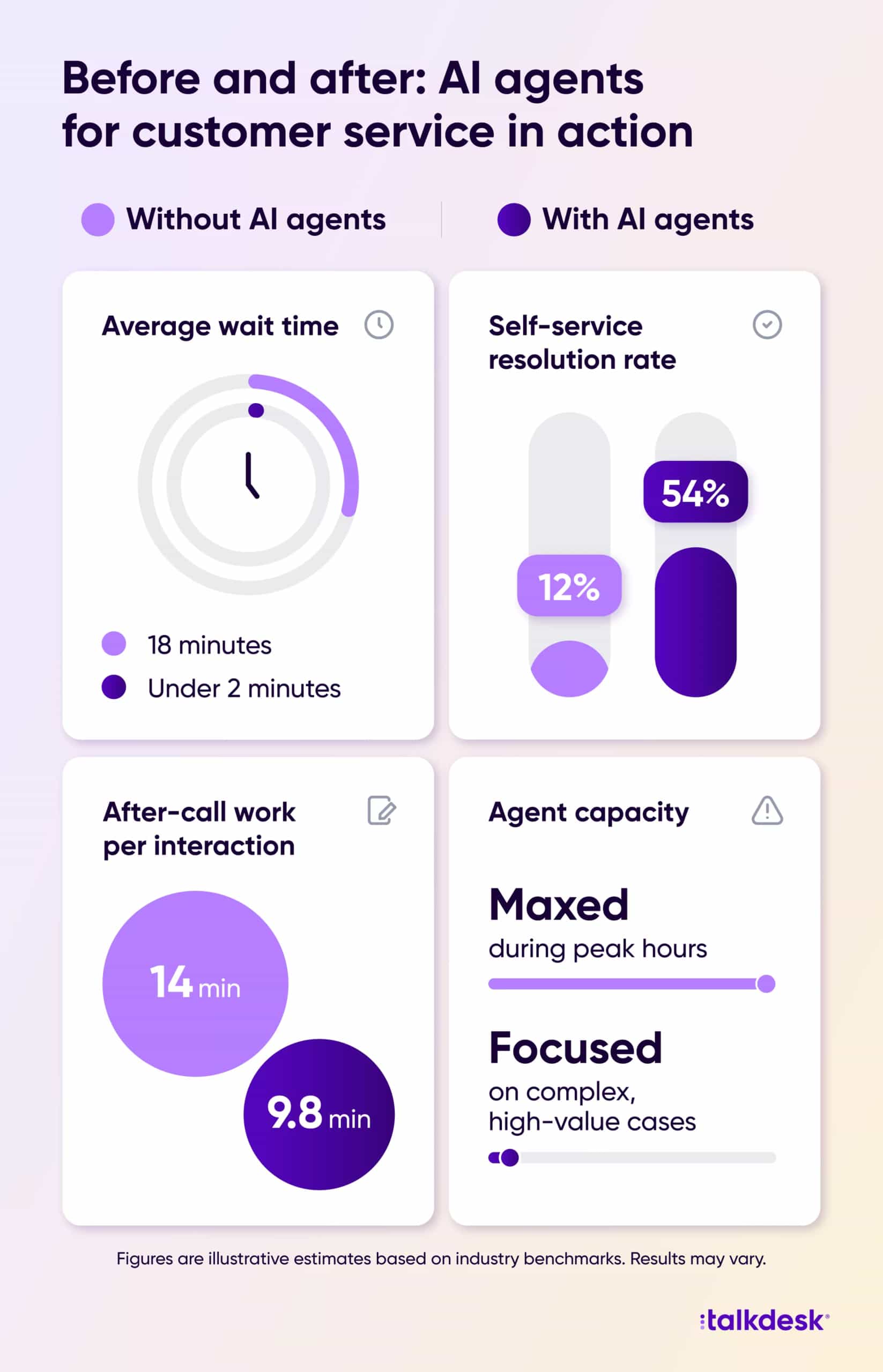
Faster resolution without adding headcount. AI agents handle high-volume interactions autonomously, freeing your team to focus on complex, high-value cases. Humann scaled chat volume by 150% without growing their support team.
-
Shorter wait times and higher satisfaction. Customers get answers faster. Evara Health reduced patient wait times by up to 98% using Talkdesk Autopilot.
-
More productive agents. When AI handles routine interactions, your agents spend more time on the work where they make the biggest impact. Talkdesk clients have seen measurable reductions in average handle time alongside significant gains in satisfaction.
-
Consistent service quality at scale. AI agents deliver the same standard of service at 2 am as they do at 2 pm, across every channel, without the variability that comes with managing large agent teams.
Real-world AI agent use cases by industry.
AI agents are delivering results across some of the most complex and high-volume service environments. Here’s how Talkdesk customers put that into practice.
TowneBank.

Managing member service across loans, cards, and online banking at enterprise scale means your agents are constantly context-switching between systems while customers wait.
TowneBank unified its operations with Talkdesk CXA, giving agents real-time insights and AI-driven knowledge at their fingertips. The result was a 23-second reduction in average handle time and a 97% increase in satisfaction.
Humann.

As your customer base grows, so does the volume of routine inquiries around orders, subscriptions, and product guidance. Humann deployed Talkdesk Autopilot to handle these interactions autonomously, enabling 24/7 support with zero hold times. Chat engagement more than doubled, growing from under 10% to over 20% of total customer interactions, without adding headcount.
Evara Health.

Evara Health reduced patient wait times by 98% and improved overall satisfaction by nearly 120%. The driver was Talkdesk Autopilot, which automated appointment scheduling, cancellations, and new bookings directly via its Epic EHR integration, handling 45% of call volume without human agents.
How Talkdesk CXA operationalizes AI agents.
AI agents for customer service understand requests, complete tasks, and resolve issues with minimal or no human intervention.
That starts with the right platform. Talkdesk built its Customer Experience Automation platform around AI agents from the start, bringing together multi-agent orchestration to automate the entire customer journey.
See what a platform built for AI agents looks like in practice.
AI agents for customer service FAQs.
AI agents for customer service are autonomous software systems that interpret customer intent and access live business data to resolve issues end-to-end without a human managing each step, while also helping improve the agent experience.
AI agents reduce handle times and lower operational costs, freeing human agents to focus on complex, high-value interactions. They also deliver consistent service quality across every channel, 24 hours a day.
Chatbots follow fixed scripts and can only respond to questions they’re programmed to handle. AI agents use large language models to understand unstructured language, reason through problems, and execute multi-step actions across connected business systems.
The five most common types are:
-
Autonomous customer-facing agents that handle inquiries end-to-end.
-
Agent assist tools that support human agents in real time.
-
Voice AI agents that handle phone-based interactions.
-
Proactive outbound agents who initiate contact for alerts or follow-ups.
-
Analytics agents that analyze interactions to surface insights and improve performance.
Some examples include AI agents that handle appointment scheduling, order tracking, account updates, subscription management, and identity verification.
Talkdesk clients like Evara Health and Humann have used AI agents to automate large portions of their call and chat volume, reducing wait times and improving customer satisfaction.
Financial services, healthcare, retail, and public sector organizations see the highest-impact use cases for AI agents in customer service. High interaction volumes, strict compliance requirements, and 24/7 customer expectations make these industries a natural fit.

About Celia Cerdeira
Célia Cerdeira has more than 20 years experience in the contact center industry. She imagines, designs, and brings to life the right content for awesome customer journeys. When she's not writing, you can find her chilling on the beach enjoying a freshly squeezed juice and reading a novel by some of her favorite authors.