Engineering agent harness delivery at Talkdesk
How an AI-first CCaaS leader is rebuilding its entire software lifecycle around AI agents to ship faster, eliminate technical debt, and automate routine work.
15:41 min read
Listen to article
21:44
Every couple of decades, the tectonic plates of software engineering shift. Waterfall gave way to agile. Agile expanded to DevOps. Each evolution moved engineering teams up a level of abstraction, shifting focus away from mechanics and toward intent. The next great shift is already here. The industry is beginning to align on nomenclature— OpenAI writes about harness engineering while others describe a software factory or lights-out delivery. At Talkdesk, we are leaning into it fully under the banner we use internally: agent harness delivery .
To be clear, we didn’t invent this concept. It’s an emerging industry-wide movement.What we’ve done is adopt it deliberately, name it so our teams rally around it, and build the enterprise-scale platform and practices to make it real. The core idea is simple to state and profound in its consequences:
"Coding models have reached a level of sophistication where 'writing lines of code' is no longer the primary bottleneck. We have simply moved up a level of abstraction."
Framing the shift Talkdesk Product & Engineering leadership
When AI coding agents can handle the bulk of the syntax, writing lines of code is no longer the primary bottleneck or the primary source of value. That doesn’t make engineering skills obsolete. Quite the opposite. Product judgment, design taste, architectural integrity, and systems thinking matter more than ever. The difference is where engineers spend their time: less typing, more directing, reviewing, and designing the systems that allow agents to execute safely.
Three decades in one image.

Each era moved engineers up a level of abstraction. AHD is the next step: humans specify intent; agents execute under guardrails.
What is agent harness delivery?
The pivotal word in agent harness delivery is harness. An LLM or a capable coding model on its own is just raw horsepower. A harness is everything you build around the model to point its horsepower at real world production workloads safely.
To achieve this, the harness pieces together several critical layers:
-
Conventions: teaching the agent how your codebase is organized.
-
Skills and tools: Reusable capabilities the agent can independently invoke.
-
Guardrails: Rigid boundaries that keep the agent inside the lines.
-
Workflow orchestration: The explicit steps required to complete a technical task.
-
Human review gates: Mandatory checkpoints where human engineering judgment is required.
Agent harness delivery is the discipline of building and operating this harness, allowing a human engineer to specify the intent while the harnessed agents carry out the execution.
This builds on ideas taking shape across the industry: OpenAI’s framing of harness engineering, and the software factory maturity ladder others have described, which runs from spicy auto-complete up to systems where humans write specs and the factory does the rest. We aren’t just playing around with AI tools where mistakes don’t matter; we have safely integrated AI into a system where failure is absolutely not an option.
What agent harness delivery means for Talkdesk engineering.
In practice, adopting agent harness delivery changes a handful of things about how we work day to day:
-
The git repository becomes the single source of truth. Specs, architecture, design guidelines, review standards, agent skills, and application code all live together.Product, design, engineering, and docs collaborate by opening pull requests against it, eliminating stale, scattered documentation.
-
Engineers move up a level of abstraction. The craft shifts from writing every line to writing sharp specs, designing the harness, and reviewing agent outputs. Directing AI is now a core engineering competency.
-
Feature teams get a productive boost. With a fleet of agents handling the heavy lifting of the implementation, engineers can run multiple workstreams in parallel without context-switching overhead. Sprints yield significantly higher output without compromising peer reviews.
-
The cadence of delivering customer value rises. When building is no longer the bottleneck, a single sprint can carry the weight of what used to be a major release. The constraint shifts from how fast can we build to what is worth building.
-
Routine work is expected to shrink. If agents are draining the backlog, the share of capacity spent on business-as-usual should trend down over time, a number we actively watch.
One belief anchors all of it. As AI makes code cheaper to produce, code becomes closer to a commodity, but enterprise-grade fundamentals do not. Quality, scale, security, safety, and support are what customers pay for, and they become more of a differentiator in an AI-accelerated world, not less. Agent harness delivery is how we get the speed; our fundamentals are what make that speed trustworthy.
The dark factory metaphor.
In manufacturing, a dark factory (or lights-out plant) runs autonomously. Raw materials go in; finished goods come out. Humans focus on designing, optimizing, and supervising the robots rather than turning the screws themselves. We have borrowed this metaphor for our software delivery pipelines. In an agent harness delivery pipeline, a clear set of requirements enters the system—whether it’s a user story, a design file, or a ticket—and a reviewed, tested pull request comes out. The human role shifts to defining what good looks like upfront, and then verifying that the resulting changes deliver it.
Critically, this is not a system where AI writes whatever it wants and ships it directly to production. It is an AI-assisted, human-in-the-loop ecosystem. Agents draft the changes; humans review the code, request revisions, and approve the merge. Our delivery pipeline is built on top of leading agent tooling and orchestrated through our internal developer platform, so every agent run inherits the same conventions, skills, and safety rails our engineers already trust.
What does an agent harness delivery workflow do?
A workflow is a sequence of steps an agent executes to complete a task: analyze, plan, implement, test, open a PR. Workflows are fully customizable, run in isolation, and can be triggered automatically by the events teams already work with.
When a task enters the system, a routing agent instantly selects the right repository and appropriate workflow. The pipeline then drafts and executes the change under rigid, automated test suites. But automation never bypasses compliance: our safe deployment practices and mandatory human code reviews remain strictly non-negotiable.
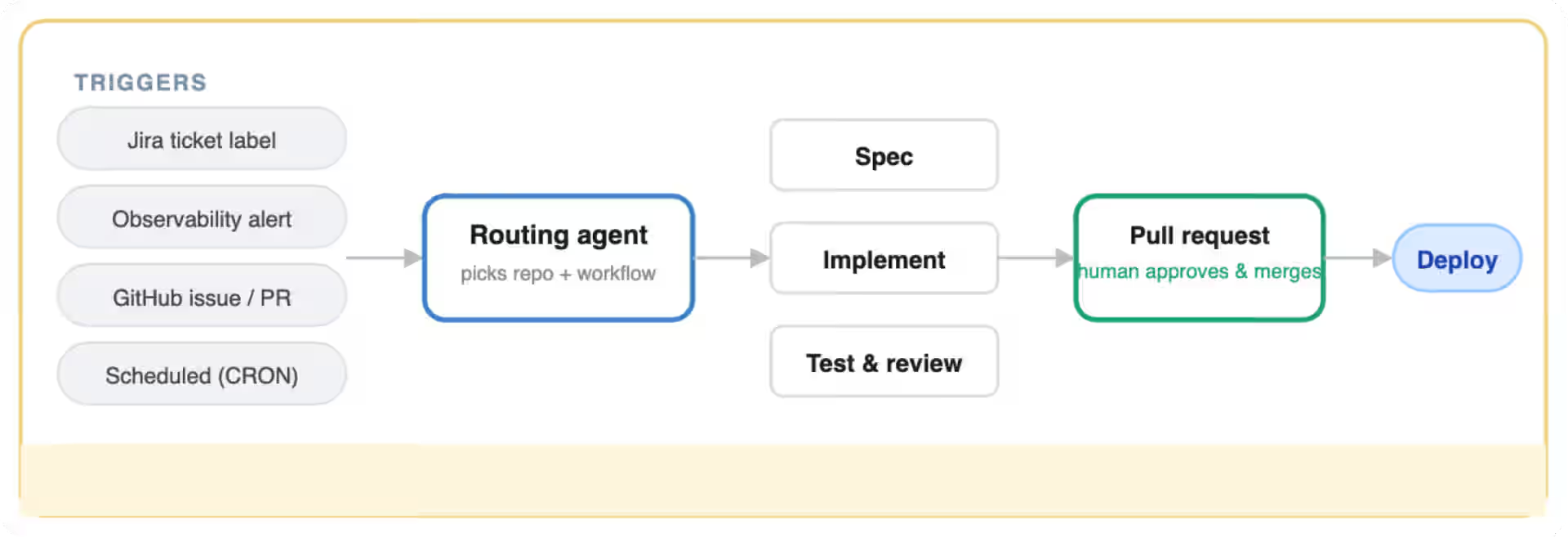
Teams have built workflows for a growing list of jobs: turning a user story into a technical spec and implementing it, root-causing a bug and opening a fix, refreshing documentation from code changes. We are also using them to convert production-meeting and post-mortem action items into real code changes so follow-ups don’t evaporate, and running continuous security reviews that automatically open PRs with fixes.
An open, tool-agnostic platform, built in-house.
Rather than tying our workflows to a single vendor’s coding assistant, we built our own internal developer toolkit. It packages the skills, agents, and conventions a team needs and installs them via a single command line interface.
This tool-agnostic design ensures two critical enterprise advantages:
-
Token cost control: We optimize exactly how data is passed to models.
-
Future-proofing: We can swap underlying LLMs or incorporate new tools without rewriting our entire playbook.
Adoption tells the story better than architecture diagrams. The platform has a curated official core of around 95 blessed skills and 18 agents, along with more than 280 contributions from Talkdesk engineers, designers, and product managers that are currently in the pipeline. That ratio is a stable spine everyone can trust, and a long tail of domain-specific capability that grows wherever someone spots a repeatable task. When a designer can ship a skill that audits interfaces against usability heuristics, or a PM can run a workflow that turns market signals into a draft spec, the platform has clearly outgrown the developer silo.
Eradicating business as usual and technical debt.
Here’s where the model gets genuinely exciting for anyone who has run an engineering team. The unglamorous reality of mature software is that a large share of engineering capacity goes to business-as-usual work and technical debt: flaky-test triage, dependency patching, small fixes, migrations, and backlog grooming. It’s vital work, but it competes directly with innovative roadmap features.
A few real patterns we’ve put into production include:
-
Automated dependency and security patching. What was a multi-day, repository-by-repository manual slog is now a single automated run that opens all the necessary PRs for human approval.
-
Stale-code and tech-debt cleanup at scale. Agents systematically identify and retire orphaned feature flags that have seen zero traffic for months, removing hidden reliability risks that teams perennially deprioritize.
-
Turning meetings into changes. Converting production-meeting and post-mortem action items directly into implemented fixes and PRs, so follow-ups don’t evaporate into a backlog.
-
Sprint busywork automation. Generating sprint reviews, breaking down tasks, and producing daily activity summaries, so people spend their time on judgment, not bookkeeping.
The strategic point is subtle but important. When the marginal cost of routine work drops, debt you’d never get to becomes tractable. The agents don’t just help you ship the next feature faster; they help you pay down the past while you do it.
Reliability: From alert noise to concrete action.
If business as usual is where agents save time, reliability and alert triage is where they earn trust. Running enterprise software at scale means a constant stream of production alerts: pods restarting, latency creeping past a threshold, error rates spiking, CPU saturating. Historically each one pulls an on-call engineer out of whatever they were doing to ask the same first questions: Is this real? What changed? Where’s the root cause?
We connected an AWS-based DevOps agent directly to our observability platform. The moment an is detected, the agent automatically opens an investigation—pulling traces, logs, deployment history, and dependency data. It then posts a structured read-out right where the alert lands, offering a clear hypothesis, the immediate cause, and a probable root cause. By the time a human engineer looks at it, the detective work is largely done.
From there, the agent routes the issue down one of three distinct paths:
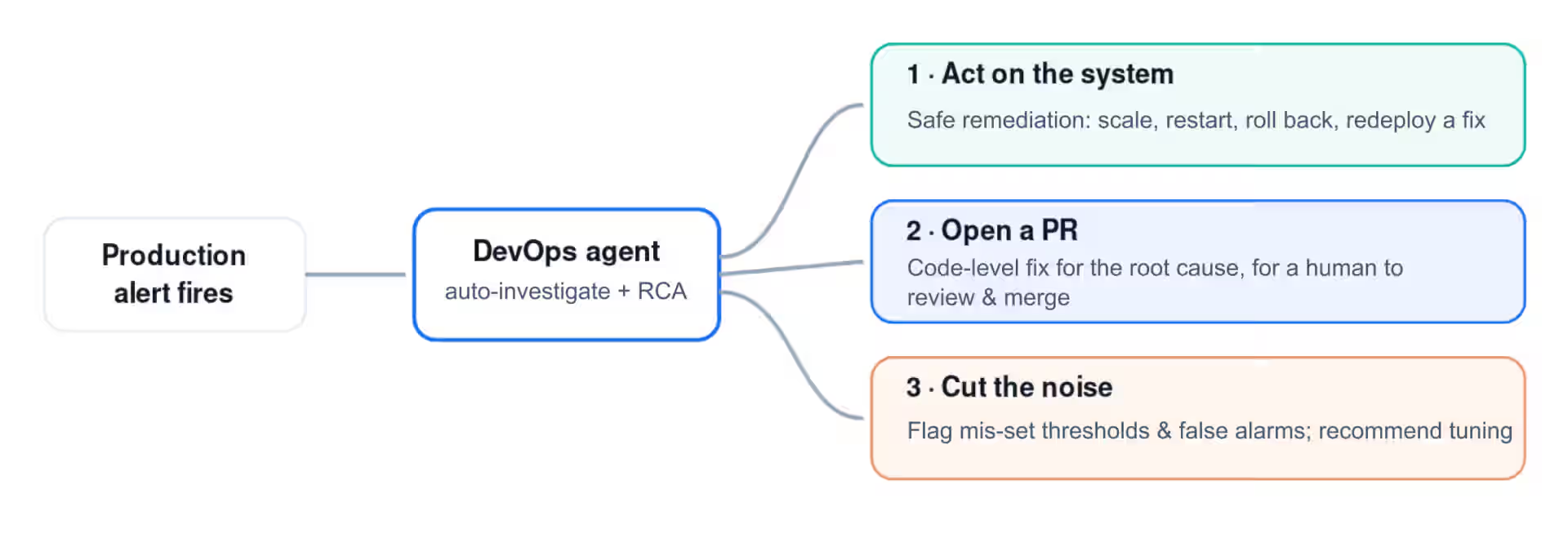
That third path is highly underrated. A large percentage of production alerts are thresholds set below a service’s normal operating range, or chronic patterns flagged as if they were new. Left alone, that noise erodes the on-call rotation’s attention until real signals get missed. Our triage agent separates genuine regressions (a memory fix was merged but never deployed) from configuration artifacts (this latency threshold sits below the service’s baseline), preventing alert fatigue and keeping our engineers focused on real issues.
The decision of which path to take is the core for how we harness these workflows responsibly. Direct action on production is reserved for safe, well-understood remediations that stay within our existing safe-deployment guardrails. Anything that changes application behavior flows through a pull request and a human reviewer. The agent connects observability directly to action, but a human engineer stays in the loop wherever the blast radius warrants it.
QA: Automated suites that build and heal themselves.
The same philosophy of responsible automation runs through how we’re rebuilding quality engineering. Rather than forcing QA engineers to hand-write every end-to-end test, a chain of specialized agents reads requirements from design files, product docs, and tickets. The agent then reconciles them into a coherent specification, plans coverage, and generates runnable test code.
To keep the system running smoothly, a dedicated agent diagnoses and repairs failing tests during development, instantly distinguishing a genuine product regression from a brittle test that simply needs an update. On the operational side, a “firefighter” agent triages synthetic-test failures every day, de-duplicates the resulting tickets, and posts a rolling summary for the team.
New workflows now trace critical changes end-to-end through our reporting paths in staging environments before they ever reach a customer. The result is a test suite that autonomously expands and maintains itself, allowing coverage to grow even as the product moves faster.
Measuring agent harness delivery honestly.
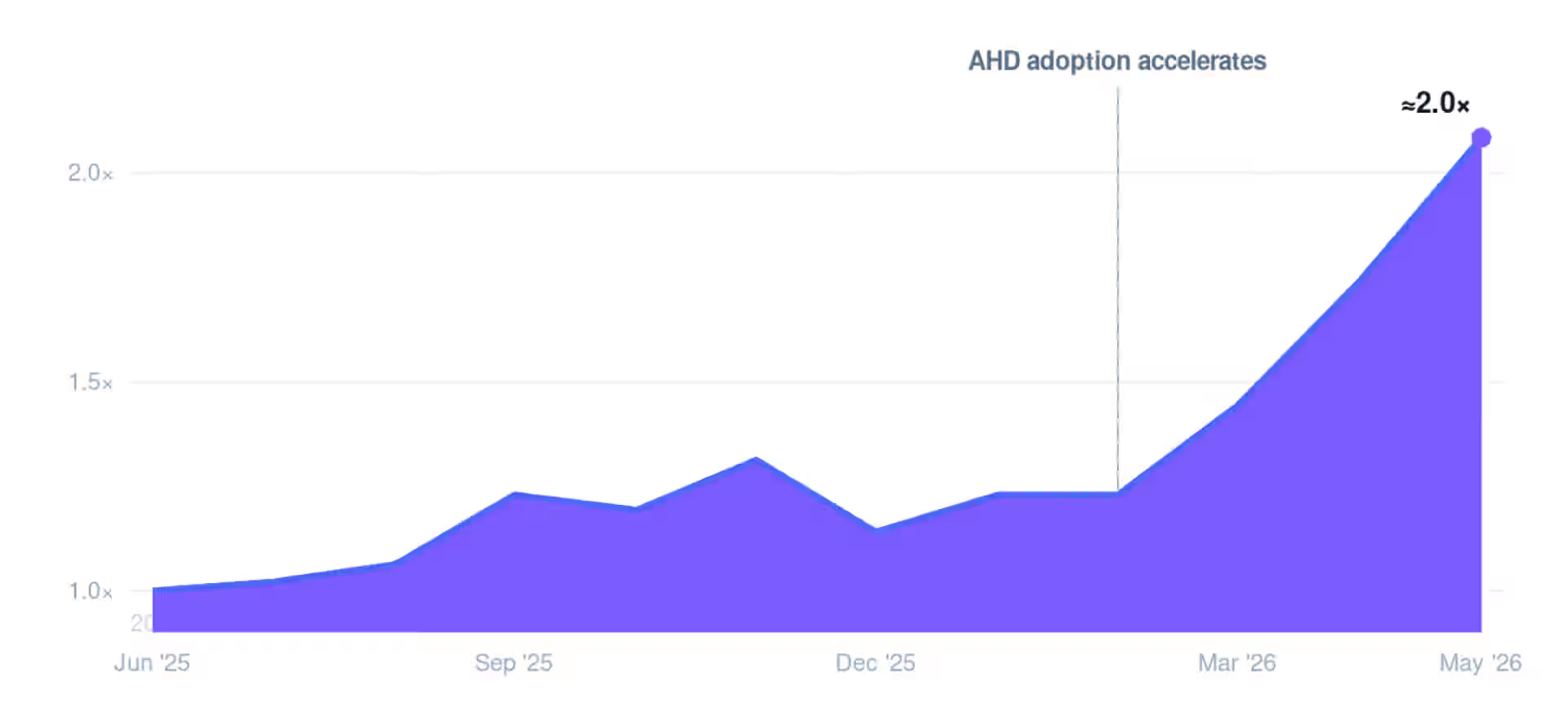
A transformation you can’t measure is just a slogan. We track delivery with a simple, hard-to-game metric: pull requests merged per week, normalized by team size and watched as a trend over time. We pair this velocity index with strict guardrail metrics like PR size, time-to-review, and the industry-standard DORA framework to ensure speed never equals sloppiness.
The data from our rollout speaks for itself:
-
~2× throughput increase. Through 2025, weekly delivery was essentially flat. As agent harness delivery adoption spread across teams in early 2026, PR throughput doubled within a matter of months.
-
Elite DORA status. Despite the massive influx of code, our change-failure rate remained in the low single digits (2–3%), and our mean time to restore (MTTR) hovered at just 1–2 hours.
-
Direct correlation. The upward inflection in code delivery tracked our internal agent-invocation metrics almost line for line, proving that the tooling—not coincidence—is driving the performance gain.
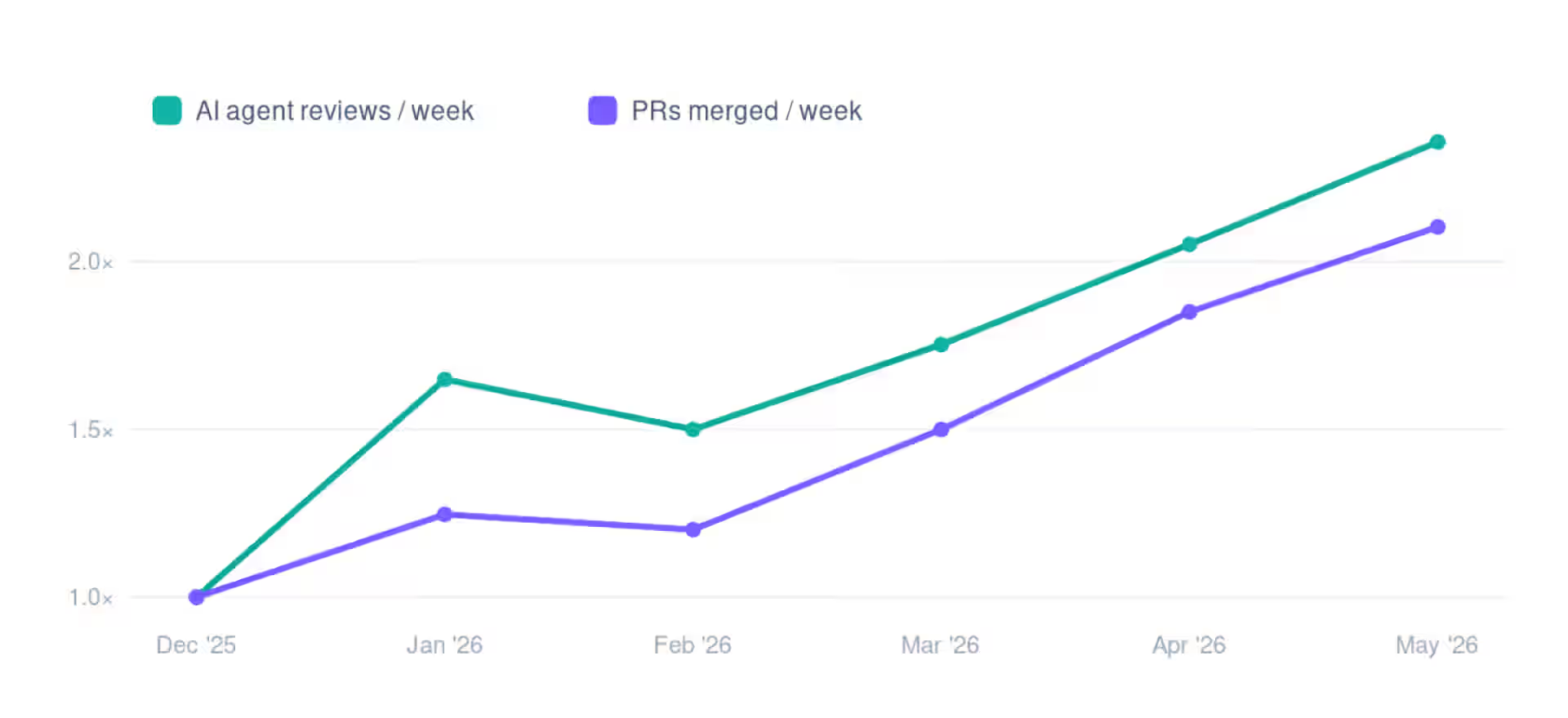
AI agent reviews and PRs merged per week, each indexed to its December 2025 level (1.0×). Agent usage and delivery throughput climb together, the signal that the tooling, not chance, is driving the gain.
[Talkdesk internal delivery dashboards, Jun 2025 to May 2026; indexed and directional]
The three things we obsess over.
Moving fast with AI agents is the easy part to get wrong. To prevent our execution model from becoming an organizational liability, we anchor our strategy in three uncompromisable principles:
-
A canonical path. Build a semi-prescribed “idea to production” workflow that gives teams a proven default without killing the experimentation that got us here.
-
Guardrails first. Reliability and security are sacrosanct. We serve enterprise customers, so safe deployment practices apply to agent-authored changes exactly as they do to human ones.
-
Cost discipline. Token cost is a real operating expense. Structuring knowledge as focused skill files, rather than loading bulky tool schemas on every call, cuts per-invocation overhead from tens of thousands of tokens to a few hundred. We separate what an agent needs to know from what it needs to do, and benchmark workflows so speed never comes at a runaway price.
Adoption is a culture problem, not a tooling one.
The hardest part of a shift like this isn’t the platform; it’s getting an entire organization to change how it works together without anyone stuck figuring it out alone. We’ve leaned on a few deliberate moves:
-
Open office hours run as pure Q&A by practitioners who’ve been in the trenches.
-
Internal tech talks and learning days dedicated to the AI-native lifecycle
-
A single subject-matter-expert channel where anyone in product or engineering can ask questions
-
A weekly digest that separates ready to adopt today from interesting but experimental, so the signal doesn’t drown in noise.
That last distinction matters more than it sounds. Moving fast with new tooling only works if everyone knows what’s an approved standard versus a promising experiment. Naming that boundary clearly is how you keep velocity and trust at the same time.
The challenges we faced.
We’d be doing the topic a disservice if we made it sound frictionless. A few things are genuinely difficult:
-
Agents are confidently wrong sometimes. A plausible-looking diff or a tidy root-cause narrative can still be incorrect. That’s the entire reason review gates and evaluation harnesses are non-negotiable. We measure whether a skill produces correct, reliable output rather than trusting it by default.
-
Securing AI-authored code is its own discipline. More code, written faster, by more contributors raises the stakes on vulnerability scanning, dependency hygiene, and secrets management. We hold agent-written changes to the same security standards and reviews as human ones, and in regulated environments, that bar is higher still.
-
Governing a long tail is hard. Hundreds of community-contributed skills are a strength, but without a clear line between officially supported and someone’s experiment, teams get confused about what to trust. Curating that boundary is continuous work.
-
Cost and quality can drift quietly. Token spend and subtle quality regressions don’t announce themselves; they have to be instrumented and watched, or the economics and the craftsmanship erode under the speed.
None of these are reasons to slow down; they’re the reasons the harness exists. The guardrails aren’t bureaucracy; they’re what makes the speed safe to keep.
What it means for our customers.
All of this is ultimately in service to the people who use our software. By accelerating our pipelines and automating routine engineering work, we deliver direct business value to our customers:
-
Faster, safer feature delivery. Customer-requested capabilities move from concept to production sooner.
-
Quick issue resolution. Autonomous triage means production issues are understood and addressed faster.
-
More innovation, less maintenance. Draining business as usual and tech debt frees our elite engineers to focus on the differentiated features that move a customer’s business.
Crucially, going faster doesn’t mean cutting corners. The enterprise fundamentals our customers depend on (quality, scale, security, support) remain non-negotiable as we accelerate.
Looking ahead.
We think about this as a journey up the levels of harness maturity: from agents that assist with autocomplete, to agents that draft whole changes, to workflows that take a task from intent to a reviewed PR, and ultimately to autonomous flows that connect observability directly to safe action in production. Extending harness workflows from application code into infrastructure and reliability is, for us, the step that moves the whole organization up a level.
We’re honest that there’s no fixed playbook yet; the state of the art changes week to week, and we’re writing parts of this as we go. But the safe bets are clear: models keep improving, and building complex products will keep getting dramatically cheaper in time and effort. Our job is to capture that upside without compromising the reliability our customers depend on.
For us, agent harness delivery isn’t a tool we adopted. It’s a change in what the craft of software is: from writing every line ourselves to designing the systems, specs, and guardrails that let a fleet of agents do the building while humans stay firmly in command of judgment, quality, and direction. If that’s the kind of engineering problem that gets you out of bed, we should talk. It’s exactly the work we’re hiring for.

About Mudit Mathur
Mudit Mathur is the global head of SRE and infrastructure engineering at Talkdesk, where he leads a global team responsible for building reliable, scalable, and secure cloud platforms for enterprise SaaS products. With deep expertise in site reliability engineering, platform engineering, cloud infrastructure, automation, DevOps, and AI-driven engineering productivity, Mudit focuses on creating resilient systems that help engineering teams move faster without compromising reliability or operational excellence.