Beyond determinism: AI agents governance
AI agents aren’t deterministic. The challenge isn’t to eliminate uncertainty, but to govern it. As enterprises give them greater autonomy, AI agent governance is crucial to managing risk, enforcing compliance, and scaling safely.
06:49 min read
Listen to article
09:16
Enterprise software runs on rails. Its route is defined in advance, its movements follow established rules, and every step is expected to lead to the next. When something goes wrong, engineers can trace the problem back to a specific point in the system.
AI agents, however, operate more like airplanes. They can take different routes, adjust to changing conditions, and make decisions based on information that wasn’t available at takeoff. Yet aviation has achieved extraordinary levels of safety, not by eliminating uncertainty, but by developing systems to manage it.
Enterprise AI faces a similar challenge. Traditional software is deterministic, following predefined rules and producing predictable outcomes. AI agents, by contrast, are probabilistic. An agent asked to greet a customer, check their loyalty status, and offer a newsletter subscription may follow different execution paths each time. Give it access to more tools, data, and business processes, and the possible outcomes multiply.
Uncertainty is inherent to autonomous systems. Just as enterprises accept that human agents can make mistakes and establish controls to manage those risks, they must recognize that AI agents will never be entirely predictable. Waiting for that uncertainty to disappear is not a viable strategy.
The real security question isn’t “How do we make AI 100% deterministic?”
It is “How do we govern probabilistic systems so they operate safely within acceptable risk boundaries?”
This is the purpose of AI agent governance. Rather than attempting to eliminate every possible error, it establishes the mechanisms to monitor, evaluate, and control AI agent behavior according to the risks involved.
The need is already evident. Talkdesk’s 2026 State of Agentic Automation in CX report states that compliance concerns (50%), security concerns (48%), and governance concerns (37%) are among the barriers to agentic AI adoption. Enterprises need to address these concerns without waiting for AI to become something it was never designed to be: fully deterministic.
AI agent governance is not static: Matching error rates to business risk.
In traditional software, a bug in production is treated with equal urgency across core systems. In agentic AI, risk is entirely contextual. Applying identical controls to every interaction either creates unnecessary exposure or restricts automation until it becomes impractical. Governance needs risk thresholds tied to the task:
-
High-stakes operations. For activities such as bank account access, error tolerance is strictly 0%. AI agent governance requires hard authentication gates, deterministic controls, and zero-trust verification to prevent unauthorized access.
-
Regulated scripting. In industries such as pharma and life sciences, error tolerance approaches zero. AI responses must be grounded in approved knowledge bases, with real-time verification and human oversight where required.
-
Low-stakes queries. For requests such as branch locators and public FAQs, error tolerance can be higher, potentially around 4% to 5%, allowing greater conversational flexibility, provided errors don’t create material harm.
By framing AI agent governance around acceptable risk budgets rather than demanding impossible perfection, enterprises can safely expand the use of AI agents across different business functions.
Three pillars of the AI agent governance stack.
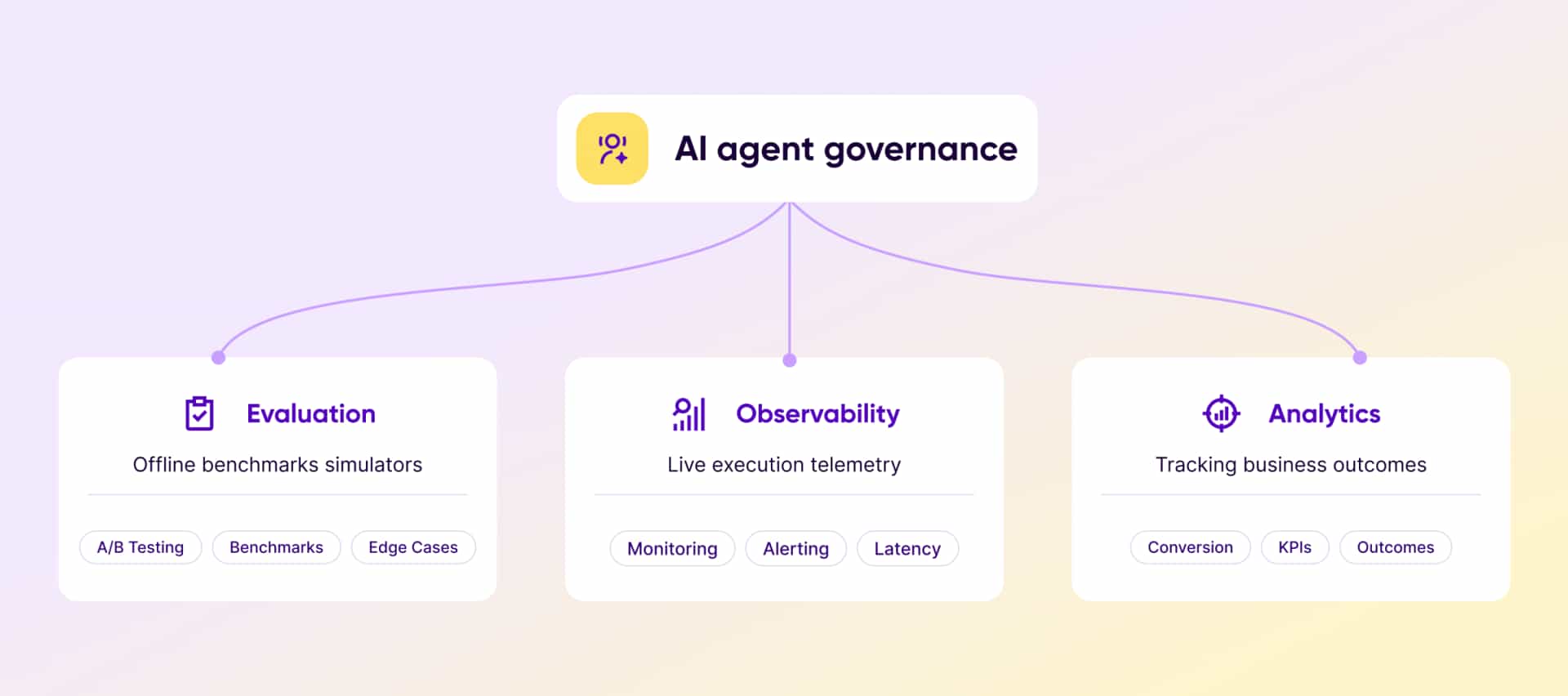
Security can’t be retrofitted through ad hoc logging. Managing probabilistic systems at scale requires an integrated AI agent governance architecture built around three essential pillars:
-
Agent evaluation (offline benchmarks). Pilots use flight simulators to prepare for situations they can’t safely practice in the air. Similarly, continuous evaluation pipelines test AI agents against generated edge-case scenarios before and after deployment. Offline benchmarking helps ensure that model updates, prompt tweaks, or new skills don’t introduce behavioral drift or security regressions.
-
Agent observability (live telemetry). You can’t govern what you can’t trace. Much like radar gives air traffic controllers visibility into a flight, observability provides turn-level execution telemetry, including latency per turn, skills utilized, and LLM call duration. These traces help security and engineering teams understand the sequence of actions and information behind an agent’s decisions to investigate unexpected behavior.
-
Agent analytics (business outcome tracking). Security and performance are inseparable. An agent may operate within its security boundaries and still fail to accomplish its intended task. Analytics tracks whether agents achieve their business objectives and measures success rates across thousands of runs.
Runtime defense: The overwatch guardrail mode.
While observability tells us what happened, evaluation tests what might happen. But neither can stop an unsafe action while an agent is executing a task. AI agent governance also requires real-time enforcement.
Much like air traffic controllers who monitor flights and intervene when necessary, an independent Overwatch layer operates alongside the primary AI agent. Unlike traditional input validation, these guardrails monitor interactions as they unfold and can interrupt execution when an agent attempts to act outside its approved boundaries.
Key guardrail capabilities include:
-
Information leakage and data privacy. Blocking sensitive corporate information or personally identifiable information (PII) from being exposed in real time.
-
Safety and input gates. Filtering malicious prompts and jailbreak attempts before they reach the primary LLM.
-
Persona and script enforcement. Preventing agents from straying into unauthorized activities, such as providing unsolicited financial or medical advice.
-
Fact verification and knowledge base safety. Cross-referencing generated responses against approved knowledge base information to prevent hallucinations.
-
Session controls. Enforcing maximum turn limits, language restrictions, and continuous authorization checks throughout the interaction.
Balancing AI compliance and customer experience.
AI agent governance decisions also shape the customer experience, particularly when regulatory requirements affect how AI agents communicate.
Regulations like the EU AI Act, particularly the disclosure obligations under Article 50, require transparency between customers and AI systems. In the US, frameworks such as FedRAMP establish strict security and authorization requirements for cloud services used by federal agencies. While these frameworks address different aspects of AI deployment, both illustrate how external requirements influence enterprise governance.
Compliance can also introduce friction into the customer experience. More explicit AI disclosures, for example, may lead some customers to disengage or end an interaction, creating a potential tension between transparency and customer satisfaction. Governance teams must consider not only whether an AI interaction meets regulatory requirements, but also how those requirements are implemented. The wording and timing of disclosures can make a difference, and testing different approaches can help organizations meet their obligations while minimizing unnecessary friction for customers.
Reliability determines who scales.
As AI agents become easier to build and their capabilities more widely available, technical sophistication alone will offer less differentiation. What once set organizations apart may soon become standard across the industry.
For enterprises, speed without control is a liability. But as the market matures, the more important question is whether they’re investing as much in AI agent governance as they are in developing new capabilities.
The next competitive advantage may have less to do with what AI agents can do and more to do with how much responsibility enterprises can confidently entrust to them.

About Pedro Andrade
Pedro Andrade is vice-president of AI at Talkdesk, where he oversees a suite of AI-driven products aimed at optimizing contact center operations and enhancing customer experience. Pedro is passionate about the influence of AI and digital technologies in the market and particularly keen on exploring the potential of generative AI as a source of innovative solutions to disrupt the contact center industry.