Holiday shopping sees retailers push AI. Shoppers are checking it twice.
Retailers are betting big on a future where AI agents don’t just recommend products—they buy them. But there’s one problem: consumers aren’t nearly as enthusiastic about handing over control.
11:12 min read
Listen to article
12:12
According to our 2026 AI Holiday Shopping Survey, 89% of retail leaders say their companies have optimized for AI agents that complete purchases on shoppers’ behalf, or are actively planning or testing those capabilities. Yet just 15% of U.S. consumers would allow an AI agent to make purchases using their payment information, even with the opportunity to review its actions first.
That doesn’t mean shoppers are rejecting AI. More than half (54%) of U.S. shoppers said AI is helpful when researching gift ideas, and 42% said it would be helpful while shopping online. Consumers are comfortable letting AI help them decide what to buy, but letting an AI agent actually spend their money is another matter.
The question heading into the 2026 holiday season isn’t whether AI will transform shopping. It’s whether retailers are moving faster than consumer trust can keep up.
We commissioned Centiment to survey 1,048 U.S. consumers and 312 U.S. retail leaders using AI to see where the two sides agree on AI’s role this season and where shoppers are still holding on to control.
Key takeaways.
-
AI-deploying retailers are getting ready for AI agents that shop (89% are optimizing or planning for them), but only 15% of shoppers would let an agent make purchases with their credit card or bank information, even with a chance to review first.
-
AI assistants can help brands win new customers: Almost half (49%) of shoppers are likely to consider buying from a brand or retailer they’ve never purchased from if an AI assistant recommends it.
-
Nearly 1 in 3 retailers using AI say AI has made errors in the past 12 months. These included taking actions it shouldn’t have, such as issuing an incorrect refund.
-
Shoppers are wary of how AI shapes what they see and how much they pay. Among those who want stronger rules for retail AI, 41% worry about paid product placement, and 41% are concerned about being charged a different price than another shopper.
-
Retailers are preparing seasonal workers to work alongside AI: While 9 out of 10 (89%) plan to upskill or reskill workers, just a fifth (19%) expect to reduce seasonal hiring because of AI.
AI assistants can steer shoppers toward new brands.
AI assistants can shape more than what shoppers research. Whether they are conversational assistants on a retailer’s website or standalone tools like ChatGPT, Gemini, Claude, and Perplexity, these assistants answer questions, suggest products, or write text when prompted. That makes their recommendations a powerful force. If an AI assistant recommended a product from a brand or retailer they’d never purchased from before, 1 out of 2 (49%) shoppers say they’d be likely to consider buying it. By contrast, 19% say they’d be unlikely to.
That makes AI assistant recommendations a potential customer acquisition channel and can level the playing field between established and emerging retailers. In my view, brands that nail answer engine optimization (AEO), personalization, and recommendations will have an advantage over those whose catalogs are not optimized for AI assistants to find.
Of course, personalization depends on what shoppers will share. For more personalized recommendations or a more convenient shopping experience, 61% of consumers would be comfortable letting an AI assistant access their product or style preferences. Financial information is another story: three-quarters of shoppers would be uncomfortable sharing their bank account or payment card details with an AI assistant. Just 17% say they’d be comfortable doing so.
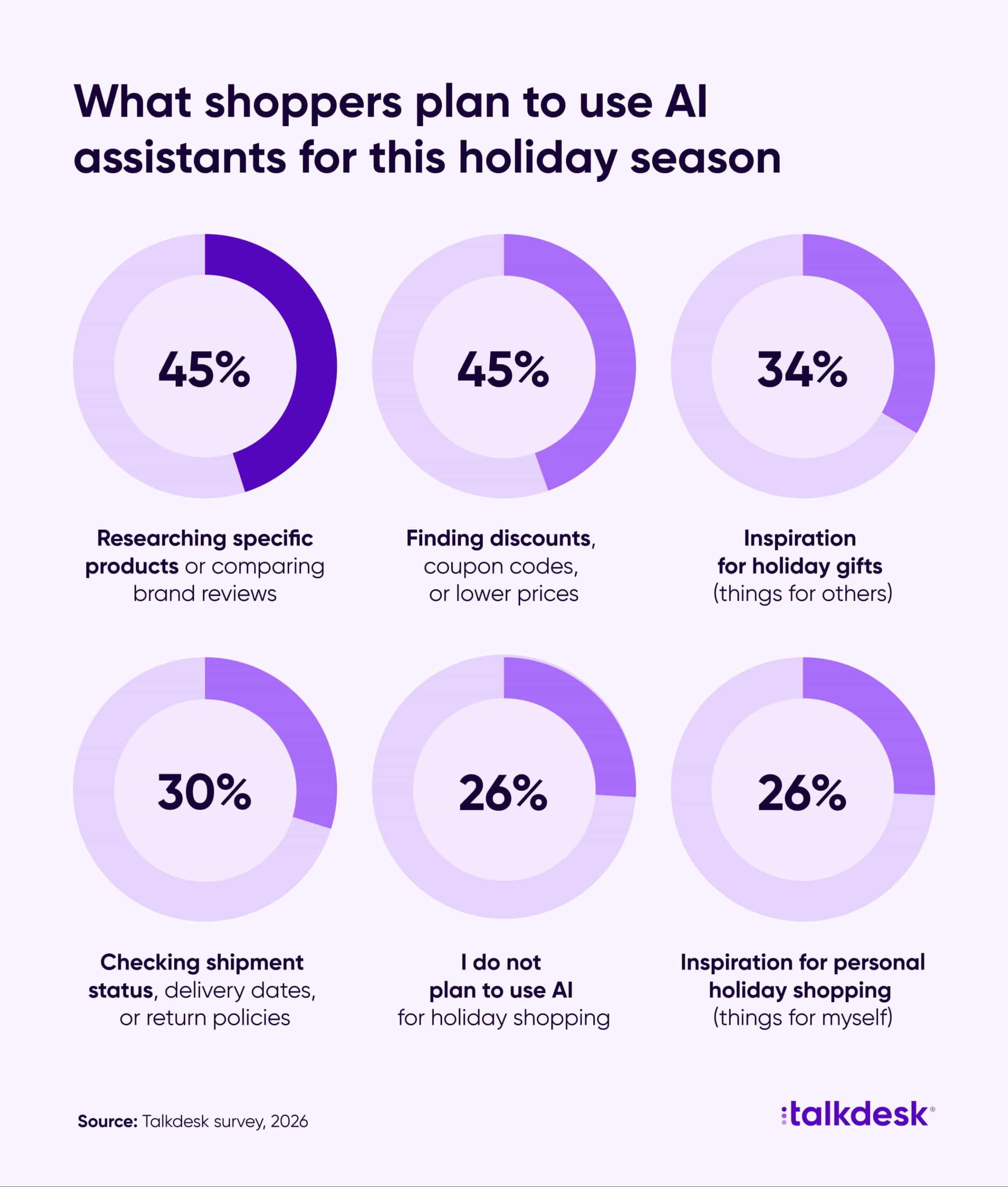
Few shoppers will let an AI agent pay for them.
AI agents go a step further than AI assistants. Instead of simply making suggestions, they can independently work through several steps toward a goal and take action, like applying a discount code or completing a purchase. Retailers are building for them, and 41% have already optimized their catalogs and checkout for AI agents, while another 48% are actively planning or testing.
Given how quickly shoppers are turning to AI for product discovery, I expected more retailers to have optimized their catalogs by now. If a brand’s catalog and product details are invisible to AI agents and large language models, it will struggle to compete this holiday season.
The findings show that shopper comfort with AI agents depends on what they’re being asked to do. With a chance to review an agent’s actions first, less than half (44%) would let it choose discount codes or sales, and as stated earlier, only 15% would let one make purchases using their card or bank information. Without a review step, those percentages fall to 26% and 10%.
| What shoppers would let an AI agent do | % of shoppers, with a review step | % of shoppers, without a review step |
|---|---|---|
Choose discount codes or sales | 44% | 26% |
Choose specific brands or products | 33% | 20% |
Select gifts for people on my list | 28% | 16% |
Send holiday cards or messages | 20% | 16% |
Ship gifts to people on my list | 19% | 14% |
Contact customer service on my behalf | 16% | 14% |
Purchase products using my card or bank information | 15% | 10% |
None of these tasks | 31% | 51% |
It doesn’t surprise me. We’re still far from a majority of shoppers letting an agent buy on their behalf, especially for high-consideration gifts. The move to agentic commerce isn’t only a technology shift—it’s a trust shift. Retailers that build trust and transparency now will be the ones shoppers eventually feel comfortable delegating purchases to through their AI agents.
31% of retailers say their AI took action it shouldn’t have.
This holiday season, 93% of retailers will deploy AI agents in customer service, and over half (51%) of them plan to have those agents complete returns, refunds, or exchanges.
But retailers’ AI isn’t always getting it right. In the last 12 months, 58% of retailers say their AI produced at least one problem, and 31% say it took an action on a customer’s account that it shouldn’t have, such as a wrong refund or an incorrect order change.
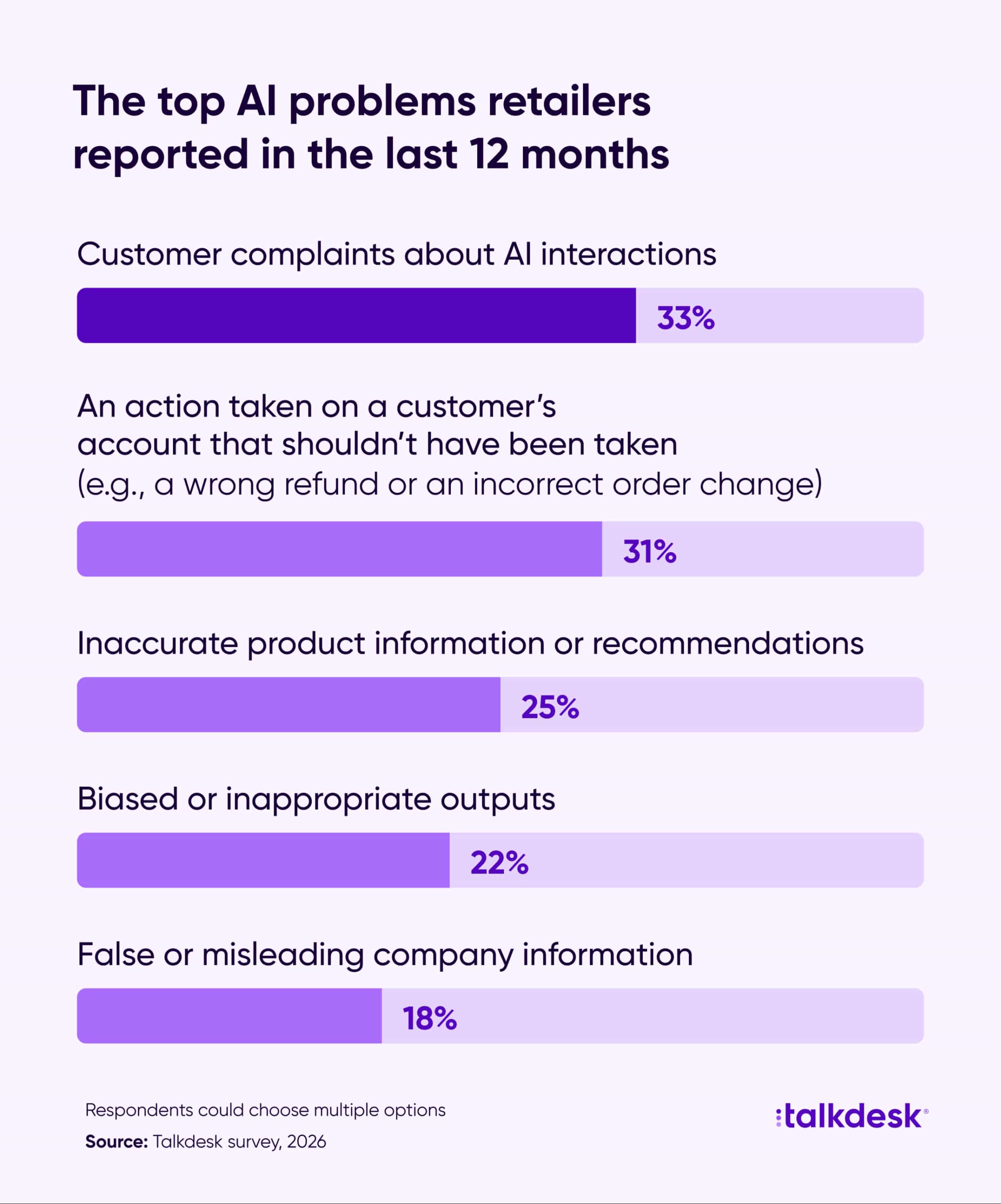
Those problems carry a cost. Among the 58% of retailers whose AI caused at least one problem, 29% lost a customer as a result. When AI goes wrong, the damage goes well beyond a bad refund. As AI agents become another face of the brand, my advice to retailers is to vet them as rigorously as a new hire. This means testing and simulating AI agents before they go live, and continuously evaluating their performance once they do.
Shoppers worry AI influences what they see and pay.
Most shoppers (74%) want stronger rules on how retailers use AI, up from 60% who wanted stricter oversight and standards last year. Among this year’s respondents, 48% worry they could get stuck with no way to reach a human to fix a problem.
Others are wary of what happens behind the scenes: 41% worry about being shown products because a brand paid for placement rather than because they fit their needs, and another 41% worry about being charged a different price than another shopper for the same item.
| Why shoppers want stronger rules on AI in retail | % who want stronger rules |
|---|---|
Retailers could collect or share my personal data without my consent | 55% |
I could get stuck with no way to reach a human to fix a problem | 48% |
I could be charged a different price than another shopper for the same item | 41% |
I could be shown products because a brand paid for placement, not because they fit my needs | 41% |
I could be misled into buying something that isn’t right for me | 40% |
No one person would be held accountable if an AI-driven purchase goes wrong | 40% |
I don’t believe existing rules adequately protect consumers when AI is involved | 38% |
Retailers don’t have to wait for regulators to set the standard. Telling shoppers when AI is involved, explaining why they’re seeing a recommendation, and letting them opt out builds the kind of personalized customer experience shoppers trust.
AI is changing seasonal work more than cutting it.
Retailers’ seasonal hiring plans point to a hybrid workforce of human agents and AI agents. The largest segment of retailers surveyed (47%) will hire about the same number of seasonal workers as last year but expects AI to change how they work. About 1 out of 5 (19%) plan to hire fewer seasonal workers because of AI.
Most retailers (89%) also plan to upskill or reskill workers, whether that’s training them to use AI tools or preparing them for roles AI is changing.
I believe that kind of support matters for seasonal hires, who have little time to ramp up and will handle many of the escalations AI can’t resolve. AI tools that support human agents can surface suggested answers, next steps, and automatic summaries in real time, helping new hires get up to speed quickly and support customers effectively.
How retailers can prepare AI for the holiday rush.
It’s clear the upcoming holiday rush will test how well retailers balance automation with the human touch that shoppers still expect. Customer experience automation can help you orchestrate AI through peak season with human-in-the-loop capabilities that protect consumer trust. Here are six ways to prepare before peak demand hits:
-
Make your catalog visible to AI. Keep product catalogs, pricing, and inventory data current, clean, and easy for AI search crawlers to read. Revisit old web site maps that were created for SEO to ensure that AEO can navigate your sites. If large language models can’t find your products, those products won’t make the AI-generated shortlist.
-
Give shoppers a choice in how they buy. Let shoppers use AI agents to complete purchases with a clear review step, alongside a familiar checkout for shoppers who’d rather buy for themselves.
-
Pressure-test your AI agents before peak. The holiday rush is no time to discover your AI agents are making promises your business can’t keep. Test them in real-world scenarios using accurate, connected, real-time data. With multi-agent orchestration, specialized AI agents can coordinate across systems to resolve refunds, returns, and order changes end-to-end without losing context.
-
Build a fast, context-rich path to a human. When an AI agent can’t resolve an issue, hand the shopper off to a person, along with the full conversation history, so they don’t have to repeat themselves.
-
Be open about how AI shapes recommendations and prices. Disclose AI use across your ecommerce customer experience and service conversations, and let shoppers opt out of AI features.
-
Equip seasonal staff with agent assistance. Tools like Talkdesk Copilot give human agents suggested answers, next steps, and automatic summaries during live conversations.
See how Talkdesk helps retailers handle routine work at holiday scale while keeping people available when shoppers need them, or request a demo to prepare for peak season.
Methodology.
Talkdesk commissioned Centiment to survey 1,048 U.S. adults ages 18 and older who plan to make online purchases for themselves or others this holiday season. The survey was fielded Sept. 16-21, 2026. The sample is census-balanced, and the margin of error is approximately ±3% at a 95% confidence level.
Centiment also surveyed 312 U.S. retail decision-makers at the director level or above at U.S. retail companies with 50 or more employees that use AI, all of whom were at least somewhat knowledgeable about their company’s AI strategy. That survey was fielded Sept. 16-Oct. 3, 2026, with a margin of error of approximately ±5.5% at a 95% confidence level.

About Michael Klein
Michael Klein is the Head of Retail, Travel & Hospitality Product Marketing for Talkdesk, a leader in Contact Center Software. Michael is a trusted executive advisor to enterprise brands and was named a 2025 Top Retail Expert by Rethink Retail for the second consecutive year. As a global business leader with deep expertise in the technology and consumer industries, he is known for authenticity and getting to the heart of the matter. He has a wealth of experience in marketing, merchandising, technology, customer experience, Ecommerce, and digital transformation. Prior to Talkdesk, Michael was the Global Director of Industry Strategy & Marketing for the Adobe Digital Experience Cloud, where he led the GTM strategy targeting retail, travel, and consumer goods clients. Michael’s retail expertise is vast. He was a senior merchant and marketer for specialty brands including William-Sonoma, Harry & David, Discovery Channel Stores, eLuxury.com (LVMH Group), Dean & DeLuca, and wine.com where he consistently delivered positive comp store sales and margin growth for these specialty retailers. As a thought leader in global commerce Michael regularly contributes to industry events. He is an active member of the NRF Digital Council and the Retail Cloud Alliance Advisory Council. Michael also sits on the board of Visional, a video commerce platform and AndesML, a retail media platform.