Beyond deflection: Why traditional metrics don’t work for AI agents

By Pedro Andrade
00:00 min read

One interesting pattern in AI interactions is that the dashboards don’t always tell the same story as the conversations.
Looking at analytics, things may look great. Containment numbers are healthy, escalation rates are low, and the charts suggest the AI agent is doing exactly what it is supposed to do. However, a deeper look into the conversations reveals that some customers clearly get what they need and leave happy, while others abandon the interaction after a few turns when the AI doesn’t quite deliver what they’re asking for. From an analytics perspective, these interactions look identical as both count as successful deflections because no human agent had to step in. And that’s really where the problem starts.
For years, the customer service world has been obsessed with one main metric: deflection rate. The logic is simple. If the customer interacts with a bot and never asks for a human agent, the interaction counts as a success. If the conversation escalates, it’s considered a failure.
Back in the days of simple, rigid chatbots, this made sense, as interactions followed tightly structured flows and handled narrow tasks, so a pass-or-fail metric worked well. But today, with autonomous AI Agents, this pass/fail approach isn’t just slightly off; it’s actively hiding the real user experience from product and CX teams. AI agents handle multiple intents within the same conversation, resolve some requests while escalating others, and collaborate with human agents in the same interaction. A binary metric like deflection can’t capture the value created in the interaction.
Here’s why AI agent analytics is a lot trickier than it looks. We need new approaches, new context, and new tools to understand how autonomous AI agents perform during the entire customer journey.
The deflection illusion: Did they finish, or did they quit?
Let’s say a customer is talking to an AI agent. Halfway through, they hang up the phone or close the chat. Traditional analytics will categorize the interaction as deflected or contained because it didn’t escalate to a human.
But that classification ignores the most important question: why did the customer leave?
There are two different possibilities:
-
The customer asked a quick question, received an immediate answer, and ended the conversation satisfied: true win.
-
The customer became frustrated after repeated misunderstandings and abandoned the interaction: friction and frustration.
To an old-school dashboard, both outcomes are the same. To your business, one is a great customer experience, and the other is a fast track to churn.
Telling the difference between a happy sign-off and a frustrated rage-quit is tough, and understanding what happened requires deeper analysis. AI agents for analytics can examine interaction context to detect signs of friction and pinpoint the exact moment of friction that caused the customer to hang up. Instead of guessing why a conversation ended, we gain visibility into the customer experience.

AI AGENTS
Meet the AI agents built for your industry.
Pick one, run a pilot in your environment, and prove ROI in 30 to 45 days.
The multi-intent reality and the why behind escalations.
Another limitation of traditional metrics is when customers pursue multiple goals within a single interaction
Think about a banking customer interacting with an AI agent:
-
They ask for their current balance (AI handles it).
-
They ask to hear their last five transactions (AI handles it).
-
They notice a suspicious charge and ask to dispute it (escalate to a human).
Under the old rules, this entire session gets slapped with an escalated label. The dashboard basically says the AI failed.
But that’s not what happened at all! The AI agent for analytics successfully knocked out two distinct tasks, giving the customer immediate answers and saving the human agent a ton of triage time. By the time the human picks up, they can jump straight into the complex dispute. If analytics focuses only on the final outcome, it misses the progress AI has made throughout the multi-step journey.
Plus, knowing that a call escalated isn’t enough; we need to know why. For that, we use … well … AI … to automatically scan the transcripts of escalated sessions and provide the reason for the handoff. Did the customer get frustrated? Did they specifically ask for a human? Was it just a really complex, critical case? This gives teams immediate, actionable context.
The catch: Analytics needs context.
Here’s another big piece of the puzzle: no two AI agents are exactly alike. They aren’t standard, off-the-shelf widgets; they act more like custom applications with their own unique workflows and goals. A retail returns assistant, for example, will have completely different success criteria than a healthcare scheduling agent or a financial services support agent.
Because of this, you can’t just slap a generic analytics dashboard on top and call it a day. AI agent analytics has to be aligned with the specific purpose of the agent. What counts as a “success” for a retail returns bot looks completely different from a healthcare scheduling agent.
This leads to one of the most common, and costly, mistakes we see: treating analytics as an afterthought. Teams spend months building the perfect conversational AI, but dedicate little time to set up the measurement strategy. Without a customized analytics strategy to match agent specific use cases, even the smartest AI will spit out unhelpful data.
Visualizing the real story behind AI agents for analytics.
To really understand what’s happening inside complex AI-driven interactions, we need analytics that go far beyond standard pie charts.
At Talkdesk, we’ve been rethinking how AI agents for analytics should work, and our Autopilot Agentic Analytics dashboard breaks it all down through several key perspectives:
-
The big picture. We track total interaction volume alongside clear, simple visual outcomes, such as contained, escalated, and abandoned interactions over time, to spot trends and shifts in customer behavior instantly.
-
Topic drill-downs. We show the specific topics or intents that AI agents handle successfully, and those that lead to abandonment or escalation.
-
Interaction journey mapping. Rather than viewing conversations as isolated events, we map the full journey from the customer’s first question through all the twists and turns, right down to the final outcome. AI-generated insights also explain the reasons behind escalations or drop-offs.
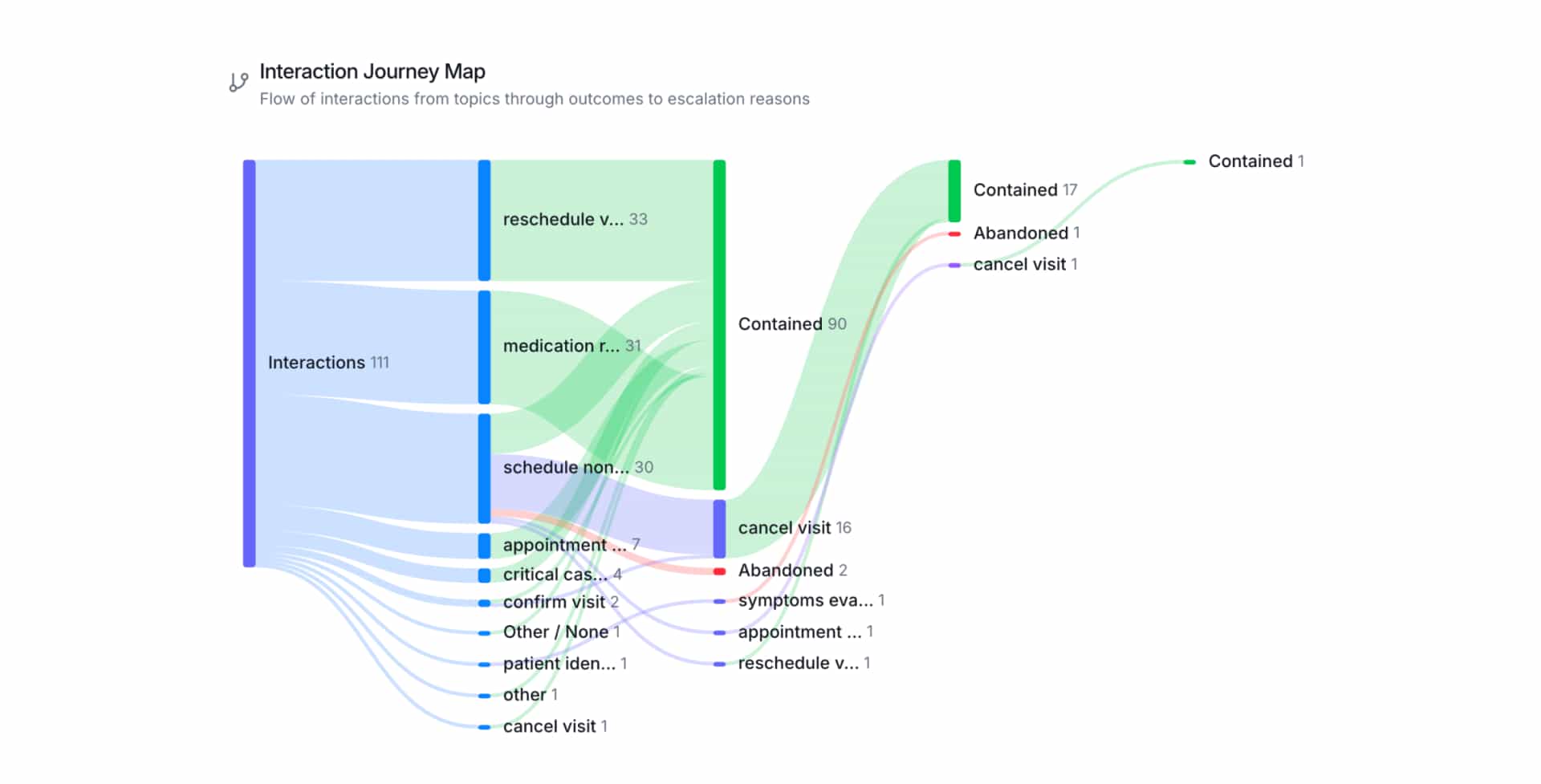
Together, these capabilities transform AI agent analytics from a simple reporting tool into a powerful diagnostic system.
Moving beyond pass or fail metrics.
As our AI agents continue to evolve, so must the way we measure their performance. We need to stop treating interactions like single, isolated events and start treating them like fluid journeys.
Doing that requires analytics systems that understand context, analyze conversational dynamics, and reveal the full customer journey. The right approach to AI agents for analytics moves from simple metrics and gains a clear, actionable understanding of how AI is shaping the customer experience. It is this visibility that enables the continuous improvement of not only efficiency, but also the quality of every interaction.
The era of the simple chatbot is over. It’s time our dashboards reflect that.
About Pedro Andrade
Pedro Andrade is vice-president of AI at Talkdesk, where he oversees a suite of AI-driven products aimed at optimizing contact center operations and enhancing customer experience. Pedro is passionate about the influence of AI and digital technologies in the market and particularly keen on exploring the potential of generative AI as a source of innovative solutions to disrupt the contact center industry.