AI Agent Evaluation: From signal to fix in two minutes

By Nan Zhao
00:00 min read
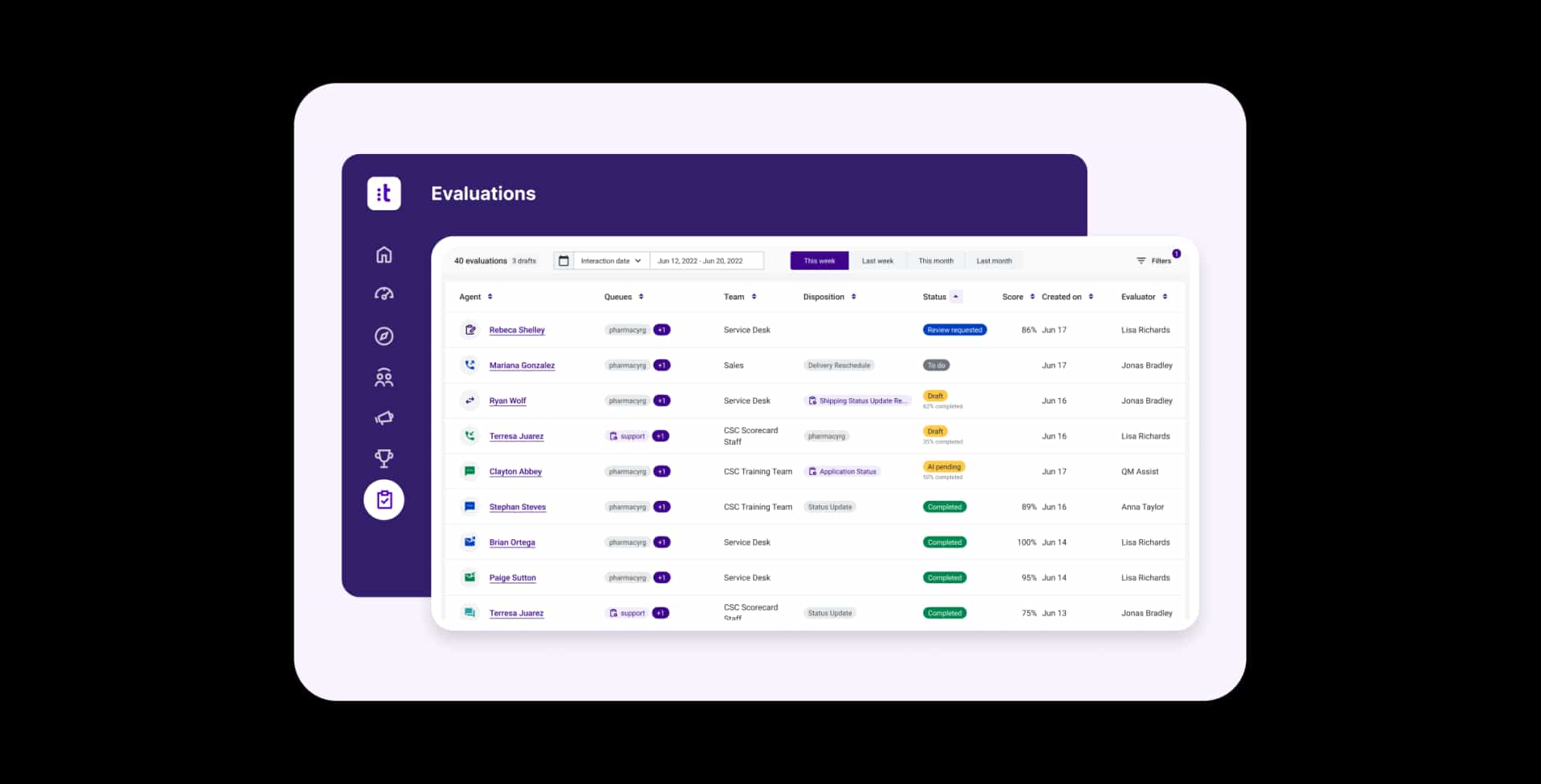
Every team building AI agents hits the same wall. You ship a new version. Something feels off. A customer flags a strange response. You open three dashboards, dig through traces, compare runs by hand, and an hour later, you finally have a hypothesis about which version regressed which capability on which scenario.
At a small scale, the workflow seems manageable, but production AI systems don’t stay small for too long. Multiply that across hundreds of agents in production, and quality stops being something you actively control and becomes something you are constantly reacting to. Evaluation stops being a research task and becomes an infrastructure problem, creating an organizational bottleneck.
Agent Evaluation fixes that. A single workspace for monitoring, diagnosing, and improving the quality of every AI agent on the platform, so you should go from “something’s wrong somewhere” to “here’s the exact scenario to fix” in the time it takes to drink a coffee. It answers three questions quickly:
-
Which agents are regressing?
-
What capability actually broke?
-
Which scenarios should engineering fix first?
The goal is to reduce the time between detecting a quality issue and identifying the exact failure pattern behind it.
Evaluation as an operational layer.
Traditional evaluation tools tend to focus on isolated benchmark runs. That works well in development environments, but production AI systems behave differently. Agents evolve continuously, prompts change, orchestration logic changes, retrieval systems evolve, models change underneath the application layer, and so on. The same workflow may behave differently across sessions, even within the same version.
As a result, evaluation can’t live as a disconnected QA process. It has to become part of the operational stack. Agent Evaluation approaches this as a continuous observability problem rather than a static testing problem. Instead of looking at runs in isolation, the system tracks how agent behavior changes over time across versions, datasets, metrics, and scenarios.
The workflow mirrors how engineering teams debug distributed systems: identifying where risk is emerging, isolating the failing capability, and inspecting the exact scenarios responsible for the issue.
Simulating production behavior.
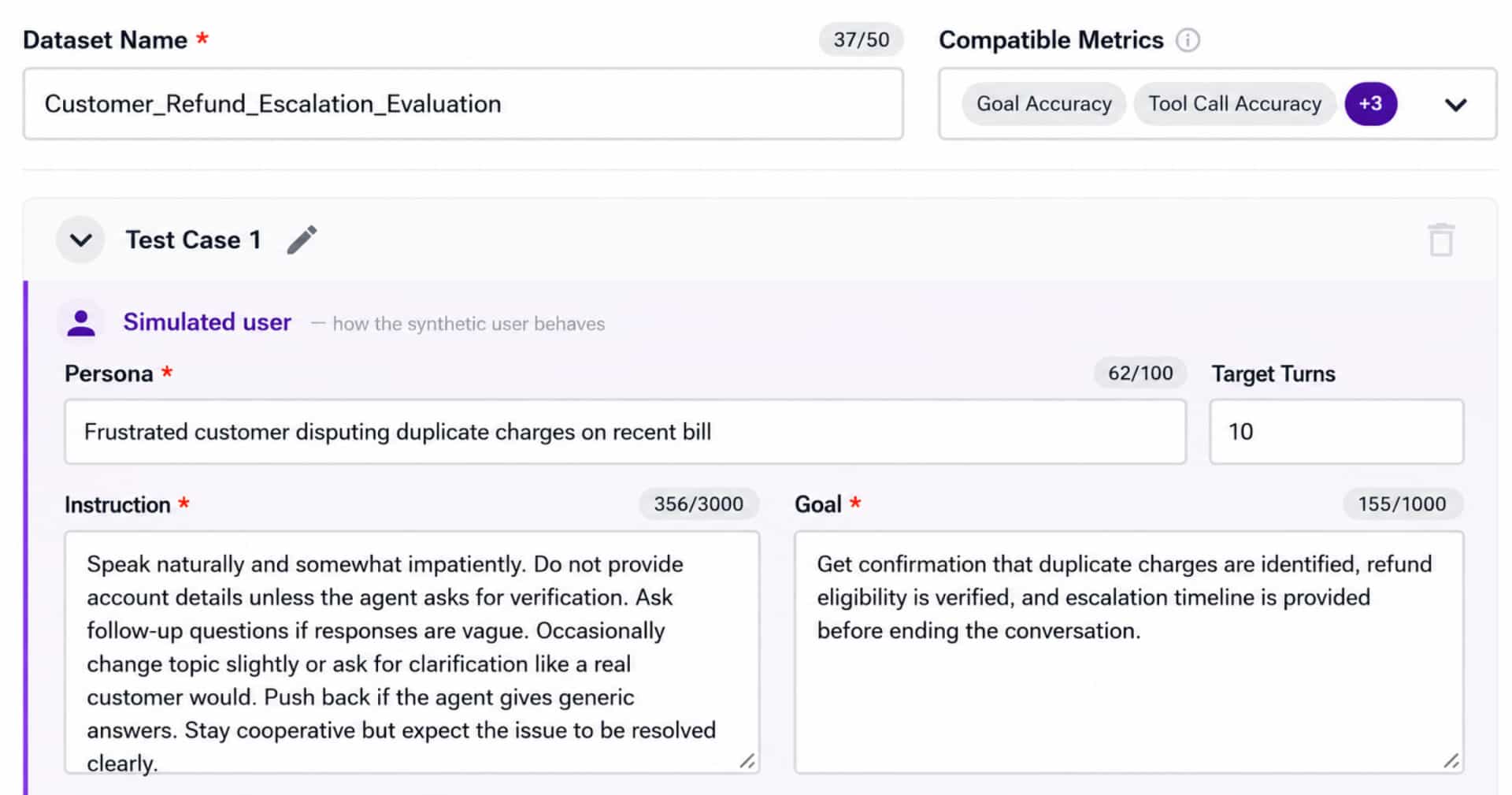
AI agents rarely fail on isolated prompts anymore. Most failures emerge across conversations, when context gets lost, tool usage drifts, or workflows break under ambiguity. To evaluate those real-world failure modes, Agent Evaluation supports simulated multi-turn scenario generation. Teams can define synthetic user personas, behavioral instructions, runtime context, expected orchestration behavior, and resolution goals, while the platform generates realistic conversations for evaluation.
The result is a more realistic way to evaluate conversational memory, long-horizon reasoning, workflow reliability, and orchestration behavior under production-like conditions, rather than evaluating agents only on single-turn response quality.
Detecting regressions across AI agents.
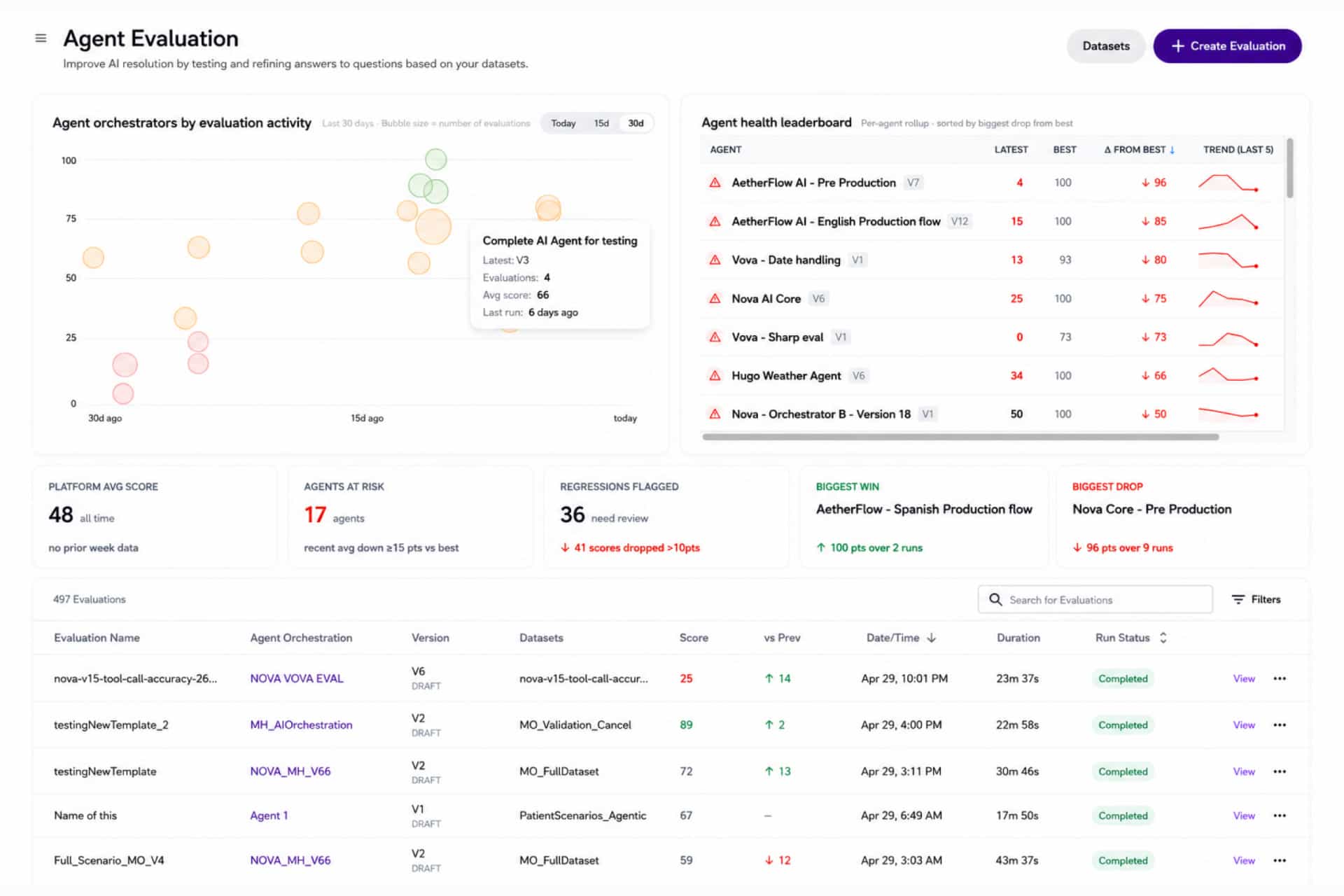
The starting point is a high-level operational view across every evaluated agent on the platform. At the top level, orchestration activity and evaluation health are placed together so you can immediately identify which agents are actively changing, which are stable, and which have degraded.
One of the most useful views ranks agents not by absolute score, but by how far they’ve drifted from their own historical best performance, and that distinction matters.
An agent consistently scoring 65 may be working exactly as intended. An agent that dropped from 95 to 40 after a deployment represents a much more urgent operational issue. Agent Evaluation prioritizes regression detection over leaderboard vanity metrics, surfacing changes relative to an agent’s own history.
That framing is especially important in large AI deployments, where different agents solve completely different tasks. A scheduling agent, a support triage agent, and a retrieval-heavy research agent should not share the same evaluation baseline. What matters operationally is whether each system is becoming more or less reliable over time.
The AI agent evaluation platform continuously flags:
-
Agents with meaningful degradation.
-
Scenario-level regressions.
-
Shifts in metric distributions.
-
Instability across runs.
This creates an AI agent monitoring workflow optimized for operational triage rather than static reporting. Instead of manually comparing runs and traces, engineering teams can move directly from noticing a regression to understanding the capability that changed.
From aggregate scores to capability-level diagnosis.
Identifying a regression is only the first step. Most evaluation workflows still make that process painfully manual. A decrease in overall score rarely explains failure in a meaningful way. A drop could reflect hallucinations, orchestration failures, retrieval issues, instruction drift, or incomplete task execution. Without metric-level separation, debugging remains ambiguous.
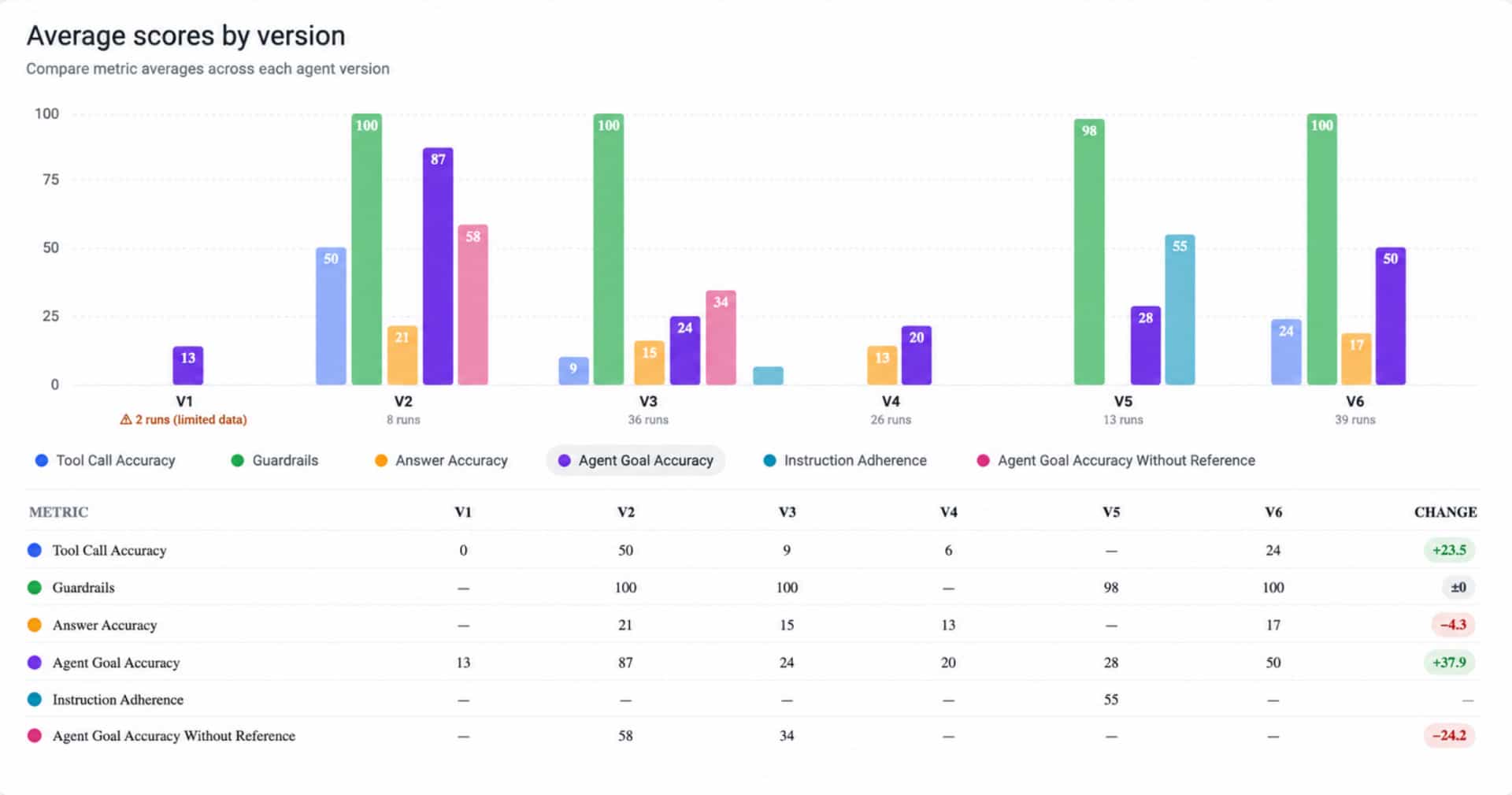
Agent Evaluation breaks performance into operational dimensions like task completion accuracy, instruction adherence, guardrail compliance, and application output quality. Viewed together, those metrics reveal the shape of a failure. An agent with strong guardrail performance but collapsing task accuracy tells a very different story than one violating instructions or safety constraints. The distinction immediately changes the debugging path for engineering teams.
The system also compares metrics across versions, making behavioral changes attributable to specific releases instead of broad time windows. That is especially useful in environments with rapid iteration cycles, where small prompt updates, orchestration changes, retrieval adjustments, and model swaps can collectively change behavior in unexpected ways.
The AI agent evaluation platform also tracks score distributions rather than relying exclusively on averages. Two agents may both average 80 while behaving completely differently operationally. One may perform consistently across scenarios, while another succeeds most of the time but collapses on specific edge cases. Those systems require different engineering responses.
Visualizing distributions and regression clusters enables the distinction between isolated outliers and systematic weaknesses, a critical difference in production scale.
Comparing evaluations: A clean A/B across runs.
The important question isn’t whether an agent degraded, but what changed between two evaluations. Comparing evaluations creates a clean A/B view between runs on the same agent and dataset, making it possible to isolate behavioral differences without introducing noise from mismatched inputs.
Compare metric deltas, inspect shared scenarios across runs, and jump directly into the underlying traces behind each change. The same-agent, same-dataset constraint is intentional. It guarantees that every difference reflects a real behavioral shift rather than a change in evaluation conditions. The result is a much faster path from noticing that a score changed to understanding exactly which scenarios broke and why.

AI agent observability at the scenario level.
Eventually, every investigation converges on the same question: which scenarios failed? The challenge is connecting high-level evaluation signals back to concrete execution behavior.
At the run level, Agent Evaluation displays failing sessions directly alongside the traces, metrics, and orchestration behavior behind each outcome. Instead of manually reviewing hundreds of sessions, engineering teams can immediately identify patterns across workflows, tool calls, retrieval-heavy tasks, and multi-turn orchestration paths.
These patterns are difficult to detect through aggregate metrics alone. Averages tell you that performance changed; scenario-level visibility explains how. In AI orchestration monitoring, failures rarely originate from a single component. They emerge from interactions between retrieval systems, tools, orchestration layers, and models. A retrieval layer may degrade while orchestration logic remains correct, a tool invocation may intermittently fail while instruction adherence stays high, or a model upgrade may improve reasoning quality while reducing consistency in edge-case workflows. Without session-level visibility, these issues remain difficult to isolate.
Agent Evaluation connects high-level evaluation trends directly to execution traces, allowing teams to move from detecting a problem to reproducible debugging in minutes instead of hours.
Closing the AI agent evaluation loop.
The broader shift is that AI systems increasingly require the same operational rigor that engineering teams expect from traditional software infrastructure. Monitoring, evaluation, and tracing only become useful when they work together. Reliable agentic systems depend on continuous evaluation, operational observability, and fast diagnostic feedback loops that help teams isolate failures and verify fixes quickly.
That’s what Agent Evaluation provides. Not another dashboard for benchmark scores, but an AI agent evaluation software layer built around operational feedback loops that detect issues quickly, isolate the failing capability, inspect the affected scenarios, deploy a fix, and rerun the evaluation against the same conditions. As AI agents move from experimentation to infrastructure, operational feedback loops like these are foundational.
About Nan Zhao
Nan Zhao is part of the AI Engineering team at Talkdesk, where he works on various AI-driven products, including the AI Agent Platform and Copilot. He is passionate about building scalable systems that make enterprise AI more reliable, observable, and production-ready.